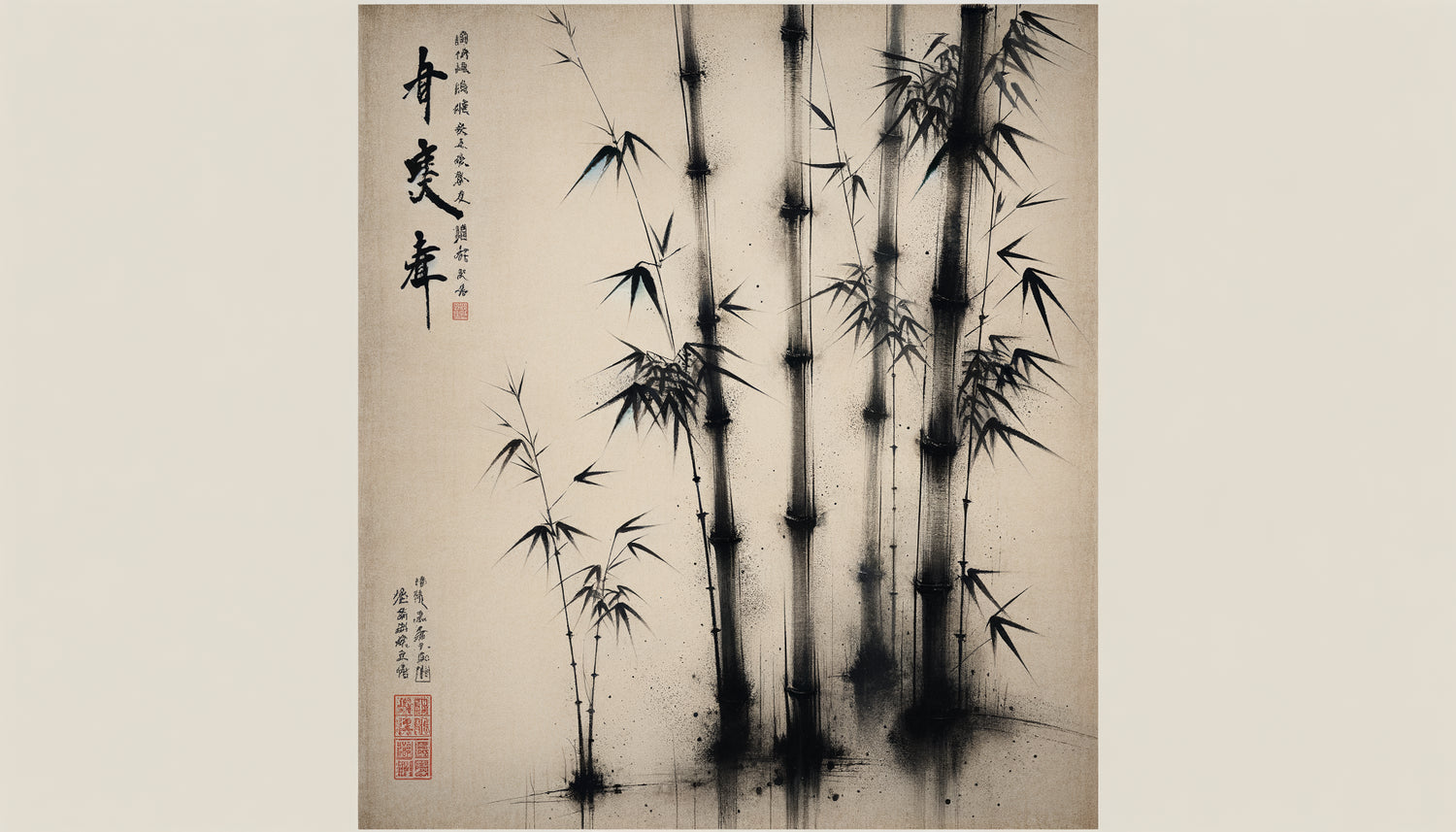
The first time I saw a roll of bamboo painted with Chinese ink in a private collection in Kyoto, I was struck by this obviousness: how could a few black lines contain so much movement, strength and emptiness at once? It wasn't just a plant depicted on paper. It was an entire philosophy, a worldview captured in a few mastered brushstrokes. Bamboo painting was not born out of a decorative desire, but out of a deeply rooted spiritual necessity more than a thousand years ago.
Here is what the origin of bamboo painting in Asian art reveals to us: a discipline that transcends simple botanical representation to become a meditative exercise, a universal symbolic language, and a bridge between nature and spirit. Perhaps you are looking to understand why these motifs cross centuries without losing their emotional strength, or how a single bamboo stalk can embody resilience, humility and moral uprightness. Rest assured: this story requires no prior knowledge of Asian art. I take you to the source of this millennial tradition, where the first Chinese literati painters transformed a common plant into an eternal symbol. You will discover how bamboo painting became the fundamental exercise of every Asian artist, and why it continues to inspire our contemporary interiors.
Chinese roots: when bamboo becomes ink and philosophy
The origin of bamboo painting dates back to the Tang dynasty (618-907), but it was truly under the Song dynasty (960-1279) that it reached its artistic and philosophical peak. At this time, Chinese scholars – these erudites who mastered poetry, calligraphy and painting – sought to express their worldview through natural forms. Bamboo emerged as their subject of choice for a simple reason: its very structure resembles calligraphic strokes.
The painter Su Shi, a major figure of the 11th century, claimed that before painting a bamboo, it must first grow in one's heart. This revolutionary approach marked a fundamental break: bamboo painting in Asian art was no longer a copy of nature, but a manifestation of the artist's inner state. Each section of stem had to be traced with a single decisive gesture, without possible repentance. The ink absorbed by the paper forgave no hesitation.
Wen Tong, contemporary of Su Shi, established the technical codes that still define traditional bamboo painting today. He observed bamboo groves for hours, in all weathers, until he internalized the movement of stems in the wind, the curvature of leaves in the rain, the silent strength of the nodes. His monochrome black compositions became the absolute standard, prioritizing essence over appearance, structure over color.
Bamboo as a mirror of the soul: symbolism and spirituality
Why bamboo specifically? This question runs throughout the history of bamboo painting in Asian art. The answer lies in the exceptional qualities of this plant. Bamboo bends under the storm without ever breaking, it grows straight towards the sky while remaining hollow inside, its regular sections evoke discipline and measure. For Confucian philosophers, it embodied the ideal gentleman: flexible but upright, modest yet noble.
In the Taoist tradition, bamboo painting represented fertile emptiness, this apparent void that contains all possibilities. The white spaces left around the stalks were not unpainted paper, but vital breath (qi) circulating freely. This revolutionary conception transformed each work into an energetic landscape rather than a simple botanical representation.
Zen Japanese painters, from the 13th century onwards, pushed this abstraction even further. For them, bamboo painting became an exercise in active meditation, a way to achieve instantaneous enlightenment (satori) through the perfect gesture. The monk painter Sesshū Tōyō sometimes reduced an entire bamboo stalk to three or four lightning-like strokes, capturing the essence of the plant in a dizzying economy of means.

The sacred apprenticeship: how one learned to paint bamboos
Understanding the origin of bamboo painting is also grasping its method of transmission. Unlike academic Western painting, Asian teaching did not begin with observational drawing. The student spent years copying the works of ancient masters, stroke by stroke, until physically integrating their gestures.
The process of learning bamboo painting followed a codified progression. First individual leaves, each traced according to a precise angle, with brush pressure varying from beginning to end of the stroke. Then groups of leaves, where the balance between density and emptiness created the visual rhythm. Then sections of stalks, these vertical strokes charged with ink that had to express solidity and flexibility at the same time. Finally the nodes, these crucial articulations that structure the composition.
This rigorous discipline explains why bamboo painting in Asian art has become the ultimate test of technical mastery. A painter capable of rendering the vitality of a bamboo grove in a few minutes revealed their spiritual level as much as their artistic one. Collectors scrutinized the quality of the line, its controlled spontaneity, to assess not only talent but also the artist's inner depth.
From China to Japan and Korea: metamorphoses of a tradition
The Chinese origin of bamboo painting did not prevent each Asian culture from bringing its own sensitivity to it. In Japan, the Zen influence radicalized the minimalist approach. Painters like Hakuin Ekaku in the 18th century produced bamboos of astonishing expressive violence, where splashed ink and nervous lines translated the raw energy of spiritual awakening.
In Korea, bamboo painting developed a particular lyricism under the Joseon dynasty (1392-1897). Korean artists favored more airy compositions, with special attention to bamboos bent by wind or snow. Kim Jeong-hui, a major figure of the 19th century, integrated calligraphy and painting in a single gesture, his bamboos literally merging into the poems inscribed alongside them.
In Vietnam, the tradition of bamboo painting was enriched by local influences, particularly in the use of lacquer. Bamboo symbolizes resistance to adversity, a recurring theme in Vietnamese art. This geographical diffusion shows how a unique artistic origin can generate a diversity of expressions while preserving its philosophical core intact.

The four seasons of bamboo: variations on an eternal theme
A fascinating aspect of the origin of bamboo painting lies in its ability to express the passage of time. Unlike trees that lose their leaves, bamboo remains green all year round, a symbol of constancy. Yet, masters of bamboo painting have developed subtle visual codes to evoke each season.
In spring, young shoots emerge with particular vigor, the leaves are a tender green, the composition rises vertically. In summer, fullness is translated by dense foliage, robust stems, and deep saturated ink. Autumn brings an elegant melancholy: a few yellowed leaves, slightly inclined stems, a lighter tone in the ink.
But it was winter that inspired the most poignant works of bamboo painting in Asian art. Bamboo under the snow, bending under the weight of white but refusing to break, embodied resilience in the face of adversity. These wintry compositions, often reduced to their minimal expression, rank among the peaks of Asian contemplative art. The contrast between black ink and white paper (representing snow) created a visual tension of rare emotional power.
Contemporary legacy: when painted bamboo reinvents our interiors
Today, the millennial origin of bamboo painting continues to nourish contemporary creation. Current Asian artists revisit this tradition with mixed techniques, integrating photography, installation and performance. Xu Bing, a major Chinese artist, has created monumental bamboo groves where invented calligraphy and painting merge in immersive installations.
In our Western interiors, bamboo painting brings that contemplative dimension often lacking in modern spaces. A traditional or contemporary work inspired by this genre instantly creates a visual anchor point, an invitation to calm in daily bustle. Interior designers are rediscovering the power of black and white monochrome, this timeless elegance that characterizes Asian bamboo painting.
The philosophy underlying this artistic tradition resonates particularly with our current aspirations: simplicity, authenticity, connection to nature. Integrating a bamboo painting into your living space is not following a trend, but inviting millennial wisdom to dialogue with your daily life. It's understanding that true luxury does not lie in accumulation, but in the precision of the line, the relevance of emptiness, the balance between presence and absence.
Let Asian wisdom transform your space
Discover our exclusive collection of landscape paintings that capture the contemplative essence of nature and bring serenity and elegance to your interior.
Your gaze transformed by a thousand years of history
You are now able to recognize in a bamboo painting much more than a decorative motif. You will see the trace of a meditative gesture, the expression of a philosophy of life, the culmination of patient learning. The origin of this artistic tradition in China among scholars reveals a timeless truth: true art does not seek to impress, but to reveal the invisible.
Next time you contemplate a bamboo painting, authentic or contemporary-inspired, take the time to follow each stroke with your eyes. Observe how the brush loaded with ink deposited its material on the paper, how the empty spaces breathe between the stems, how the entire composition seems to vibrate with a silent energy. This attention will transform your experience from that of a viewer into a moment of active contemplation.
Simply start by choosing a work that speaks to you, place it in a spot where your gaze naturally rests several times a day. Let this discreet but constant presence remind you that true strength, like that of bamboo, lies in flexibility combined with integrity. The legacy of Asian bamboo art does not belong only to museums – it can enrich your daily life, one vertical stroke at a time.
Frequently Asked Questions about Bamboo Paintings
Why do Asian artists almost always paint bamboo in black and white?
This question touches on the heart of the philosophy that has animated bamboo painting since its origins. Monochrome is not a technical limitation, but a profound aesthetic and spiritual choice. Chinese ink black allows for an infinity of nuances depending on its dilution and the pressure of the brush – from the palest gray to the deepest black. This reduced palette forces the artist and viewer to focus on the essential: the structure, rhythm, vital energy of the plant rather than its superficial appearance. In Zen tradition in particular, black and white represents the union of opposites (yin and yang), fullness and emptiness, form and formlessness. Using color would divert attention from this contemplative and symbolic dimension. Moreover, this monochrome approach brings bamboo painting closer to calligraphy, establishing a direct link between writing characters and representing nature. That is why even today, contemporary artists who revisit this tradition often retain this restricted palette, seeing it not as a constraint but as creative liberation.
How long does it take to master the technique of bamboo painting?
The traditional response of Asian masters would be: a lifetime. But rest assured, this perspective is not discouraging; it's liberating. Learning bamboo painting breaks down into progressive steps. A motivated beginner can learn the basic strokes – simple leaves and sections of stems – in just a few months of regular practice. After a year of diligent exercise, one generally manages to compose a complete bamboo technically correct. But true mastery begins beyond that: when the gesture becomes so natural that it spontaneously expresses your inner state, when you no longer need to think about technique because it has merged into your gestural language. The great masters of Asian art continued to practice daily even after decades, considering each session as a meditation and rediscovery. The wonderful advantage of this discipline is that even your first clumsy attempts have contemplative value. Each stroke you make connects you to this millennial lineage of literate painters. Begin with patience and humility, and you will see that bamboo painting transforms you as much as you practice it.
How to integrate a traditional bamboo painting into a modern interior?
Excellent question, because that's where the art of blending eras and cultures lies. The beauty of an authentic or traditionally inspired bamboo painting is precisely its timelessness. Its minimalist aesthetic and monochrome palette naturally dialogue with clean contemporary interiors. Here are some principles for successful integration: prioritize a location where the work benefits from space around it, as emptiness is an integral part of its composition. A white wall or in neutral tones will highlight the subtlety of the ink nuances. Avoid overloading the same space with other works – bamboo painting requires a certain visual solitude to unleash its contemplative strength. It naturally finds its place in an office (reminiscent of the tradition of scholars), a bedroom (promoting calm), or a meditation space. In terms of style, it harmonizes remarkably well with Scandinavian furniture, contemporary Japanese design, or even industrial aesthetics, which it tempers with metallic coolness. Lighting plays a crucial role: prefer soft, indirect light that reveals the variations in ink intensity without creating reflections. Finally, consider your bamboo painting as a contemplative anchor point in your interior, a daily reminder to slow down and breathe.