The cannons were still booming when the first artists pulled out their sketchbooks. In the mud of Flanders, between two bombings, they captured on paper what no one had ever seen before: landscapes transformed into earthly hells.
War Landscapes: When Artists Document European Conflicts
Otto Dix was 23 when he voluntarily enlisted in the German army in 1914. For three long years, he sketched the horror on postcards that he sent to a friend, as if keeping a visual report of "the devil's work." What he saw marked him forever: dismembered bodies, charred trees, land so riddled with shells that it resembled the lunar surface.
At Verdun, more than 700,000 soldiers were killed, wounded or missing (Source: French Military Archives). In just two days, 2 million shells rained down on 20 kilometers of front (Source: Musée de l'Armée de Paris). The verdant landscape became a gray desert where nothing could survive.
Paul Nash, British painter, discovers the same horrors in 1917 in the Ypres sector. Unlike most official painters who worked behind the lines, Nash refuses comfort. He wants to paint on site, as close to the chaos as possible. His watercolors capture places with names that have become tragically famous: Mont-Saint-Éloi, Menin Road, Passchendaele. In a letter to his wife Margaret, he wrote of being amazed by what he discovered, as if no account had prepared him for this reality.
On the French side, Félix Vallotton feels useless. At 52, he is considered too old to fight. Depressed, he abandons his studio for months. Then he decides to participate in artistic missions organized by the government. In June 1917, he spends a few days near the front. Paradoxically, he will paint one of the most powerful paintings on the Battle of Verdun without ever having set foot there. His approach is different: he wants to show "the idea of war," not just its appearance.
Artistic Techniques to Capture War Testimonies
How to paint the unthinkable? The classic techniques of war art no longer work in the face of this unprecedented violence. Vallotton expresses it clearly: "To draw or paint 'forces' would be far more profoundly true than to reproduce their material effects, but these 'forces' have no form." For his painting Verdun, he exceptionally adopts a cubo-futurist style with geometric beams of light piercing clouds of gas.
Dix chooses a different path: raw realism pushed to the extreme. In his 50 etchings in the portfolio Der Krieg (1924), he spares nothing. Decaying corpses, skeletons, mutilated bodies, collapsed trenches. Each engraving shows a stage of annihilation. His friend George Grosz, figure of German Expressionism, reformed after a depression, uses caricature to denounce German society which continues to feast while soldiers die on the front.
Paul Nash develops a visual language where broken lines and protruding angles translate the violence of explosions. His landscape paintings blend Cubist influences with English romantic sensibility. The tattered trees resemble ancestral standing stones, giving these scenes of destruction a timeless dimension.
The painter artists combine several complementary approaches:
- Quick sketches despite the bombings and constant danger
- Memorial reconstruction after the conflict, when traumas resurface
- Symbolic interpretation to capture the essence rather than the appearance
Devastated landscapes as major artistic testimonies
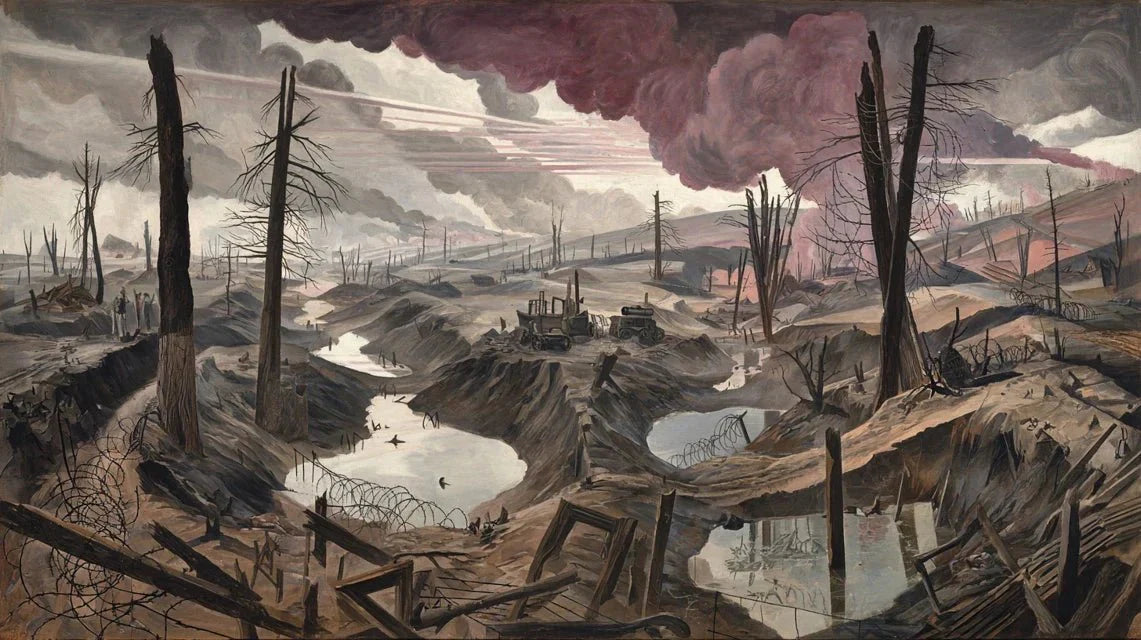
Some images remain etched in memories. The painting Void by Paul Nash is one of them. Not a single soldier visible, just a truck and cannons abandoned in flooded trenches. A flaccid corpse among the shells. Smoke and an airplane in the distance – impossible to know whether it is bombing or falling. It rains incessantly. No hope remains in this nameless place become a simple field of death.
The dead trees become characters in their own right. In Dix's works, a skeleton remains attached to a branch, suspended for eternity. In Nash’s, the sectioned trunks form an entanglement of broken bones under a cold sun. Vallotton paints ghost churches: that of the Howlers, that of Souain, emaciated silhouettes on devastated lands.
The landscape itself becomes the tragic protagonist. The earth is riddled with craters that fill with muddy water. Fields cultivated for centuries disappear beneath an amorphous mass. Entire villages are erased from the map. This massive destruction affects not only humans: fauna, flora, entire ecosystems are annihilated.
The evolution of representations of war landscapes in Europe
The way of painting war has radically changed over the centuries. In the Renaissance, battles were glorified with epic compositions. Bernard van Orley represents the Battle of Pavia (1529-1530) by showing Charles V's victory in all its splendor. A century later, Jacques Callot breaks with this tradition. His engravings The Misfortunes and Calamities of War (1633) show the ravages of the Thirty Years’ War on the Lorraine civilians: pillages, hangings, burnt villages.
World War I causes a total break. Avant-garde artists definitively abandon allegory. Fernand Léger represents soldiers transformed into mechanical robots in The Card Game (1917). The human disappears before the machine. Italian futurists like Gino Severini first paint the war with enthusiasm (Cannon in Action, 1915) before becoming disillusioned by reality.
When World War II breaks out, Paul Nash is called up again as an official artist. Despite being ill and asthmatic, he produces
The impact of artistic testimonies on the memory of conflicts
These works go beyond their simple function as documentation. They become weapons against oblivion. Otto Dix knows this well: when he paints his triptych
His works are disturbing. The Nazis consider them « degenerate art ». His triptych is briefly exhibited in Berlin in 1937 at an exhibition intended to ridicule modern art, then it is hidden to avoid its destruction. More than 260 of Dix’s works are confiscated. He is forbidden to teach and even exhibit. To survive, he retreats into harmless landscapes during the war years.
This censorship shows the subversive power of these artistic testimonies. By showing the war in all its ugliness, by refusing heroization, these painters directly oppose nationalist and militarist discourses. Their landscapes devoid of human presence, dominated by titanic forces and machines of destruction, denounce the absurdity of modern conflicts.
Today, these works retain an essential memorial value. The landscapes of war bear the stigmas of conflict but nature ends up reclaiming its rights. Artists have frozen a moment that time gradually erases. Their paintings allow new generations to viscerally feel what statistics and dates cannot convey. They build a shared European memory around pacifism and reconciliation.
The landscapes of war by Dix, Nash and Vallotton remain irreplaceable artistic testimonies. They remind us that behind every conflict lies total destruction – of men, territories, civilization itself. Their message still resonates today: that these horrors never happen again.
FAQ : War landscapes in European art
Why did artists change their way of representing war landscapes during World War I?
The industrial war made classical techniques inadequate. Faced with the unprecedented violence of bombings, totally pulverized landscapes and the dehumanization of combat, artists such as Otto Dix, Paul Nash and Félix Vallotton had to invent new visual languages. They adopted expressionism, cubism and abstraction to translate « forces » that had no defined form or color.
Who are the most emblematic European artists of war landscapes?
Otto Dix (Germany) with his triptych The War and its 50 etchings, Paul Nash (United Kingdom) with The Menin Road and We Are Making a New World, and Félix Vallotton (France/Switzerland) with his painting Verdun are the three major figures. George Grosz, Fernand Léger and Christopher Nevinson also produced significant works documenting European conflicts.
What is the difference between landscapes of war from the First and Second World Wars?
The First World War produced representations of trenches, shell craters and devastated land on a human scale. The Second World War brought artists like Paul Nash to paint machines (crashed planes in Totes Meer) and a more aerial and technological vision of destruction. The transition from trench warfare to mobile warfare transformed artistic testimonies.