Imagine Florence in the 15th century. In the workshops of Florentine Quattrocento, debates raged passionately about geometry, light, and depth. At the heart of this effervescence of the Italian Renaissance, Piero della Francesca distinguished himself. This mathematician-painter, born between 1412 and 1420 in Sansepolcro, did more than master vanishing lines and perspective points. He understood something more subtle: how air itself transforms our vision.
Aerial Perspective in the Work of Piero della Francesca
Carefully observe a real landscape. Distant mountains appear bluer, less sharp than nearby trees. This is called aerial perspective: the atmosphere softens contours and alters colors with distance. Piero della Francesca integrates this natural principle into his landscape painting with remarkable finesse.
Consider The Legend of the True Cross in Arezzo, his masterpiece created between 1452 and 1464. The Tuscan hills in the background gradually fade away, creating an almost tangible atmosphere. This is not merely a decorative effect. In his perspective treatise De Prospectiva Pingendi from the 1470s, he explains how atmospheric light builds space as much as geometry.
His characters bathe in a clear and unified light that unifies the entire scene. This luminosity naturally creates spatial depth: details fade as they recede, as in reality. The Baptism of Christ in London perfectly illustrates this approach. The background shows a subtle degradation of greens to blues, a technique borrowed from Flemish painters that he adapts to his rigorous Italian style.
Piero della Francesca and His Contemporaries: Cross-Influences on Aerial Perspective
Florence was bubbling with artistic innovations in the Quattrocento. Piero della Francesca did not invent everything alone. He learned from Domenico Veneziano, who passed on to him his passion for color and light. Veneziano already knew the secrets of atmospheric depth thanks to exchanges between Italy and Flanders.
Before him, Masaccio (1401-1428) had paved the way. In The Tribute in the Brancacci Chapel, distant hills already show an intuitive understanding of these effects. Masaccio painted instinctively what Piero della Francesca would later theorize and perfect in his treatise.
Fra Angelico (c. 1395-1455) adopted a more nuanced position. This Dominican friar selectively used the emerging innovations. His Annunciation in San Marco (1435-1445) shows impeccable linear perspective architecture, but retains an almost Gothic luminosity. His aerial depth remains discreet, subject to his spiritual intentions rather than mere observation of nature.
Paolo Uccello (1397-1475) represents the extreme opposite. Obsessed with geometry according to Vasari, he neglects atmospheric subtleties. His Battle of San Romano presents sharp forms all the way through, almost abstract. Two visions oppose each other: Uccello favors intellectual construction, Piero della Francesca seeks balance between mathematical rigor and sensitive observation.
Aerial perspective techniques by Piero della Francesca
How did he proceed concretely? His works reveal a consistent method for creating spatial depth:
- Progressive chromatic degradation: the warm tones of the foreground evolve into blues-grays in the distance
- Attenuation of contours: silhouettes become less defined with distance
- Reduction of details: precision decreases gradually towards the horizon
- Unified luminosity: a atmospheric light consistent that bathes the entire composition
- Sfumato before its time: a hazy effect anticipating Leonardo da Vinci
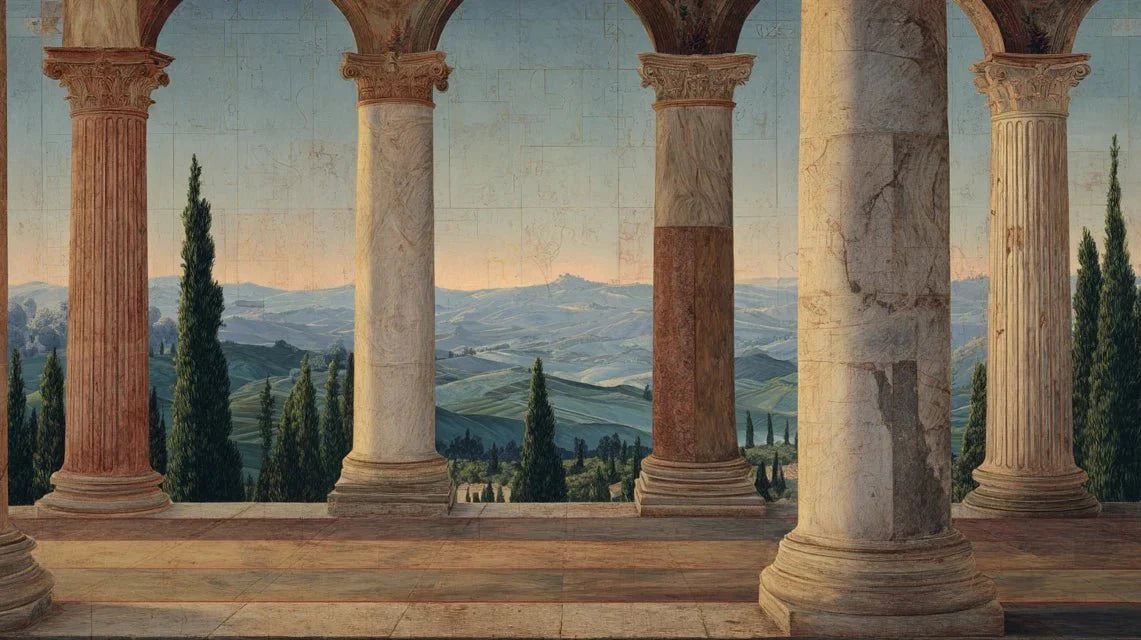
The Flagellation of Christ (c. 1455-1470) in Urbino demonstrates this virtuosity. The architecture of the foreground displays sharp details and saturated colors. But look through the columns: the atmosphere becomes lighter, creating several planes of depth. This juxtaposition generates a fascinating visual tension between geometric rigor and atmospheric fluidity.
Where does this mastery come from? Piero della Francesca studies medieval optics treatises by Alhazen and Alberti's theories in De Pictura (1435). He understands that atmospheric perspective is not an artifice: it scientifically represents how air modifies our vision. This double training as a mathematician and painter allows him to unite science and art in his landscape painting.
Contemporary wall art landscapes continue to explore these same principles of atmospheric perspective, five centuries after these first experiments of the Italian Renaissance.
Piero della Francesca's aerial perspective compared to his contemporaries
Let's put things into perspective. Masaccio initiates atmospheric depth in Italy intuitively, without theorization. Fra Angelico uses it sparingly, preferring spiritual clarity. Paolo Uccello almost completely ignores it, fascinated by pure geometry.
Piero della Francesca achieves a unique synthesis characteristic of the Florentine Quattrocento. He combines Florentine mathematical rigor with Flemish chromatic sensitivity. In his Arezzo cycle, each fresco perfectly harmonizes the linear perspective of architectures and the aerial effects of backgrounds. This double mastery was exceptional at the time.
Flemish painters like Jan van Eyck had developed these techniques as early as the first quarter of the 15th century. The Virgin and Chancellor Rolin (1435) shows a distant landscape of remarkable atmospheric subtlety. These innovations travel south thanks to merchants and diplomats. The master of Arezzo integrates them without abandoning his Italian identity based on Euclidean geometry.
The legacy of aerial perspective: Piero della Francesca and the next generation
This transmission shapes Italian art permanently. Luca Signorelli and Perugino frequent the workshop of the aging master. They absorb his lessons and pass them on to their own students, creating a true artistic lineage that crosses generations.
Leonardo da Vinci (1452-1519) pushes the concept even further. In his notebooks, he systematically theorizes what he calls prospettiva aerea, building on the foundations laid a generation earlier. His landscapes in the Mona Lisa or Saint Anne show an atmosphere steeped in vapor that perfects the research of the Arezzo master. The famous Leonardo sfumato owes much to these early 15th-century experiments.
Atmospheric depth gradually becomes a standard tool. Artists of the 16th century consider it as acquired, sometimes forgetting the pioneers who had to extract it from empirical observation to transform it into a reasoned method. Rediscovered in the 19th century, Piero della Francesca appears to us today as a complete artist: rigorous geometer and sensitive colorist, capable of uniting science and poetry in compositions that cross the centuries.
FAQ: Aerial perspective at Piero della Francesca
What is aerial perspective in Piero della Francesca's painting?
Aerial perspective is a pictorial technique that consists of creating depth by progressively degrading colors and softening the contours of distant elements. Piero della Francesca used it to imitate the natural effect of the atmosphere on our vision, thus creating landscapes where mountains and hills in the distance appear bluer and less sharp, just like in reality.
How did Piero della Francesca differ from his contemporaries such as Paolo Uccello?
Unlike Paolo Uccello who was obsessed with linear perspective and pure geometry, Piero della Francesca achieved a unique synthesis between mathematical rigor and atmospheric sensitivity. He combined Florentine linear perspective with the effects of atmospheric depth borrowed from Flemish painters, creating works where science and poetry coexist harmoniously.
What influence did Piero della Francesca have on Leonardo da Vinci?
Piero della Francesca laid the theoretical and practical foundations that Leonardo da Vinci would perfect. In his treatise De Prospectiva Pingendi, he already theorized how light and atmosphere change our vision. Leonardo drew on this research to develop his own theory of prospettiva aerea and his famous sfumato, this vaporous technique visible in the Mona Lisa and Saint Anne.