Imagine a painting where every tree hides a message, where ruins whisper political secrets, where the light of sunset symbolizes the fall of empires. Welcome to the fascinating universe of baroque allegorical landscapes, these monumental canvases that revolutionized European art between 1600 and 1750.
At this time, painting a landscape no longer simply means capturing the beauty of a valley or forest. Baroque artists transform nature into a symbolic theater where the great issues of their time are played out: religious faith, the power of kings, the discovery of new continents.
Understanding baroque allegorical landscapes: a coded visual language
A baroque allegorical landscape is much more than a pretty rural view. It's a carefully orchestrated composition where every element carries a hidden meaning. A woman holding a trumpet? Fame. A personified river? An entire civilization. Ruins of temples? A reminder that nothing is eternal.
This complex visual language draws on Cesare Ripa's Iconology, published in 1593. This manual becomes the bible of 17th-century painters. They draw from it a whole vocabulary of symbols that cultivated viewers of the time decipher as we read road signs today.
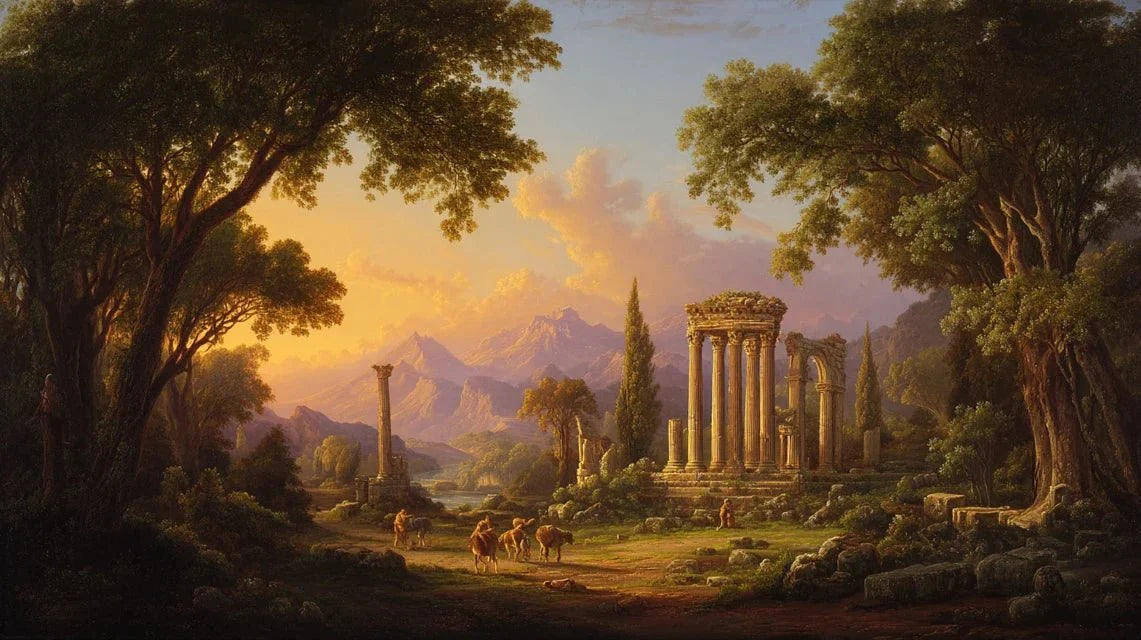
Take the Roman countryside, a favorite source of inspiration for artists. In their paintings, it never quite resembles reality. It becomes a mythical Arcadia where ancient shepherds mingle with Greek temples and majestic ruins. Everything is idealized, embellished, loaded with references to classical culture.
Visually, these baroque paintings immediately grab attention. The compositions follow diagonal axes that create movement. Dramatic contrasts of light, inherited from Caravaggio, sculpt the forms. Colors burst forth, applied generously. Each character occupies a precise place in the symbolic hierarchy of the scene.
The subtle art of composing an allegorical landscape
Behind the apparent freedom of these paintings lies a rigorous construction. Claude Lorrain, settled in Rome as early as 1627, leaves nothing to chance. He draws invisible grids, places each tree, each building according to a calculated geometry to guide the viewer's gaze.
Baroque masters organize their idealized landscapes into successive layers. In the foreground, monumental figures capture attention. In the center, trees and architectures give body to the scene. In the background, luminous horizons open onto infinity. This depth is skillfully constructed to tell a story that leads from the earthly to the celestial.
The chosen time of day is never neutral. Dawn evokes spiritual renewal and hope. Twilight suggests melancholy and the end of empires. Ancient crumbling temples recall that even the greatest civilizations eventually turn to dust. Conversely, centuries-old oaks embody the permanence of nature in the face of human vanities.
Light plays a crucial role in these compositions. Claude Lorrain spends hours painting outdoors, capturing the subtle nuances of dawn and dusk in the Roman countryside. This revolutionary attention transforms his landscapes into almost mystical spaces where divine light illuminates every corner.
Characteristic elements of a baroque allegorical landscape:
- Personified figures: divinities, allegories of continents, seasons or virtues
- Classical architecture: ancient temples, Roman ruins, majestic porticoes
- Codified natural elements: centuries-old trees, symbolic rivers, sacred mountains
- Dramatic lighting effects: golden dawns, purple twilights, backlight effects
- Geometric composition: diagonal axes, layering of planes, balance between voids and solids
The three geniuses of the allegorical landscape: Rubens, Lorrain and Poussin
Pierre Paul Rubens embodies baroque exuberance at its peak. In Les Quatre Continents, painted between 1612 and 1615, he personifies Europe, Asia, Africa and America under the features of majestic women accompanied by the gods of the rivers: the Danube, the Ganges, the Nile and the Río de la Plata. This ambitious canvas celebrates the peace restored after the religious wars that tore through the Netherlands. Rubens, who was also a diplomat, encodes his dreams of universal concord into his landscapes.
Claude Lorrain revolutionizes the genre with a more contemplative approach. His pastoral landscapes combine direct observation of nature and classical idealization. For the Parisian collector Michel Passart, he paints views of the Roman countryside at different hours: one bathed in the golden light of morning, the other enveloped in purple tones of evening. Ancient temples, Renaissance villas and Virgilian shepherds coexist in a serene harmony that already foreshadows romanticism.
Nicolas Poussin, a more intellectual spirit, constructs heroic landscapes where nature becomes the backdrop for mythological dramas. His compositions obey a rigorous geometry inherited from Bolognese painters. In Paysage avec Saint Jean à Patmos, the Greek island transforms into a philosophical space where the saint meditates on divine mysteries. With Poussin, the landscape invites moral reflection.
These three complementary approaches define the major families of baroque landscape symbolism: Rubens and diplomatic splendor, Lorrain and luminous poetry, Poussin and intellectual meditation. Their masterpieces now adorn the walls of the greatest museums, from the Louvre to the Kunsthistorisches Museum in Vienna.
This tradition continues to influence our way of representing nature. To see how these centuries-old visual codes still inspire contemporary decorative art, discover this selection of wall art landscapes that perpetuates the legacy of these masters.
When allegorical landscapes serve religion and power
The Catholic Counter-Reformation turns allegorical landscapes into a weapon of propaganda. The Council of Trent, meeting between 1545 and 1563, understands that images touch hearts more effectively than sermons. Artists create biblical landscapes where nature itself preaches: the arid desert symbolizes spiritual trial, the lush garden represents rediscovered divine grace.
Absolute monarchs exploit the same language to assert their power. Louis XIV is not mistaken. At Versailles, André Le Nôtre translates into three dimensions the principles of Baroque paintings: symbolic fountains evoking the rivers of paradise, infinite perspectives manifesting royal omnipotence, nature subdued by human geometry.
Rubens, who juggles brushes and diplomatic missions, encodes his political messages in his allegories.
Art academies, such as the Accademia di San Luca founded in Rome in 1593, establish a strict hierarchy of genres. Officially, landscape remains inferior to religious or mythological painting. But allegorical landscapes cleverly circumvent this rule by integrating mythological narratives and erudite symbolism.
The timeless legacy of Baroque allegorical landscapes
Around 1750, the Rococo style gradually lightens compositions. Canvases become more graceful, less dramatic. François Boucher and Jean-Honoré Fragonard prefer lightness to grandeur. Yet, the fundamentals of
The influence of Baroque masters crosses centuries. In England, the style of Claude Lorrain inspires a whole movement: the picturesque garden. Aristocrats design their estates to resemble Claude's paintings. William Turner, giant of Romanticism, weeps with emotion before his predecessor's canvases before pushing further research on light. John Constable hails him as "a more perfect landscape painter than the world has ever seen".
The 19th-century Romanticism inherits this tradition by adding a dose of subjectivity and emotion. Allegorical codes remain but are charged with melancholy and sublimity. The
Frequently asked questions about Baroque allegorical landscapes
What is the difference between a classic Baroque landscape and an allegorical Baroque landscape?
A classic baroque landscape depicts a natural scene with dramatic effects of light and composition. An allegorical baroque landscape goes further by encoding symbolic messages: each element (characters, architecture, nature) conveys a precise meaning according to the codes of Cesare Ripa's Iconology. It tells a moral, political or religious story through the language of nature.
Why are Claude Lorrain, Poussin and Rubens considered masters of the genre?
These three artists embody the three major approaches to allegorical baroque landscape. Rubens excels in monumental compositions serving diplomacy, Lorrain revolutionizes the rendering of light in contemplative pastoral scenes, while Poussin develops the heroic intellectual landscape. Together, they define the aesthetic and symbolic standards of the genre for all of 17th century Europe.
Where can one admire allegorical baroque landscapes today?
The most beautiful collections are found at the Louvre in Paris, the Kunsthistorisches Museum in Vienna, the National Gallery in London, the Prado in Madrid and the Capitoline Museum in Rome. The Palace of Versailles also offers a monumental three-dimensional version of these allegorical principles through its gardens and symbolic fountains designed by André Le Nôtre.