Faced with The Sea of Ice by Caspar David Friedrich, I felt that wave which traverses the body – a mixture of fascination and dread that 18th-century philosophers called the sublime. For fifteen years studying European Romantic movements, analyzing every brushstroke of Turner in the reserves of the Tate Britain, I understood an essential truth: these artists were not painting landscapes; they were capturing the intimate collision between the human soul and the titanic forces of nature.
Here's what the Romantic sublime brings to our understanding of art and decoration: an invitation to move beyond simple beauty to embrace total emotion, the ability to transform a space into a transcendent sensory experience, and the rediscovery of a visceral connection with the natural elements. This aesthetic current revolutionized our relationship with landscapes, elevating them to the rank of extreme philosophical and emotional experiences.
Too often, we reduce Romantic works to pretty rural scenes. We pass by these monumental canvases without grasping their revolutionary dimension – this mad ambition to make us feel simultaneously terror and ecstasy, human smallness and cosmic grandeur. Yet, understanding this aesthetic shift of the 18th century illuminates our entire way of inhabiting spaces, of choosing the works that surround us.
Rest assured: no need to be a Kantian philosopher or art historian to grasp this revolution. The aesthetics of the sublime speaks directly to our emotions, to that archaic part which shivers before a storm or freezes before oceanic immensity. In this article, I take you into the workshops of Turner and Friedrich, at the heart of this transformation that made landscape more than just a pictorial genre: an existential experience.
When philosophy meets the brush: birth of the concept of sublime
The sublime predated the Romantics, first formulated by Edmund Burke in 1757 in his Philosophical Enquiry into the Origin of Our Ideas of the Sublime and Beautiful. Burke established a radical distinction: where beauty reassures, harmonizes and pleases, the sublime terrifies, overwhelms and fascinates. Emmanuel Kant deepened this theory in 1790, identifying that paradoxical moment when imagination fails to conceive of immensity, provoking simultaneously pain and pleasure.
This philosophical aesthetics found its most brilliant visual interpreters in Turner and Friedrich. These painters transformed abstract concepts into devastating visual experiences. They understood that the landscape could become the theater of this extreme emotional dialectic – no longer a decorative backdrop, but an absolute protagonist.
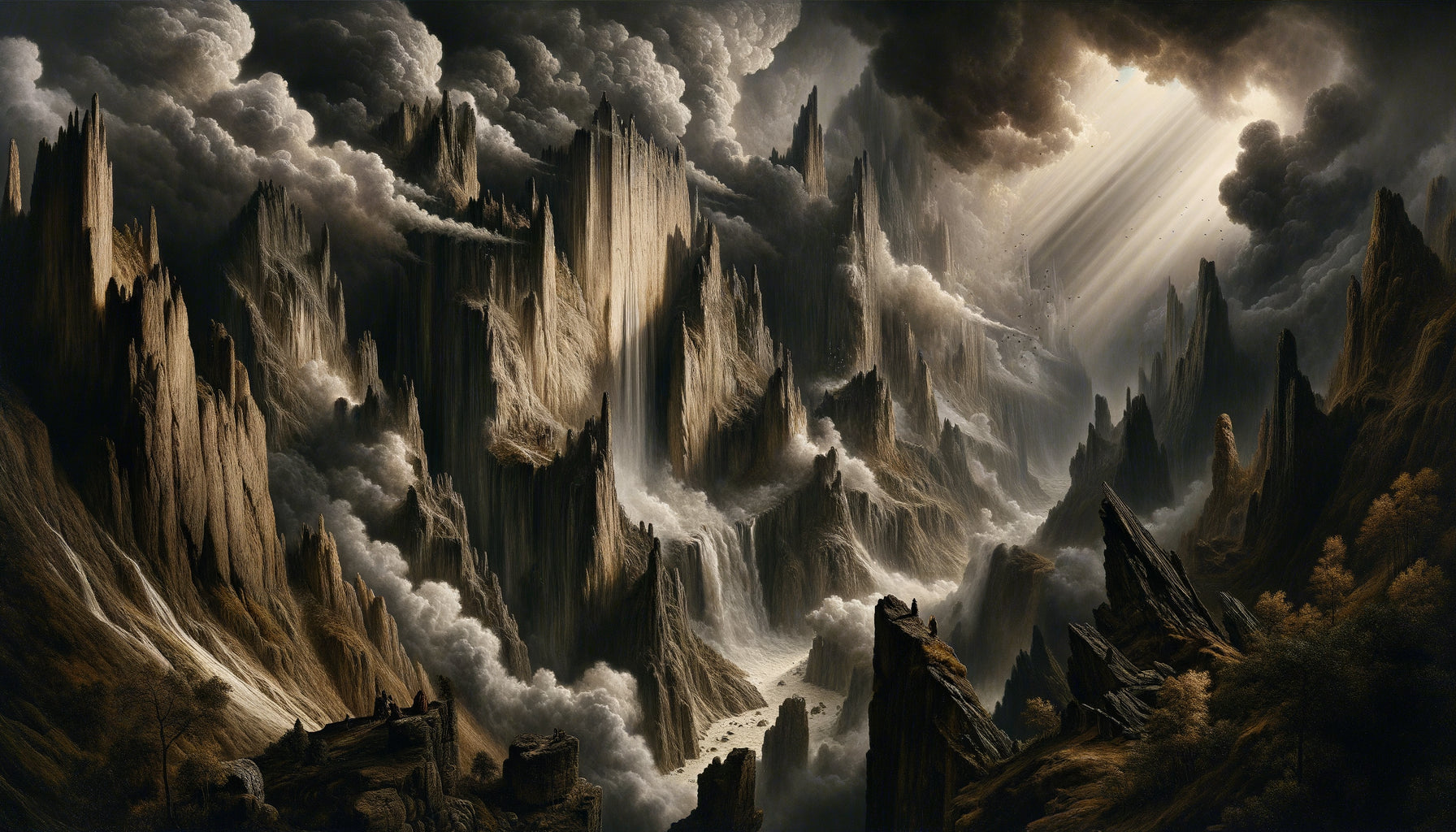
The Romantic landscapes ceased to be topographic inventories to become materialized states of mind. Every dizzying mountain, every raging storm, every enigmatic mist carried a symbolic and emotional charge that infinitely exceeded the mimetic representation of nature.
Turner: Dissolving the World in Light and Fury
Joseph Mallord William Turner embodied the sublime through dissolution. In Snow Storm: Steam-Boat Fourth Rate of Fifty Gun Ship, off Cape Ann (1842), he had himself tied to a ship's mast for four hours to physically feel the violence of the ocean. This anecdote summarizes his approach: emotional experience took precedence over descriptive accuracy.
His later landscapes drift into abstraction ahead of their time. Forms disintegrate in whirlwinds of light, water and air. Critics of the era, disoriented, spoke of 'tomato soup' in front of The Fighting Temeraire. They did not understand that Turner was seeking to capture not the appearance of things, but the raw emotion of immersion in elemental forces.
The Technique of Luminous Terror
Turner used translucent washes, layered glazes, scraped the still-wet canvas to make pure light bursts shine through. His incandescent skies, phosphorescent seas created an atmosphere of sublime apocalypse. In front of The Burning of the Houses of Lords, the viewer does not simply see a historical event, but viscerally feels the devastating and magnificent power of fire.
This revolutionary approach to landscape heralded Impressionism and abstraction. Turner demonstrated that extreme emotion required pushing formal boundaries, sacrificing immediate readability to achieve a deeper sensory truth.

Discover this inspiring artwork
Friedrich: The Silent Immensity and Metaphysical Solitude
In contrast to Turner's fury, Caspar David Friedrich cultivated the sublime through silence and immobile contemplation. His Germanic landscapes – snowy fir forests, precipitous chalk cliffs, misty mountains – function as natural cathedrals where man measures his insignificance.
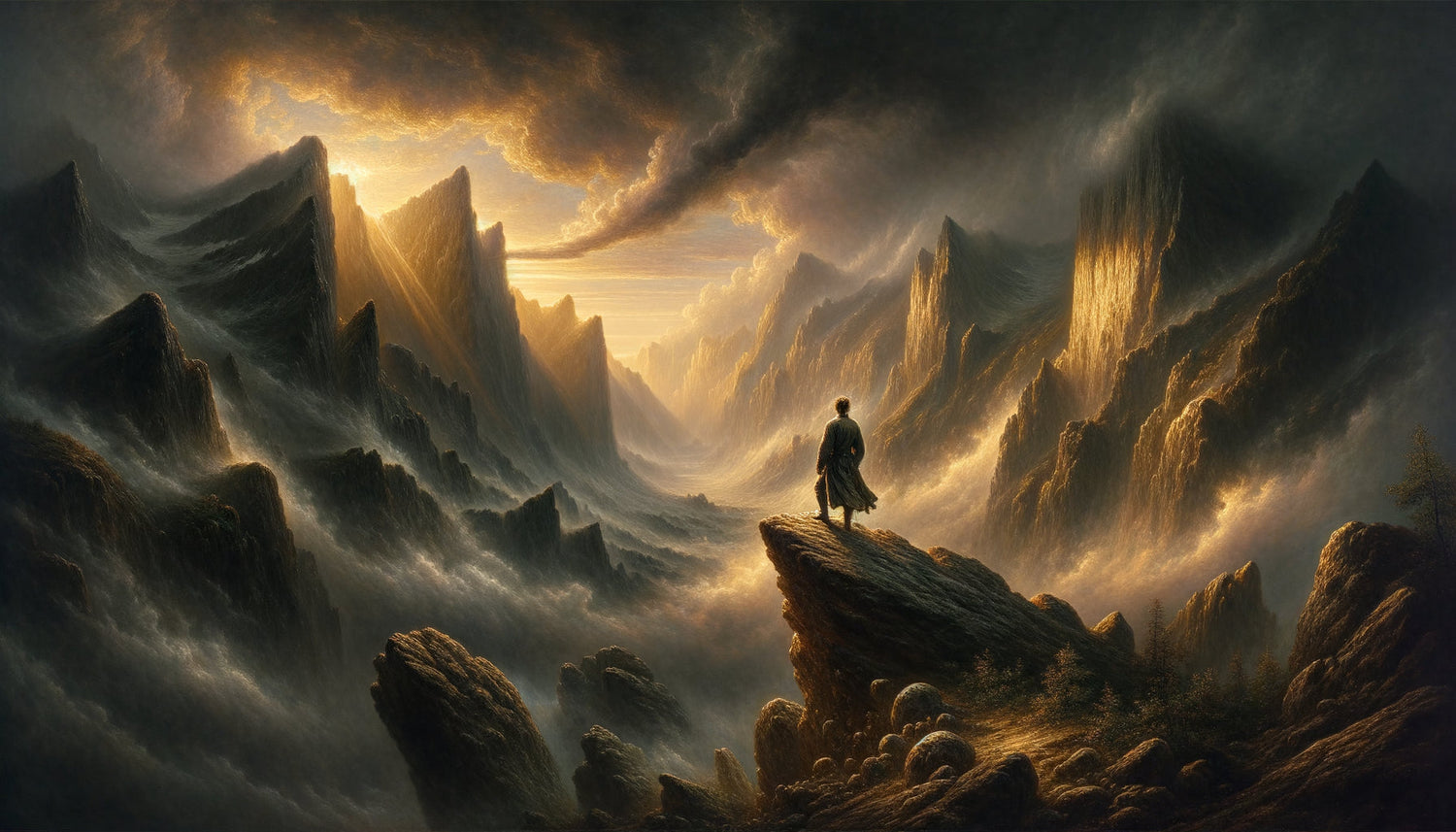
In The Wanderer Above the Sea of Fog (1818), this solitary figure seen from behind facing the hazy immensity perfectly embodies the aesthetic of Romantic sublimity. The character does not dominate the landscape: he confronts it, measures himself against it, perhaps loses himself in it. This posture became the icon of German romanticism, symbolizing the existential quest in the vastness of nature.
Spiritual Architectures of Nature
Friedrich structured his compositions with a near-religious rigor. His landscapes obey a sacred geometry – the verticals of trees like cathedral pillars, horizontals that mark out space, games of symmetry and unstable balance. This rigorous construction multiplies the effect of the sublime: the apparent order makes the immensity that escapes all human measure even more vertiginous.
His Gothic ruins emerging from the mists, his solitary crosses on Alpine peaks connected Christian spirituality and natural pantheism. Nature became the site of a transcendent experience, where terror and ecstasy mingled in a meditation on human finitude facing the eternity of the elements.
The Delicious Terror: Understanding the Emotional Paradox of the Sublime
How to explain this fascination for what terrifies us? Burke and Kant identified this particular psychological mechanism: the sublime occurs when we are exposed to a threat (storm, precipice, immensity) while being physically protected. This safe distance allows terror to be transmuted into aesthetic pleasure.
The landscapes of Turner and Friedrich precisely create this experience: we feel the dread of the storm or the abyss without real risk. It is a delicious terror, a controlled shiver that makes us feel intensely alive. This emotional catharsis explains why these works retain their power of fascination today.
In our contemporary interiors, integrating a sublime landscape is not simply a decorative choice: it is inviting this emotional dialectic into the daily space, creating a window onto immensity that contrasts with domestic comfort. This tension generates a psychological depth that mere 'prettiness' cannot reach.

Discover this inspiring work
The Legacy of the Sublime: From Romantics to Our Contemporary Spaces
The aesthetic of the romantic sublime still permeates our visual culture. From photographs of Icelandic storms to films by Terrence Malick, from the minimalist architecture of Tadao Ando to the immersive installations of Olafur Eliasson, this quest for extreme emotional experiences facing nature remains vibrant.
In interior decoration, this lineage is manifested by a passion for large-scale landscapes, monumental photographs of wilderness, works that create a contemplative gap in everyday life. Choosing a sublime landscape for your space is refusing decorative neutrality to embrace emotional intensity.
Create emotionally charged spaces
The teaching of Turner and Friedrich transcends the history of art: it reminds us that our visual environment shapes our inner life. An interior dotted with sublime works becomes a place of contemplative intensity, where the mundane everyday meets the extraordinary cosmic.
This approach opposes purely harmonious or soothing decoration. It assumes the disruptive power of art, its ability to destabilize, question, and deeply move. This is an aesthetic of productive confrontation, where beauty and dread coexist to enrich the sensory experience of living space.
Invite the power of romantic sublimity into your interior
Discover our exclusive collection of landscape paintings that capture this emotional intensity where terror and ecstasy meet, transforming your walls into windows onto infinity.
Your daily appointment with infinity
The romantic sublime teaches us an essential lesson: art does not simply decorate, it transforms our way of inhabiting the world. These landscapes by Turner and Friedrich which combined terror and ecstasy remind us of our dual nature - fragile creatures facing immensity, consciences capable of contemplating and transcending this fragility.
Choosing to integrate this aesthetic into your space is refusing reassuring blandness to embrace emotional complexity. It is creating moments of contemplative suspension in the daily flow, breaths where the soul measures itself against infinity. The legacy of the romantic sublime remains a permanent invitation: dare intensity, welcome extravagance, let the landscapes transform you as much as you welcome them.
For ultimately, as these 18th-century visionaries understood, we do not simply look at a landscape – we confront it, we seek in it, we find it.