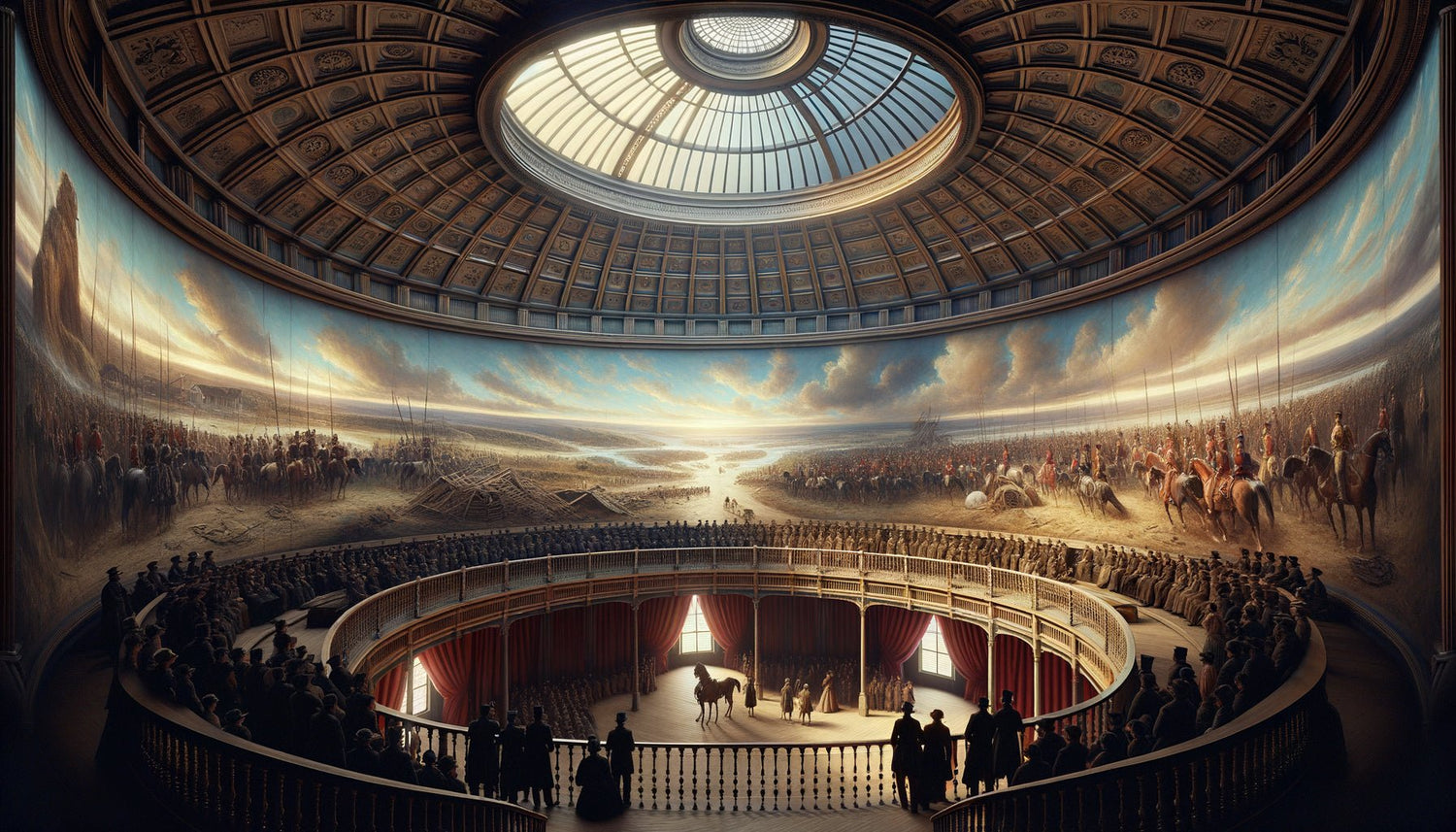
Imagine a round room steeped in twilight. You climb a few steps, and suddenly, a titanic battle unfolds 360 degrees around you. Soldiers emerge from the smoke, the ground seems to vibrate under the cannons, the horizon stretches into infinity. It's 1889, and you are experiencing the most spectacular immersive experience of your time: the rotating panorama. Long before IMAX theaters and virtual reality, these cathedrals of spectacle revolutionized our relationship with images and space.
Here's what rotating panoramas brought to their era: total immersion that abolished boundaries between spectator and spectacle, unprecedented cultural democratization allowing everyone to travel without leaving their city, and the invention of a visual language that foreshadowed cinema by over a century.
Today, we are saturated with screens, accustomed to virtual universes, jaded by special effects. Yet, we desperately seek that feeling of wonder, that ability to transport ourselves elsewhere, to feel rather than simply watch. The pioneers of circular panoramas had solved this equation with a canvas, paint and astonishing architectural genius.
Rest assured: rediscovering this forgotten revolution does not require being an art historian. It just takes understanding how these visionaries transformed painting into experience, observation into sensation, entertainment into total art.
I invite you on a journey through these temples of illusion where immersive landscapes made the hearts of millions of spectators beat, from Paris to New York, from London to Moscow.
1787: The birth of a visual revolution
It all begins with Robert Barker, an Irish painter based in Edinburgh. In 1787, this artist obsessed with perspective filed a patent for an invention he named panorama – from the Greek pan (all) and horama (view). His brilliant intuition? To abandon the traditional rectangular frame to wrap the viewer in a continuous circular canvas.
The first rotating panorama opened its doors in 1794 in Leicester Square, London. The effect is stunning. Visitors climb a central platform and discover a 360-degree view of the city from the heights. No edges, no limits, no escape for the gaze. For the first time in Western art history, the circular landscape is not contemplated: it inhabits you.
The technique is as simple as ingenious: a monumental canvas – often 15 meters high by 100 meters in circumference – stretched in a cylindrical building. The public stands in the center, on an elevated platform, separated from the canvas by a carefully calculated space. Zenithal light, filtered by a velum, eliminates shadows. Three-dimensional elements – false terrain, accessories, vegetation – fill the space between the platform and the canvas, blurring the boundary between real and painted.
The architecture of perfect illusion
The buildings housing these immersive vistas are architectural feats. In Paris, the Panorama of the Champs-Élysées becomes a must-see attraction as early as 1799. These monumental rotundas, often topped with glass domes, punctuate major capitals like temples dedicated to wonder.
The experience begins upon entry. Spectators walk through dark and winding corridors – a calculated transition to disconnect from the outside world. This shadowy antechamber psychologically prepares for the revelation. Then, suddenly, the burst of light: the circular landscape unfolds in all its splendor.
Creators of rotary panoramas master the art of trompe-l'oeil like no other. They play with atmospheric perspective, softening distant contours, saturating foregrounds. They study anatomy, botany, military architecture with a quasi-scientific rigor. Some panoramists travel for months to capture every detail of a site – relief, vegetation, color of the sky, quality of light.
The spectacle that truly turns
A major evolution occurs in the 1880s with the invention of the rotary panorama mobile. This time, it is not the spectator who moves mentally, but the platform itself which rotates slowly. Parisians discover mechanized journeys: a cruise on the Seine, a crossing of the Alps, an expedition to the Orient.
The mechanism is fascinatingly complex. A hydraulic or steam system turns the central platform – sometimes 20 meters in diameter and capable of holding 200 people – at a speed of a few meters per minute. Meanwhile, painted sets parade before their eyes, creating the perfect illusion of movement. Sound effects, diffused scents, sometimes even vibrations simulating the roll of a boat, complete the sensory immersion.

Discover this inspiring artwork
When entertainment becomes a mass phenomenon
Circular panoramas are not reserved for a cultured elite. On the contrary, they embody the democratization of culture in the 19th century. For a few cents, the Parisian worker visits Cairo, the London docker attends the Battle of Waterloo, the New York seamstress contemplates the Swiss Alps.
The numbers are dizzying. The Panorama of the Battle of Sedan, exhibited in Paris in 1883, attracts more than 1.5 million visitors. At its peak, Paris has a dozen active rotundas simultaneously. London, Brussels, Berlin, Vienna, New York follow suit. It is estimated that between 1880 and 1900, more than 50 million people visited an immersive panorama somewhere in the world.
This popularity can be explained by a thirst for discovery in a society undergoing profound change. Industrialization confines workers to factories and offices. Circular landscapes offer an escape, a window onto a fantasized but visually credible elsewhere. They also feed colonial and nationalist imaginings: glorious battles, conquered territories, exotic peoples become consumable spectacles.
The themes that ignite the crowds
While rotatable panoramas address all subjects, certain themes dominate. Historical battles come first: Waterloo, Gettysburg, Rezonville, the storming of the Bastille. These monumental reconstructions combine documentary accuracy and epic drama. Artists consult veterans, study uniforms, recreate the terrain with the precision of a cartographer.
Picturesque journeys constitute the other major vein: snow-covered Alps, Venetian canals, African deserts, Asian temples. These immersive landscapes satisfy a geographical curiosity at a time when photography is still rare and distant travel inaccessible to most.
A few panoramas venture into science fiction before its time. The Mareorama, presented at the 1900 World's Fair, simulates a maritime crossing from Marseille to Constantinople. Spectators board a mock ship whose deck pitches, while painted canvases scroll laterally, depicting the receding coastline. Marine wind, recreated by fans, the smell of iodine, recorded seagull cries: everything contributes to the total illusion.
The twilight of a spectacular era
Paradoxically, it is their success that precipitates the decline of rotatable panoramas. The arrival of the cinematograph in 1895 offers a different but equally powerful immersion, with a decisive advantage: real movement, captured by the camera. Animated images, infinitely reproducible and distributable, offer flexibility that monumental fixed installations cannot match.
Operating costs complete the condemnation of the model. Creating a circular panorama takes months of work for a team of artists, dedicated buildings, constant maintenance. Cinema, on the other hand, is content with a dark room and a projector. In a few years, the rotundas close one after another, their canvases are cut, sold, destroyed.
Yet, a few survivors still bear witness to this glorious era. The Panorama of the Battle of Waterloo, in Waterloo, Belgium, created in 1912, continues to welcome amazed visitors. The Panorama of Borodino in Moscow, depicting the Napoleonic battle of 1812, remains a major patriotic monument. In Lucerne, the Panorama of the Battle of Sempach retains its evocative power intact.

Discover this inspiring work
The invisible legacy of cathedral illusions
Although rotating panoramas have disappeared from the cultural landscape, their influence permeates modern visual culture. Cinema owes them the idea of collective immersion in a dedicated space, separate from everyday life. Special effects, three-dimensional sets, synchronization of sound and image: it was all present, in germ, within these 19th century installations.
Contemporary amusement parks, with their simulators and dark rides, directly perpetuate the tradition of immersive landscapes. Isn't Disneyland, at its core, a gigantic rotating panorama where the visitor moves through meticulously orchestrated scenes?
More recently, virtual reality and immersive installations – think of Les Bains de Lumières in Bordeaux or Atelier des Lumières in Paris – reinvent with digital means what 19th-century panoramists accomplished with painting and ingenuity. This direct lineage demonstrates that circular panoramas were not a mere passing entertainment, but a perceptual revolution whose possibilities we are still exploring.
Extend the magic of immersion at home
Discover our exclusive collection of landscape paintings that captures this sense of infinity and depth which made the rotating panoramas so successful.
Rediscover the wonder of the first spectators
The history of rotating panoramas reminds us of an essential truth: wonder does not depend on technological sophistication, but on the ability to create a total, coherent experience that engages all our senses and imagination.
These visionaries of the 19th century, with their limited means, accomplished what many digital creators struggle to achieve today: making us forget the device in order to live only the experience. When a worker from 1885 emerged from the Panorama of the Battle of Champigny, his legs still trembling from the imaginary cannonade, he had experienced something irreversible – a mental and emotional shift that expanded his world.
Today, integrating this philosophy into our interiors means choosing works that do not simply decorate a wall, but open windows to other horizons. An immersive landscape correctly chosen transforms a room into a space for contemplation, an invitation to mental travel, a visual breath in our overloaded lives.
The legacy of circular panoramas also teaches us the importance of the ritual of contemplation. These spectacles imposed a dedicated time, an open posture, a mental availability. In the age of infinite scrolling and fragmented attention, rediscovering this contemplative relationship with images becomes almost a revolutionary act.
The creators of rotatable panoramas invented mass entertainment, but they also demonstrated that popularity and quality do not necessarily oppose each other. Their works simultaneously seduced the naive gaze of the child and the expert eye of the connoisseur – an ambition that every creator should nurture.
Frequently asked questions about rotatable panoramas
Can we still visit rotatable panoramas today?
Yes, a few historical circular panoramas have survived and remain open to the public. The most famous is undoubtedly the Panorama of Waterloo in Belgium, created in 1912 and beautifully restored. It depicts the Battle of Waterloo on a canvas 110 meters in circumference. In Switzerland, the Bourbaki-Panorama in Lucerne (1881) remains perfectly preserved. In France, the Panorama of Jerusalem in Sainte-Anne-d'Auray offers a unique view of the holy city. These sites are valuable testimonies of a disappeared art and are well worth a visit. The experience remains striking even for a contemporary viewer accustomed to digital special effects. Monumentality, attention to detail, consistency of illusion continue to fascinate. Several of these immersive panoramas historical now offer digital mediation devices that enrich the visit without distorting the original experience.
How did artists create these immense circular canvases?
Creating a rotating panorama was a remarkable logistical and artistic feat. The process began with intensive preparatory studies: on-site trips, sketches, photographs (after 1850), consultations with experts. The team – often 10 to 20 artists – worked in special workshops equipped with mobile platforms allowing access to all points of the monumental canvas. The principal painter established the overall composition and perspectives, then different specialists intervened: figure painters for the characters, animaliers, landscape artists, architects for the buildings. The canvas, woven in several sections sewn together, was stretched over a temporary frame during creation, then transported and installed in the rotunda. The work generally lasted 6 to 18 months. The major difficulty was maintaining light and chromatic consistency throughout the circumference, anticipating the effect of the final zenithal lighting. Some panorama makers like Paul Philippoteaux or Louis Dumoulin achieved astonishing technical virtuosity, creating circular landscapes of a hallucinatory realism.
Why this fascination with panoramas today?
The renewed interest in rotating panoramas is part of a broader reflection on the history of immersive media and the genealogy of our contemporary visual experiences. Art historians are rediscovering these devices as essential milestones between classical painting and cinema, or even virtual reality. On an aesthetic level, these works demonstrate that a simple analog technology can create immersion as powerful as the most sophisticated digital devices – a valuable lesson in an era of technological inflation. Philosophically, immersive panoramas question our relationship to spectacle, representation, and the construction of collective imagination. They also testify to a unique historical moment when popular entertainment and artistic ambition converged without complex. Finally, in our age saturated with individual screens, the idea of a collective, ritualized experience in a dedicated space regains a certain seduction. Contemporary immersive installations, from teamLab to collective virtual reality experiences, directly perpetuate this legacy of 19th-century circular landscapes, proving that true innovation always dialogues with history.