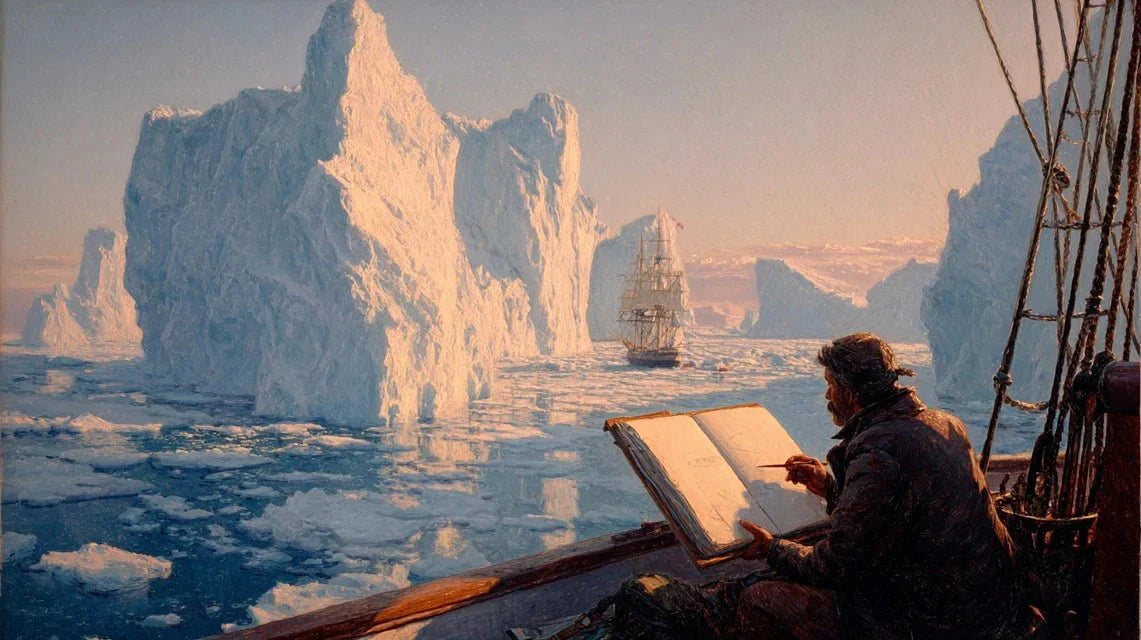
Imagine. 1839, a ship cleaves the icy waters of the Arctic during one of those Arctic expeditions that mark the century. On board, François-Auguste Biard, a painter from Lyon aged 40, holds his sketchbook with trembling hands. Not just because of the cold. It's the emotion facing these polar landscapes that overwhelms him.
This is how the art of exploration is born: in urgency, biting cold, and this insatiable desire to capture the impossible.
Techniques for representing polar landscapes in exploration art
Painting at the pole is first a battle. Against the cold that numbs your fingers. Against the wind that slaps the pages. Against time that flies too fast when the aurora borealis dances in the sky.
19th-century explorer artists understood this: it was impossible to bring their studio equipment in these extreme conditions. They therefore invent a minimalist approach but devilishly effective, comparable to techniques used in mountain painting European.
Watercolor becomes their best ally. Why? It is light. It dries quickly (even at -20°C). And above all, it captures these infinite nuances of blue and white that make up the magic of Arctic glaciers.
François-Auguste Biard in Spitsbergen, William Bradford in Labrador... all adopt the same reflex: sketch first, paint later. A5 sketchbook slipped into the inside pocket, a few pencils, and off you go.
The subjects impose themselves:
- Majestic icebergs that drift slowly
- The grazing light of the midnight sun on the ice sheet
- These auroras borealis that transform the black sky into a cathedral of colors
- The crew fighting against the elements
But how to render this brilliant whiteness without falling into the trap of monotony? Explorer painters develop a secret: playing on subtle contrasts. Purples in the shadows. Deep blue for crevasses. Touches of ochre when the sun grazes the ice. This collection of landscape paintings perfectly shows how artists solved this chromatic equation specific to Nordic art.
Explorer artists and their approach to polar landscapes
Not all painters of polar landscapes have set foot on the ice sheet. And that's where the beauty of the story lies.
Take Caspar David Friedrich. This German Romantic painted his famous Sea of Ice in 1824 without ever having seen the Arctic. He draws inspiration from explorers' accounts, engravings, and a lot of his imagination. The result? A work so powerful that it remains one of the masterpieces of 19th-century painting. The public of the time found it too radical. It will remain unsold until his death.
Conversely, some artists immerse themselves completely in the polar adventure. François-Auguste Biard embarks in 1839 with his young wife, Léonie, 20 years younger than him. She becomes the first woman to participate in an official Arctic expedition in the polar regions. Twelve years later, their paintings of the Far North exhibited at the 1841 Salon cause a sensation.
William Bradford goes even further in the documentary approach. This self-taught American undertakes seven Arctic expeditions between 1861 and 1869. His revolution? To bring photographers with him. John L. Dunmore and George Critcherson capture the icebergs and frozen landscapes while Bradford paints. This synergy creates a revolutionary visual documentation. His book The Arctic Regions, published in London, becomes an immediate success.
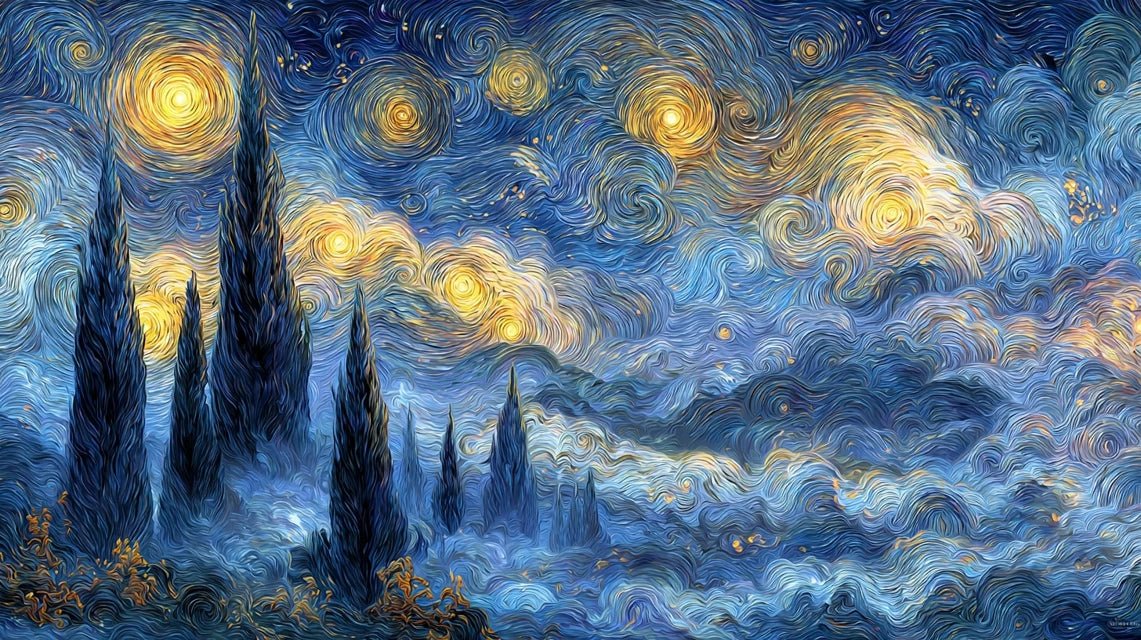
The Group of Seven, a Canadian collective from the early 20th century, breaks the codes of traditional Arctic art. No more uniform white and timid blues. These artists explode the color palette. Their polar landscapes vibrate with bright colors, influenced by Impressionism and Van Gogh. They want to show that the Far North is not just a white desert, but a luminous festival.
Expedition notebooks: tools for capturing polar landscapes
The expedition notebook is much more than just a simple notebook. It's the confidant of the explorer artist. His creative life insurance.
A good notebook for the poles must tick several boxes:
- Thick paper (200-300 g/m²) that resists moisture from condensation
- Portable format (A5 or A6) to fit in a pocket
- Rigid cover that protects even when you fall in the snow
- Solid binding that supports being handled with mittens
In addition to drawings, annotations make all the difference. "Deep cobalt blue here", “north-east wind”, “golden light at 2 p.m.”. These valuable notes allow scenes to be faithfully recreated months or even years later.
Paul-Émile Victor perfects this method in the 1930s. During his crossing of Greenland and his 14 months living with the Inuit, he fills notebooks that combine art and ethnography. Drawings, glued photos, scientific observations. A documentary treasure on the polar regions.
Faced with an aurora borealis exploding in the sky, it is impossible to take your time. The artist has a few minutes, no more. The quick sketch becomes an art in itself. Fridtjof Nansen, Norwegian explorer and Nobel Prize winner, excels at this exercise. His auroras boreales, scribbled hastily on the ship's deck, possess a striking raw energy.
Painting of polar landscapes: from sketch to finished work
The real work begins upon returning home. In the warmth of the Parisian or London studio, the artist spreads his notebooks on the table. Dozens, sometimes hundreds of sketches. A process of selection, composition and maturation then begins.
François-Auguste Biard dedicates twelve years to transforming his sketches of Spitsbergen into monumental paintings. Twelve years to mentally relive every moment of the expedition. To remember the cry of the seagulls, the cracking of the ice, the salty smell of the Arctic Ocean.
The process unfolds in stages:
First, choose the strongest sketches. Those that really tell a story. Then compose the final work by mixing several sketches. An iceberg from here, a sky from elsewhere, the light of another moment. The artist recreates his polar truth.
Light requires particular care. How to render on canvas this special luminosity of extreme latitudes? This almost supernatural clarity of the midnight sun? Bradford achieves it with inspired meticulousness inspired by the Hudson River School. His paintings reach a photographic precision without losing their soul.
A romantic dimension permeates these works. The painters do not coldly document. They convey raw emotion: the feeling of being tiny in the face of frozen immensity. Absolute solitude. The sublime that takes your breath away.
Today, the art of polar landscapes is taking an ecological turn. Zaria Forman creates pastel icebergs and Arctic glaciers with stunning hyperrealism. In partnership with NASA, she documents the melting of ice in Antarctica and Greenland. Her monumental works become urgent testimonies. A silent cry about the fragility of these worlds of ice that are disappearing.
The art of exploring polar landscapes has crossed two centuries. From Friedrich's romanticism to Forman's ecological commitment. A common thread unites these artists: fascination for these extreme territories and a visceral need to share them with the world.
FAQ : The representation of polar landscapes in exploration art
Which artists actually participated in polar expeditions?
François-Auguste Biard embarked in 1839 for an expedition to Spitsbergen, while William Bradford made seven Arctic expeditions between 1861 and 1869. Fridtjof Nansen, Norwegian explorer and artist, also visually documented his Arctic missions. These explorer artists are distinguished from painters like Caspar David Friedrich who created his famous Sea of Ice without ever seeing the Arctic.
Why was watercolor preferred during polar expeditions?
Watercolor imposed itself for its lightness and transportability in extreme conditions. It dries quickly even at sub-zero temperatures and allows to capture the subtle nuances of glaciers and ice floes. Artists could thus work quickly before the cold numbed their fingers, unlike oil paint which requires more time and equipment.
How did expedition notebooks serve after the artists returned?
Shipping notebooks constituted the visual and descriptive memory of the polar experience. Sketches accompanied by annotations on colors, light, and weather conditions allowed artists to faithfully recreate scenes in their studios, sometimes years later. François-Auguste Biard took twelve years to transform his Spitzbergen sketches into monumental paintings.