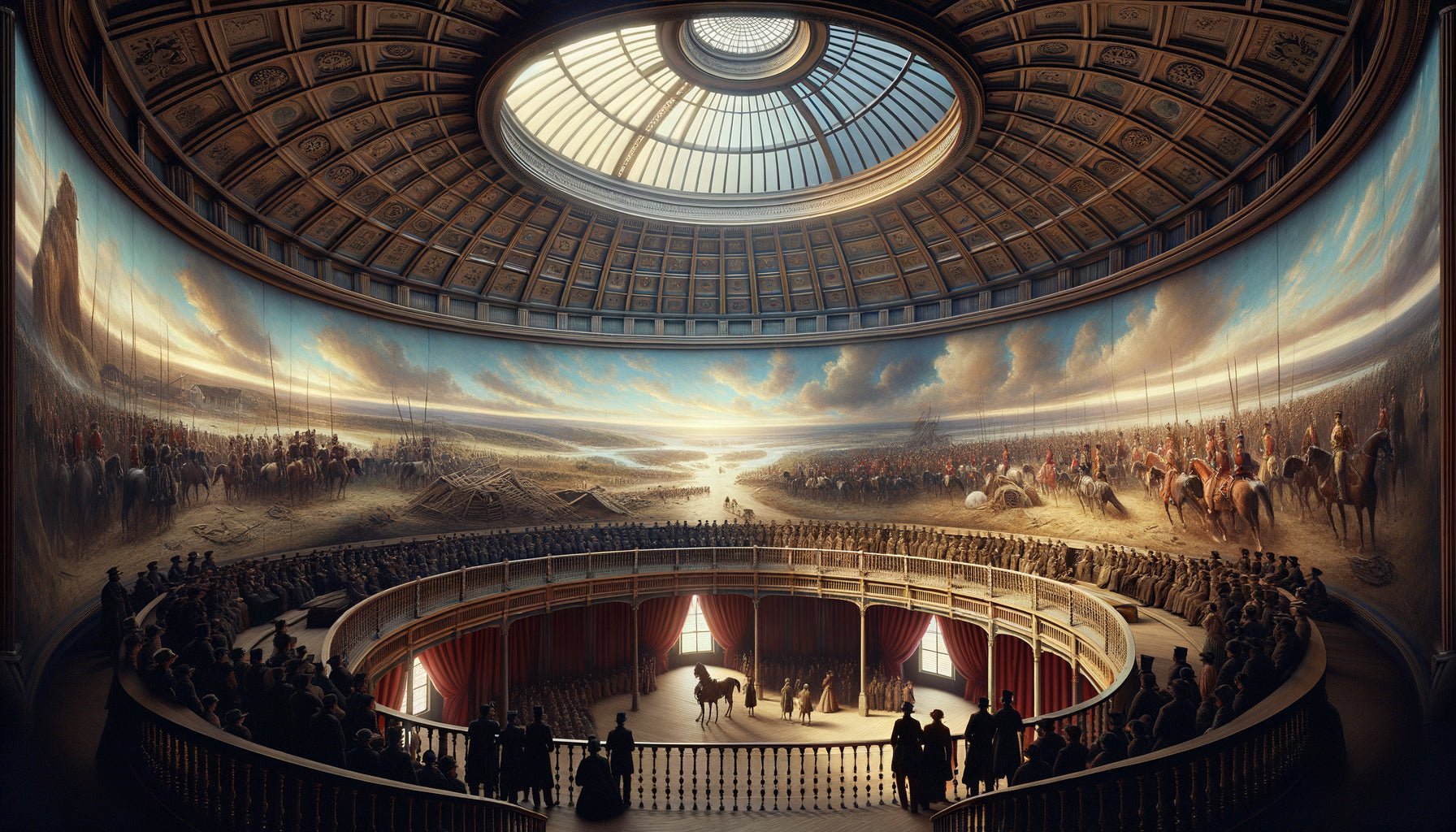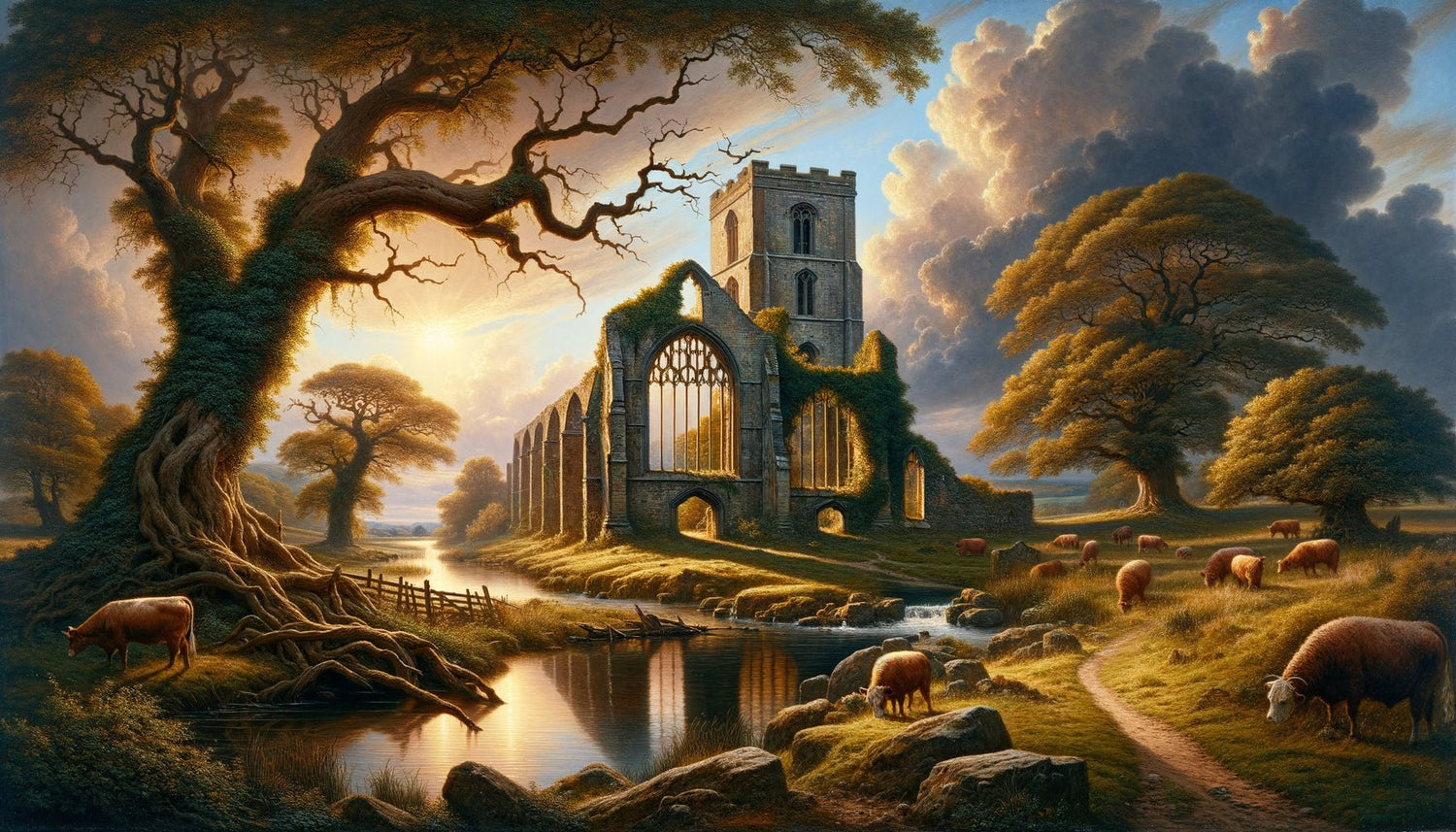
Imagine an era when viewing a landscape required a frame. Literally. In the 18th century, English aristocrats strolled through their estates carrying a Claude glass – a tinted mirror – or a portable frame to compose nature as a canvas. This practice was not eccentricity: it embodied the Picturesque movement, an aesthetic revolution that transformed our way of seeing the natural world.
Here's what the Picturesque movement bequeathed us: a visual grammar for appreciating landscapes, gardens designed as living paintings, and the revolutionary idea that wild nature could be beautiful. Three concepts that shaped modern landscape architecture and our very conception of natural decor.
You may be looking at an English garden, an asymmetrical floral composition, or even an Instagram photo of waterfalls without realizing that a 250-year-old aesthetic code guides your gaze. This codification of natural beauty seems invisible today, integrated into our visual culture. Yet, understanding the Picturesque is discovering why certain landscapes instantly move us while others leave us indifferent.
Rest assured: no need to be an art historian to grasp this aesthetic. The Picturesque speaks a universal language – that of composition, texture and emotion in the face of nature. I invite you to discover how Georgian England invented our modern gaze on landscapes, and how this vision continues to influence contemporary decoration.
When nature wasn't natural enough: the birth of the Picturesque
In the mid-18th century, the English elite returned from the Grand Tour – that initiatory journey through Italy – with suitcases full of paintings by Claude Lorrain and Salvator Rosa. These artists depicted idealized landscapes: romantic ruins, twisted trees, dramatic waterfalls, golden lights. The problem? The English countryside, with its geometric fields and impeccable lawns, was nothing like these Italian compositions.
William Gilpin, pastor and theorist, formulated a revolutionary question in 1768: what makes a landscape worthy of being painted? His answer gave birth to the Picturesque movement, a concept that sat between the Beautiful (the smooth and harmonious beauty) and the Sublime (the terrifying grandeur of mountains). The Picturesque celebrated roughness, irregularity, variety – everything that created visual interest.
This aesthetic established precise criteria for judging a landscape. There had to be texture: rough bark, mossy stones, irregular surfaces that caught the light. Complexity: superimposed planes, winding paths that hid and revealed views. Calculated imperfection: a leaning tree was better than a perfectly straight specimen, an artificial ruin surpassed a new building.
The three golden rules for composing a picturesque landscape
The Picturesque movement wasn't an abstract philosophy. Its theorists – Gilpin, Uvedale Price, Richard Payne Knight – codified compositional principles that landowners literally applied to their estates.
The rule of variation
A picturesque landscape multiplies contrasts: light and shadow, heights and depths, open and closed spaces. English gardens abandoned French symmetrical parterres to create successions of scenes – each viewpoint offering a distinct composition. Trees were strategically planted to frame a sunlit meadow, creating this characteristic play of light and shadow.
The rule of roughness
Exit smooth surfaces. The Picturesque valued contrasting textures: rough stones against lush vegetation, gnarled trunks against delicate foliage. In gardens, certain elements were deliberately allowed to age, follies were built – these false Gothic ruins or artificially aged Greek temples. This search for authentic or simulated wear created a visual depth that classical gardens lacked.
The rule of irregularity
Straight lines were banished. A picturesque path winds, gradually revealing the landscape. A lake takes a natural, irregular shape rather than geometric. This calculated asymmetry created a sense of discovery, inviting exploration. Capability Brown, England's most famous landscape architect, transformed entire properties according to these principles, diverting rivers and replanting forests to create picturesque views.

Discover this inspiring work
Tools for framing nature: the Claude glass and the art of looking
The Picturesque movement didn't just transform landscapes – it changed the way they were viewed. Cultured enthusiasts equipped themselves with instruments to visually compose nature.
The Claude glass, named after the painter Claude Lorrain, was a convex mirror tinted black. The walker turned their back on the landscape and observed it in this mirror, which reduced the scene, darkened the colors and unified the composition – just like a varnished painting. This mediation by the object reveals something essential: for followers of the Picturesque, raw nature was not enough. It had to be framed, filtered, composed to become truly beautiful.
Others used portable frames or viewing stations – specific locations where benches invited contemplation of a carefully orchestrated view. Tourist guides for the Lake District, written by Gilpin, indicated exactly where to stand to appreciate each landscape from its optimal angle. Picturesque tourism was born, with its codes and rituals.
This approach may seem artificial, but it democratized the aesthetic appreciation of landscapes. Before the Picturesque, only artists and collectors developed this gaze. Afterwards, any educated person could read a landscape according to shared criteria, transforming the walk into an aesthetic experience.
The Picturesque in action: Stourhead and garden-paintings
It is impossible to evoke this movement without mentioning Stourhead, in Wiltshire. Created from 1740 by Henry Hoare II, this garden perfectly embodies the picturesque philosophy. A walking circuit surrounds an artificial lake, revealing successively: a neoclassical temple of Apollo, a Palladian bridge, a grotto adorned with a nymph, a Pantheon, a Gothic tower.
Each element is placed to create composed views – three-dimensional paintings that the visitor traverses. The light changes according to the hours, reflections in the water multiply perspectives, trees naturally frame each scene. Stourhead does not hide its artifice: it is an assumed natural decor, a nature reorganized according to precise aesthetic principles.
Other properties adopted this approach. At Stowe, more than forty fabriques – temples, obelisks, bridges – punctuated a 400-hectare landscape. These elements had no practical function: they existed only to create focal points in the composition of the landscape, to tell mythological or historical stories through space.

Discover this inspiring artwork
The modern legacy: from the Picturesque movement to your garden
The Picturesque movement disappeared as a conscious theory around 1820, but its influence persists everywhere. Whenever we prefer a natural garden to a geometric flowerbed, we unconsciously follow its precepts. Whenever a landscape architect creates depth levels, plays with plant textures or designs a winding path, they apply rules established 250 years ago.
In contemporary interior decoration, this aesthetic translates into the valorization of raw materials: aged wood, exposed stone, authentic patinas. Asymmetrical floral compositions, reclaimed furniture, living walls – all these elements reflect a preference for textured irregularity rather than smooth perfection.
Landscape photographers still use Picturesque principles: seeking interesting foregrounds, framing views with natural elements, capturing light contrasts. Instagram is full of unconsciously Picturesque landscapes – Icelandic waterfalls, winding forest paths, rustic cabins in clearings. We have integrated this visual grammar without even knowing its origin.
Transform your interior into a gallery of Picturesque landscapes
Discover our exclusive collection of landscape paintings that capture this timeless aesthetic: plays of light, natural textures and compositions that invite travel.
Controversies and criticisms: when nature becomes too artificial
The Picturesque movement was not universally accepted. Its detractors criticized this artificialization of nature: building false ruins, felling mature forests to replant according to an aesthetic plan, moving entire villages to clear a view – practices common among large landowners.
Jane Austen, in Northanger Abbey (1817), gently mocked Picturesque tourists armed with their guides and Claude glasses, unable to appreciate a landscape without mediation. The movement had created a standardization of taste: everyone was looking for the same types of views, transforming natural diversity into a catalog of approved compositions.
More deeply, the Picturesque embodied a colonial vision of the landscape: nature must be controlled, organized, improved according to specific cultural criteria. The farmers who worked these picturesque lands were often erased from the views – their presence was deemed unaesthetic. This tension between beauty and social reality runs throughout the history of the movement.
Yet, we can also see the Picturesque as a first form of ecological awareness. By valuing roughness and irregularity, it allowed us to appreciate landscapes once considered ugly or terrifying: marshes, moors, rocky mountains. It paved the way for the romantic movement and, indirectly, for the first initiatives of natural landscape preservation.
Seeing the world with picturesque eyes today
The true legacy of the Picturesque movement is not its gardens or its theories, but this revolutionary idea: looking consciously is a creative act. Theorists from the 18th century taught us that aesthetic appreciation requires education, practice, and attention.
Today, developing a picturesque eye means observing how light sculpts an object, how textures dialogue, how a natural or domestic composition creates a dynamic balance. In your interior, this can mean deliberately juxtaposing contrasting materials, creating framed views between rooms, playing with levels of depth.
When taking a walk, try this modern picturesque exercise: look for natural frames – branches that form an arch, rocks that frame a view. Observe how your perception changes depending on the angle. Photograph not the main subject, but the entire composition. You will then be practicing exactly what enthusiasts of the 18th century did with their Claude glasses.
The Picturesque movement reminds us that beauty does not exist only in the object being observed, but in the relationship between the observer and the landscape. This is a valuable lesson at a time when we compulsively photograph without really looking. Slow down, compose, appreciate texture and light – these simple gestures transform any environment into a source of inspiration.
The Picturesque movement transformed wild nature into decor, but in doing so, it gave us a language to express our emotions about landscapes. Two and a half centuries later, this aesthetic vocabulary remains surprisingly relevant. Every garden you admire, every landscape photo that moves you, every natural corner you arrange at home bears the imprint of this revolution of sight born in Georgian England.
Perhaps it is time to mentally bring back that old Claude glass and rediscover your environment – not as it is, but as it could be painted, composed, appreciated. The Picturesque movement invites us to become artists of our own gaze, to transform every walk into a gallery, every window into a painting. A legacy worth celebrating, questioning, and above all, practicing.
Frequently Asked Questions
What is the difference between the Picturesque and a French garden?
The French garden, embodied by Versailles, prioritizes symmetry, geometry, and total control of nature. Every hedge is trimmed, every path is straight, every flowerbed follows a precise design. It's a demonstration of human power over the natural world. The Picturesque movement, on the other hand, celebrates irregularity and natural appearance, even if it is carefully orchestrated. Paths meander, plantings seem spontaneous, architectural elements imitate ruins. Paradoxically, creating a picturesque garden often required more work than a formal garden – but the goal was to hide this artifice to give the illusion of an improved rather than dominated nature. This opposition reflects two philosophies: the French garden expresses reason and classical order, the picturesque garden values emotion and romantic discovery.
How to apply the principles of Picturesque in a small urban garden?
Excellent question! The Picturesque movement works at all scales. In a small space, focus on texture variety: mix plants with smooth and rough foliage, mineral and vegetal surfaces. Create depth levels by layering plantings – from groundcovers to shrubs up to a focal point tree. Avoid perfect symmetry: a slightly curved path, even over two meters, creates more interest than a straight line. Add a textured focal point: a mossy old stone, a piece of driftwood, a small rough-hewn fountain. The key is to create a composition that unfolds gradually rather than an immediate view. Even a balcony can become picturesque by playing with pot heights, letting some plants overflow naturally, creating contrasts of light and shadow. The Picturesque movement is not about space, but about compositional sensibility.
Is the Picturesque movement compatible with modern ecology?
It is a fascinating tension. Historically, the Picturesque was sometimes destructive: forests were felled, rivers diverted, purely decorative elements constructed. However, its aesthetic principles align remarkably well with contemporary ecology. Valuing irregularity means accepting wildflowers rather than uniform lawns. Celebrating roughness involves leaving dead wood, mossy stones – exactly what ecologists recommend for biodiversity. Preferring mixed plantations to monocultures naturally creates these varied textures dear to the Picturesque. The modern difference? We no longer need to build false ruins or move villages. A contemporary picturesque garden can use recycled local materials, favor native plants adapted to the soil, create habitats for wildlife. The spirit of the movement – appreciating beauty in natural imperfection – is ultimately very close to an ecological aesthetic. It simply requires replacing artifice with authenticity, control with collaboration with nature.