Imagine a scientist from the 18th century, hammer in hand, scrutinizing a Scottish cliff. Before him, layers of rock tell a story that had never been read before. This scene repeats itself throughout Europe between 1750 and 1800. The nascent geology transforms our way of seeing mountains, valleys, rivers. What was simple decor becomes an archive. This scientific revolution changes everything: art, philosophy, our relationship to geological time. Landscapes are no longer what they were. The influence of this new science spreads like a shock wave.
The nascent geology of the 18th century and its founding theories
Two camps clash at the end of the 18th century. On one side, Abraham Gottlob Werner and his Neptunists. From his academy in Freiberg, Werner teaches that everything comes from water. A primordial ocean would have covered the Earth, depositing sedimentary rocks layer after layer. His students come from England, France, Scotland to listen to him. His theory of stratigraphy is attractive for its simplicity.
On the other side, James Hutton shakes everything up. In 1785, this Scotsman presents a crazy idea: the Earth is millions of years old. At Siccar Point, he shows rocks vertically covered with horizontal layers. Impossible to explain without immense cycles of transformation. His principle of uniformitarianism revolutionizes thinking: the same geological processes act today as in the past. Mountains rise up. Erosion trims them down. New sediments are deposited. And it starts again. Again and again.
These two visions oppose each other, but they share something revolutionary. They force us to rethink time. The Earth dated at a few thousand years by biblical calculations? Impossible. Vertiginous durations are needed to sculpt a mountain, carve out a valley. This idea transforms everything.
And then there is the method. No more cabinet theories. Scientists go out, observe, measure. Guettard and Desmarest travel through Auvergne in the 1750s. They recognize ancient extinct volcanic formations thousands of years ago. Geology becomes a science of field observation. The landscape becomes a laboratory.
The landscapes of the 18th century transformed by geological discoveries
Discoveries change the perspective. A mountain is no longer just a relief created at the beginning of the world. It is a witness to a complex history. Uplifts. Erosions. Deposits. Each element tells a different chapter of geological time.
Volcanoes are particularly fascinating. Vesuvius has attracted curious people since antiquity, but in the 18th century, it is observed differently. The columnar basalts of the Giant's Causeway divide scientists. Werner sees crystals formed in water. Hutton recognizes solidified lava. This black stone becomes a scientific battlefield between Neptunists and Plutonists.
The cliffs reveal their secrets through stratigraphy. Each layer corresponds to a moment in the past: an ancient seabed, a vanished river delta, a fossil beach. And when you find marine shells on top of a mountain, everything changes. These elevated regions were once underwater. The landscape has a geological memory inscribed in its sedimentary rocks.
- Volcanic formations show the power of internal forces
- Stratigraphy tells millions of years of history
- Fossils prove past upheavals
- Discordances reveal cycles of transformation
To explore landscape paintings inspired by this era, many works bear witness to a new perspective on nature.
The influence of geological theories on the representation of landscapes
Painters capture this transformation. Joseph Wright of Derby travels to Italy in 1774 and paints Vesuvius erupting—not a mythological backdrop, but a direct, almost scientific observation. The colors, the light, the violence of the eruption: it's all there.
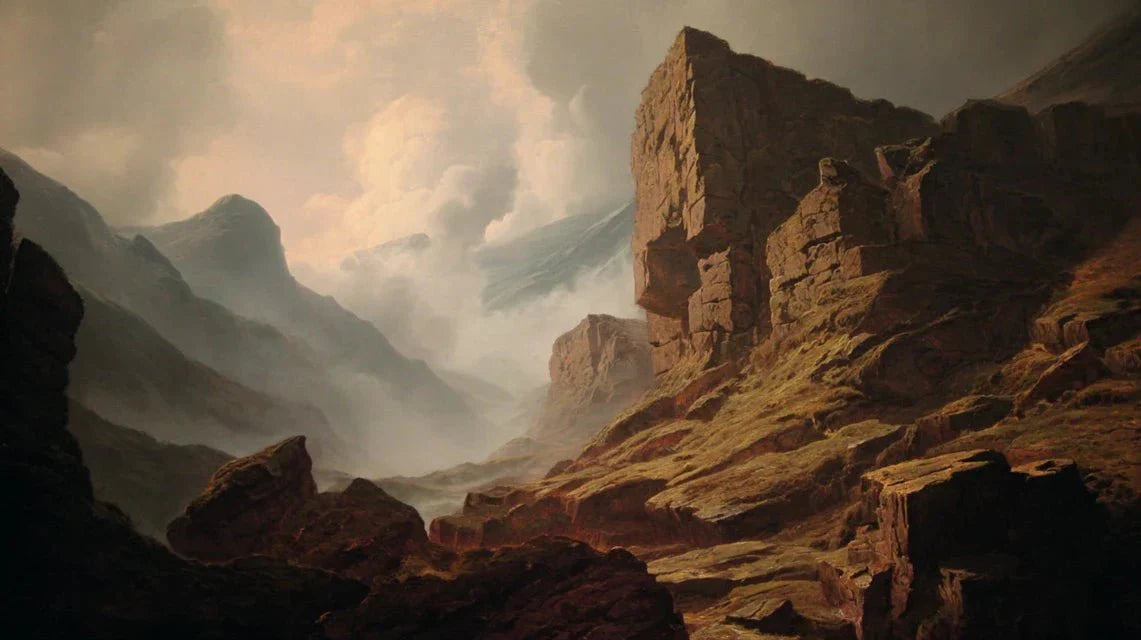
Pierre-Henri de Valenciennes goes further. Between 1777 and 1781, he travels throughout Italy with sketchbook and brushes in hand, practicing field observation like geologists, painting directly facing the landscape. His studies capture rock formations with a new precision: strata, faults, folds—he sees what geologists see. His work heralds a new generation of artist-naturalists.
The idealized landscape recedes. Artists want to show geological reality. Rocks become subjects in their own right. This evolution reflects the principle of uniformitarianism: understanding Earth is observing its current processes.
In England, Richard Wilson and Thomas Gainsborough incorporate this new sensibility. Their cliffs and mountains are no longer mere backgrounds; they have weight, texture, a history. This attention to geological structures prepares the ground for Romanticism, which will soon celebrate wild nature.
Emerging geology and direct observation of landscape formations
The method makes the difference. 18th-century geologists create field observation protocols: they measure the thickness of layers, draw stratigraphic sections, systematically map. This rigor inspires artists who become more analytical.
Horace-Bénédict de Saussure spends thirty-six years exploring the Alps. His Voyages in the Alps, published between 1760 and 1796, combine science and description. He measures, he calculates, but he also describes wild beauty. Saussure proves that the Alps were formed through successive stages over an immense geological time. His work inspires painters and writers fascinated by the mountains.
Scientific expeditions are multiplying. Naturalists and draughtsmen collaborate. They document together remarkable sites, from volcanic formations to folded sedimentary rocks. These visual archives serve both science and art. The landscape becomes a shared object of study.
This period marks a fundamental shift. Nature is no longer frozen since Creation. It evolves, transforms, lives at its slow pace according to the laws of uniformitarianism. Each valley, each peak bears witness to gigantic forces deployed over inconceivable durations. This revolution changes our place in the world. We are no longer at the center of a recent creation. We are the latest arrivals on an ancient, patient Earth, constantly transforming.
FAQ : The influence of emerging geology on 18th-century landscapes
Q1 : What are the two main geological theories of the 18th century?
The two major theories are Abraham Gottlob Werner's Neptunism, which explains the formation of rocks by precipitation in a primordial ocean, and James Hutton's Plutonism, which attributes their origin to the internal heat of the Earth. These opposing theories both contributed to establishing geology as a modern science based on field observation.
Q2 : How has geology transformed the artistic representation of landscapes?
Emerging geology pushed artists to observe landscapes with greater scientific precision. Painters such as Pierre-Henri de Valenciennes and Joseph Wright of Derby began to represent rock formations, volcanoes, and geological strata accurately, abandoning idealized compositions in favor of a more naturalistic and documentary approach.
Q3 : What is James Hutton's major contribution to understanding landscapes?
James Hutton introduced the concept of deep geological time and the principle of uniformitarianism, demonstrating that landscapes result from slow processes extending over millions of years. His discovery of angular unconformities at Siccar Point proved that mountains undergo cycles of uplift, erosion, and sedimentation, revolutionizing our perception of terrestrial relief.