Imagine Naples in the 18th century. Vesuvius awakens with a muffled rumble, lava flows down its flanks, and dozens of painters rush forward, brushes in hand. This scene is no fiction: for over two centuries, European volcanoes have inspired a revolution in landscape painting, transforming the way artists see and paint nature.
The representation of volcanoes in European art in the 18th century
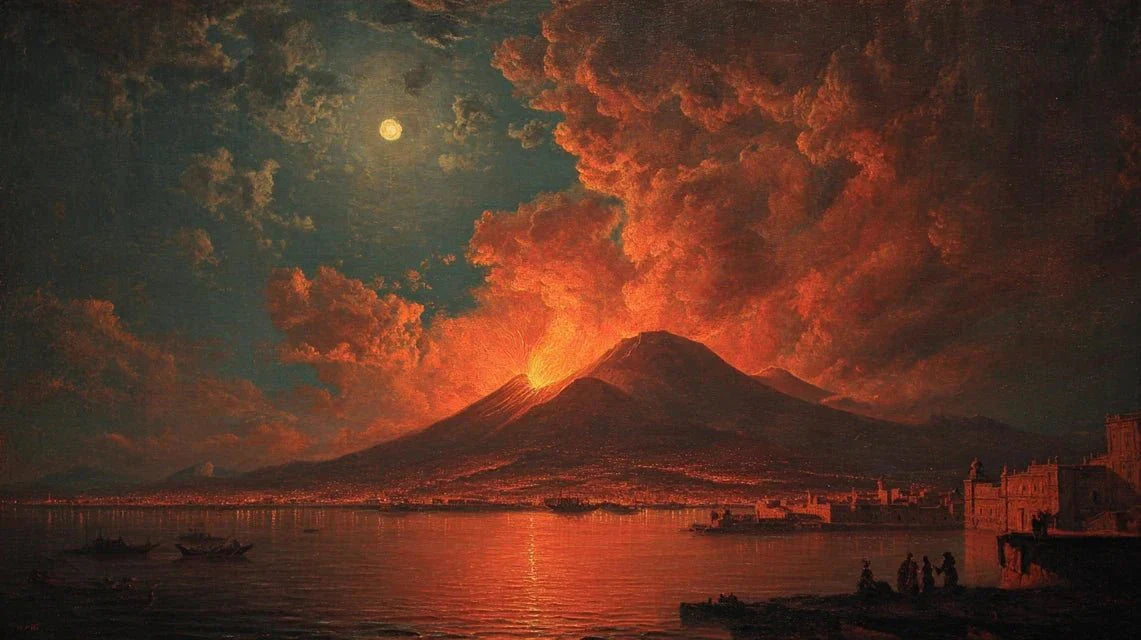
Vesuvius becomes the undisputed star for European artists of the 18th century during the Enlightenment. Seven major eruptions between 1750 and 1800 make Naples a veritable open-air studio. Pierre-Jacques Volaire, a Frenchman settled there in 1767, quickly understands the potential: he specializes in nocturnal scenes and becomes the official portraitist of the crater. His trick? Playing on contrasts between the bright red of the lava and the soft light of the moon over the bay.
This period coincides with the Grand Tour of Italy, this obligatory journey for young European aristocrats. The excavations at Pompeii, launched in 1748, add spice to the affair. Wealthy visitors all want to bring back a souvenir, creating a real commercial boom around volcanic art. Joseph Wright of Derby paints at least 30 versions of Vesuvius. The amusing detail? He never saw an eruption firsthand – it all comes from his imagination.
The Neapolitan veduta offers perfect flexibility: documentary view, scientific illustration or dramatic landscape according to tastes. Pietro Fabris pushes the concept to the extreme with 54 gouaches detailing each phase of the eruptions. It is art and science combined in a single movement. Lovers of this tradition can also find landscape paintings inspired by these masters in contemporary collections.
This fascination paves the way for an even deeper revolution: the Romantic movement will radically transform our view of these giants of fire.
Volcanoes in European Romantic painting
On April 10, 1815, Tambora explodes in Indonesia. The event seems distant, but its consequences affect all of Europe. Between 93 and 104 cubic miles of ash rise into the atmosphere and remain there for three years. Result? 1816 goes down in history as "the year without a summer", with temperatures dropping by half to one degree Celsius.
William Turner captures these upheavals in spectacular canvases. His sunsets painted between 1815 and 1820 explode with intense oranges and purples. In 2014, researchers from the Academy of Athens analyzed over 500 twilight paintings: they discovered that the mixture of red and green in Turner's works exactly reflects the amount of aerosols present in the air at that time (Source: Academy of Athens). Fascinating, isn’t it?
From his workshop in Greifswald, Germany, Caspar David Friedrich paints skies of unusual intensity. Scientific analyses confirm this: his tormented atmospheres perfectly correspond to post-Tambora atmospheric disturbances. German Romanticism finds its raw material here: expressing the sublime through untamed nature.
A profound change takes place. Volcanoes are no longer simple documentary subjects. They become vectors of pure emotion, melancholic introspection, and questioning of forces beyond our control.
The techniques of representing volcanoes in European painting
How do you translate the intensity of an eruption onto a canvas? Specialized painters develop precise techniques. Volare relies on chromatic contrast: incandescent red-orange on one side, lunar blue on the other. This recipe, inherited from his master Joseph Vernet, becomes his trademark.
Artists also exploit dramatic lighting effects depending on the moment captured:
- The silvery smoke of the day, crossed by rays of sunlight
- Nocturnal bursts of fire that spit incandescent stones
- Lava flows slowly progressing in the dark
- The fiery skies of the following day
Technical evolution follows the progress of emerging volcanology. In the late 18th century, painters became more interested in the details of lava flows than in the simple spectacle of fire. This attention is a form of naturalistic painting that combines scientific observation and artistic sensitivity. Pietro Fabris's 54 gouaches perfectly embody this bridge between art and documentation.
These innovations prepare an even deeper transformation: the very status of the volcano in the scale of pictorial genres will shift.
The evolution of the artistic treatment of European volcanoes
For a long time, the volcano remains a simple backdrop symbolizing divine wrath. In the 18th century, everything changes. Several factors converge: eruptions multiply, the Grand Tour becomes more democratic (relatively), Pompeii emerges from the earth, and science finally takes an interest in volcanism.
In the 17th century, Georges de La Tour still used fire as a religious symbol in his interior scenes. A century later, the eruption becomes an autonomous subject, capable of carrying an entire painting. Painters like Volare built their reputation on their ability to recreate the essence of Vesuvius after hours of observation in the field.
The Romantic 19th century operates a new turn. After 1825, the opera "L'Ultimo Giorno di Pompéi" and Bulwer-Lytton's novel transform the eruption into a simple backdrop for human dramas. In 1833, the Russian Bryullov painted a monumental version of the destruction of Pompeii where terrified characters occupy the entire foreground. The volcano? Relegated to the background.
This evolution tells the story of a shift: from fascination with the natural phenomenon to exploration of human emotions. European volcanoes, real or painted, become perfect mirrors of artistic evolution, from the rigorous classicism of the veduta to the romantic expression of the sublime and the tragic.
FAQ: Everything you need to know about volcanoes in European art
Why did Vesuvius inspire so many European painters?
Vesuvius combined several advantages: frequent eruptions in the 18th century (seven between 1750 and 1800), its proximity to Naples which was a major stop on the Grand Tour, and the excavations of Pompeii begun in 1748. This combination created a unique enthusiasm, attracting artists such as Pierre-Jacques Volaire who made it their specialty.
How did the eruption of Tambora in 1815 influence Romantic painting?
The eruption of Tambora ejected 150 to 175 km³ of ash into the atmosphere, changing sunsets for three years. William Turner and Caspar David Friedrich captured these skies with exceptional colors (oranges, purples, intense reds). Scientific studies have confirmed that the proportions of colors in their works correspond to the concentrations of volcanic aerosols at the time.
What is the difference between the representation of volcanoes in the 18th and 19th centuries?
In the 18th century, painters favored the veduta: a documentary or sublime representation of the volcano itself, with a naturalist approach. In the romantic 19th century, the volcano becomes a pretext for human drama. After 1825, works such as Bryullov's on the destruction of Pompeii place characters in the foreground, relegating the eruption to the background.