When Paul Sérusier arrives in Pont-Aven in the summer of 1888, he is unaware that a simple painting lesson on the lid of a cigar box will revolutionize his conception of art. This encounter with Paul Gauguin marks a decisive turning point in the history of modern art. Sérusier's landscapes, nourished by the color theories developed in Pont-Aven, embody a radical break with Impressionism. They lay the foundations for the Nabi movement and pave the way for abstraction. Between spiritual research and bold chromatic experimentation, Sérusier's landscape work bears witness to a profound artistic quest that will durably transform the way nature is represented.
The Talisman: birth of a colorist revolution in Pont-Aven
In October 1888, in the Bois d'Amour near Pont-Aven, Paul Sérusier executes under Gauguin's direction a small painting that will become legendary: The Talisman. This tiny work concentrates the essence of the color theories that will revolutionize landscape painting. Gauguin then asks essential questions: "How do you see this tree? Is it green? Put some green, the most beautiful green on your palette. And this shadow, rather blue? Don't be afraid to paint it as blue as possible."
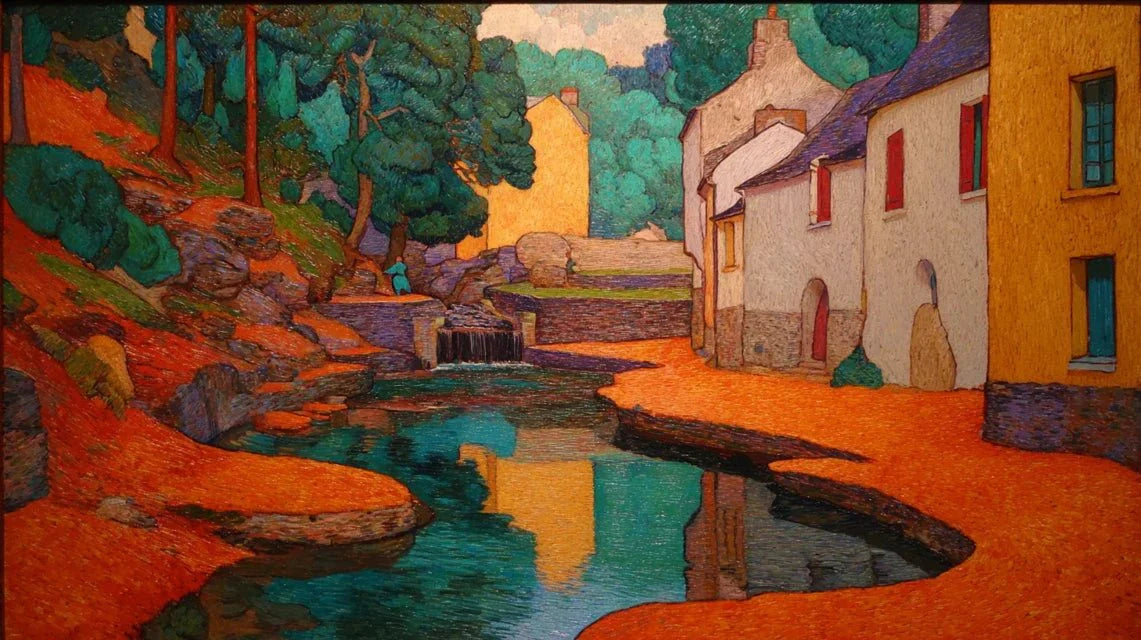
This landscape by Sérusier breaks with all naturalistic fidelity. The trees become bright orange patches, the water transforms into blocks of ultramarine blue, and the foliage explodes in emerald green. The composition favors pure color applied in simplified, almost abstract areas. This synthetic approach liberates landscape painting from the obligation of mimeticism. The painting no longer seeks to reproduce nature, but to translate a visual emotion through the autonomous language of color. Upon returning to Paris, Sérusier presents this revolutionary work to his colleagues at the Académie Julian, who christen it "The Talisman" because of its almost magical power.
Colorist principles applied to Breton landscapes
Sérusier's landscapes painted after this initiation in Pont-Aven bear witness to a systematic application of the color theories. The artist develops a rigorous method based on several fundamental principles. He abandons traditional perspective in favor of construction by superimposed color planes. Colors are no longer modulated by the subtle nuances of chiaroscuro, but affirmed in their maximum intensity.
In his views of the Breton countryside, Sérusier exploits chromatic contrasts to structure space. A field can become carmine red, a sky deep violet, a meadow lemon yellow. These choices are not arbitrary, but stem from theoretical reflection on color harmonies and their emotional impact. The artist is particularly inspired by the color circle and Chevreul's laws of complements. For art lovers seeking to draw inspiration from these pictorial daring feats, contemporary landscape paintings often perpetuate this colorist heritage.
The main elements of Sérusier's color theories are characterized by:
- Simplification of forms into geometric planes delineated by dark rings
- Exaltation of pure color straight from the tube, without any softening mixture
- Search for harmonies based on complements and chromatic analogies
- Rejection of naturalistic light in favor of a symbolic and decorative lighting
- Flattening of space which favors the surface of the painting as a decorative entity
Pont-Aven: A Landscape Experimentation Laboratory
The small Breton port of Pont-Aven becomes for Sérusier much more than just an artistic resort. It is a true experimentation laboratory where landscapes serve as a testing ground for new theories. The region offers ideal motifs: Breton crosses, megaliths, compartmentalized hedges, colorful traditional costumes. These elements lend themselves perfectly to synthetic stylization.Between 1888 and 1891, during his repeated stays in Pont-Aven and then Pouldu, Sérusier multiplied landscapes where he refined his technique. *La Barrière fleurie*, *Paysage au Pouldu*, *Paysage breton* show this evolution towards increasing abstraction. Lines simplify, colors intensify, composition geometrizes. The landscape becomes a pretext for formal research that foreshadows the future developments of modern art.
The Breton environment also influences the spiritual and symbolic dimension of Sérusier's landscapes. Historic and mystical sites nourish his quest for an art that goes beyond simple visual representation to reach an inner, almost mystical truth.The Influence of the Nabis and the Decorative Dimension of Landscape
Upon returning to Paris, Sérusier becomes the main theorist of the Nabis group, sharing the revelations received in Pont-Aven. With Bonnard, Vuillard, Denis and Ranson, he develops a conception of landscape as a decorative surface. Maurice Denis formulates in 1890 the famous principle: "A picture, before being a battlefield, a nude woman or any anecdote, is essentially a flat surface covered with colors assembled in a certain order." Sérusier's landscapes perfectly illustrate this conception. They function as colorful tapestries where each natural element becomes an ornamental motif. The tree is no longer a tree, but a decorative form participating in the overall harmony. This approach profoundly influences early 20th-century decorative painting and prepares for the advent of abstraction. Sérusier pushes this logic to create decorative panels for private interiors, where the landscape becomes an integrated architectural element. The boundary between easel painting and applied art blurs, foreshadowing the research of the Bauhaus and De Stijl.The impact of the color theories developed by Sérusier in Pont-Aven extends far beyond the Nabi movement. His research on pure color and simplification of forms directly influences the emerging Fauvism. Matisse and Derain acknowledge their debt to this chromatic liberation initiated in Brittany.
Sérusier's teaching at the Ranson Academy, then at the Julian Academy, transmits these principles to a new generation. His theoretical writings, notably ABC of Painting published in 1921, codify the discoveries of Pont-Aven into a pedagogical system. He develops a theory of proportions and colored harmonies that nourishes the reflection of abstract artists.
Today, Sérusier's landscapes continue to fascinate with their modernity. Their chromatic boldness, their rejection of naturalism, their decorative dimension resonate with contemporary concerns. They testify to a crucial moment when landscape painting shifts from representation to expression, from imitation to pure creation.
This color revolution initiated in the small Breton village of Pont-Aven has fundamentally transformed our way of conceiving and looking at painted nature, opening up avenues that continue to inspire contemporary creators.
Conclusion
Sérusier's landscapes embody a major artistic revolution born from the fertile encounter between a young painter eager for novelty and the color theories experimented in Pont-Aven. By freeing color from all mimetic constraints, by transforming nature into a decorative surface rhythmized by bold chromatic harmonies, Sérusier opens the way to modern art. His legacy continues to irrigate contemporary creation, reminding us that landscape can be much more than just a window on the world: an autonomous universe where color reigns supreme.
Frequently Asked Questions
What is Sérusier's Talisman?
The Talisman is a small landscape painted by Sérusier in October 1888 in the Bois d'Amour near Pont-Aven, under Gauguin's advice. This revolutionary work uses pure and intense colors applied in flat areas, breaking with naturalism. It synthesizes the color theories that will become the foundation of the Nabi movement and has profoundly influenced modern art.
What are Sérusier's color theories?
Sérusier's color theories are based on the use of pure and intense colors, simplification of forms into geometric blocks, rejection of traditional perspective, and exploitation of chromatic contrasts. He draws inspiration from the color wheel and the laws of complements to create emotional harmonies rather than naturalistic representations of landscape.
Why was Pont-Aven important for Sérusier?
Pont-Aven was the place of Sérusier's artistic revelation during his meeting with Gauguin in 1888. This Breton village became his laboratory of experimentation where he applied and developed color theories. The Breton landscapes, with their simplified forms and spiritual dimension, offered an ideal ground for his research on colour and formal synthesis.