Imagine yourself pushing the heavy doors of a Venetian salon in the 18th century. Your eyes fall on a wall where a stunning architectural landscape unfolds: a Roman temple borders a Gothic church, ancient arches intertwine with medieval towers, all topped by dramatic skies that never existed. You have just entered the fascinating universe of capriccio, these impossible architectural paintings that glorified Italian palaces.
Here's what a capriccio brings to your spaces: a window into impossible worlds that transcend reality, a captivating artistic conversation that impresses your guests, and a historical sophistication that anchors your decor in the great European tradition. These dreamlike compositions where the rules of perspective and logic fade before pure imagination transform any room into an aristocratic cabinet of curiosities.
You like landscapes, but realistic views seem flat, predictable. Classic compositions lack that strangeness that captivates the eye. You are looking for this sophistication that tells a story, which invites mental travel rather than simple passive contemplation.
The good news? The capriccio offers exactly this rare alchemy between architectural erudition and unbridled fantasy. These paintings that adorned the most beautiful Venetian and Roman palazzos now bring the same timeless magic to our contemporary interiors.
In this article, I take you into the workshops of Venetian masters to understand how these impossible architectural landscapes were born, why they conquered European aristocracy, and above all how their visionary aesthetics can transform your current decor.
The birth of a genre: when Venice reinvents landscape
At the beginning of the 18th century, Venice still shines as an artistic capital. Vedutisti – these painters of precise urban views – enjoy great success with Grand Tour aristocrats. But some visionary artists go further. Rather than faithfully reproducing reality, they decide to reinvent it.
The term capriccio itself – which means “whim” in Italian – reveals the essence of the genre: total freedom from the constraints of reality. These painters draw on their encyclopedic knowledge of ancient, medieval and Renaissance architecture to create impossible assemblages. A Roman triumphal arch rises in the middle of a Venetian square. Greek ruins rise near a Gothic bell tower. Historical and geographical logic gives way to pure visual pleasure.
Giovanni Paolo Panini in Rome and Francesco Guardi in Venice are among the undisputed masters of capriccio. Their compositions mix with astonishing audacity monuments that could never have coexisted. The effect is hypnotic: the eye recognizes familiar elements – a Corinthian portico, a gondola, ancient statues – but their arrangement defies all plausibility.
The anatomy of an impossible landscape
How to construct a world that doesn't exist while maintaining visual credibility? That is the genius of the capriccio. These paintings are not delirious fantasies: they obey a precise grammar.
Architecture as vocabulary
The painters of capricci possessed an encyclopedic knowledge of architectural styles. They tirelessly sketched Roman ruins, Venetian churches, Renaissance palaces. Each element of their imaginary compositions comes from a real observation, meticulously studied. It is this archaeological rigor that gives credibility to the most daring assemblages.
Perspective as mastered illusion
The capriccio plays with the rules of linear perspective established during the Renaissance. Painters create optically coherent spaces even when their content defies logic. Perspective lines converge perfectly, the scale of human figures gives a convincing sense of depth. The eye accepts the impossible because the technique is impeccable.
Dramatic light
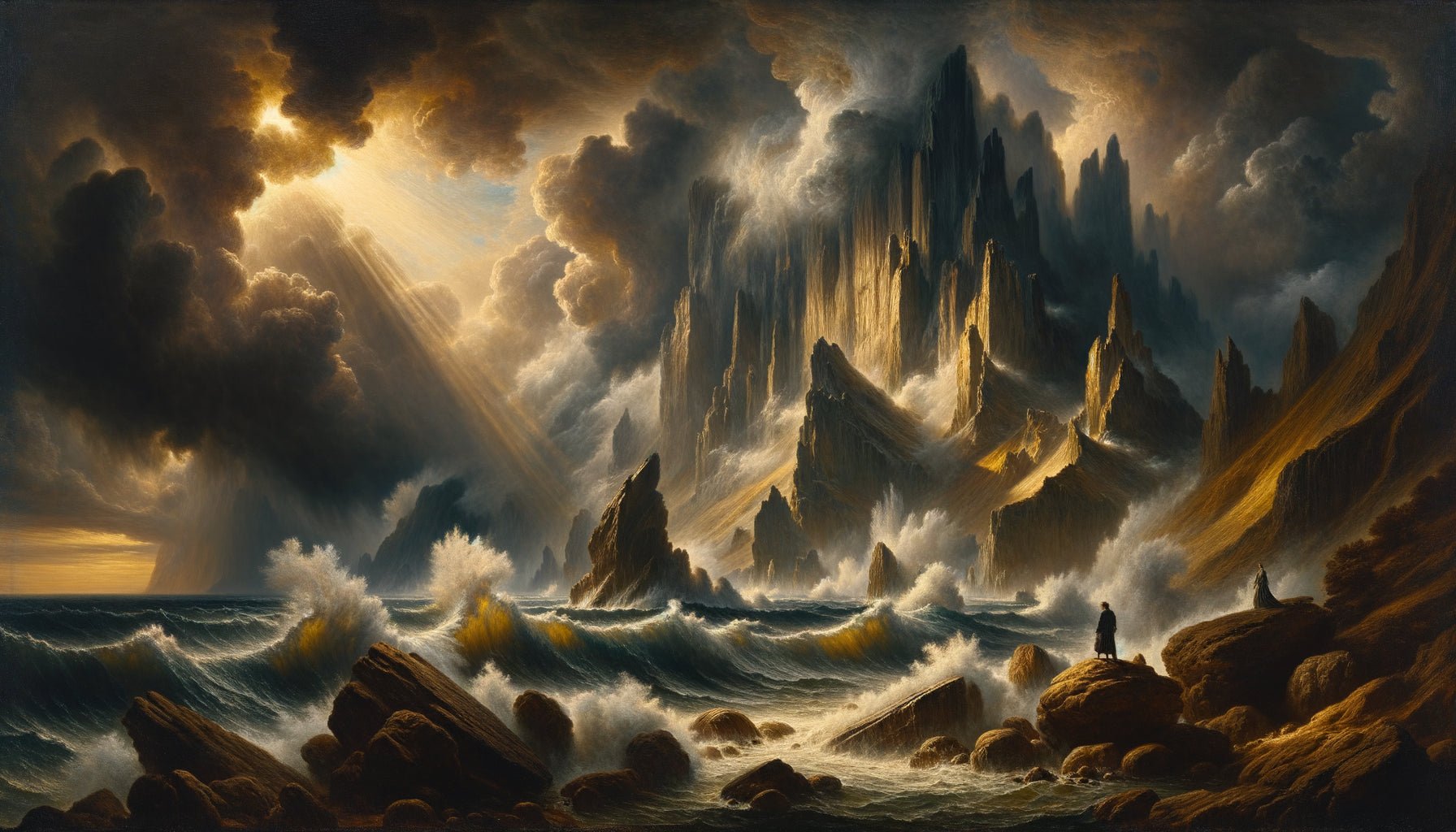
Stormy skies, theatrical games of light and shadow constitute the signature of the genre. These architectural landscapes are often bathed in twilight atmospheres, impending storms, unreal golden lights. This meteorological dramatization accentuates the dreamlike character of the scenes.

Discover this inspiring work
Why European aristocracy embraced it
The capricci were not mere wall decorations. They constituted powerful social markers. Owning such a work signaled several things to your visitors.
First, your erudition. Recognizing the different monuments mixed in a capriccio required an in-depth architectural culture, acquired during the Grand Tour – this initiatory journey in Italy reserved for the elite. Commenting on the presence of the Pantheon near the Rialto Bridge demonstrated your familiarity with major European sites.
Next, your refinement. Preferring these sophisticated compositions to simple realistic landscapes distinguished you from the ordinary. The capriccio represented a form of intellectual art, which valued creative imagination rather than mere copying of reality.
Finally, your cosmopolitanism. These paintings condensed the essence of European architectural heritage into a single painting. They transformed your living room into a kind of imaginary museum, a visual compendium of Western civilization's heritage.
Venetian palaces, Parisian townhouses, English country houses were adorned with these impossible landscapes which served as supports for cultivated conversation. Monuments depicted were debated, the boldness of juxtapositions was admired, and the relationship between art and reality was philosophized.
The magic of capriccio in our modern interiors
Three centuries later, these impossible architectural landscapes have lost none of their fascinating power. On the contrary: in the age of manipulated digital images, their analogue poetry acquires an almost subversive dimension.
In a contemporary living room, a capriccio immediately creates a narrative depth. Unlike abstraction or even realistic landscape, it tells a story – or rather, suggests a thousand. The eye travels between architectures, inventing narratives, connections, intertwined temporalities.
The effect works particularly well in spaces that mix eras. An industrial loft with exposed beams finds an unexpected echo in a capriccio: both play on historical accumulation, the dialogue between time strata. A classic Haussmannian apartment receives a welcome injection of fantasy that dusts off its potential academicism.
The color palette of capricci – these warm ochres, these atmospheric grey blues, these patinated greens – naturally integrates into sophisticated interiors. These aged tones bring a softness that pleasantly contrasts with the pristine white of contemporary walls or the coolness of polished concrete.

Discover this inspiring work
Compose your own decorative capriccio
The spirit of the capriccio is not limited to hanging a reproduction. It's about adopting a decorative philosophy: the art of bold mixing, unexpected juxtaposition, and erudition carried with lightness.
Think of your wall as these impossible landscapes. Rather than a homogeneous collection, dare to create unlikely dialogues: a Venetian capriccio next to a contemporary photograph of brutalist architecture. Eras converse, styles respond to each other. That's exactly what Panini and Guardi did with the monuments.
Framing plays a crucial role. A classic gold frame anchors the capriccio in its historical tradition while creating a striking contrast with a minimalist environment. This visual shock amplifies the dreamlike dimension of the work – it literally becomes a window to another time.
Lighting deserves special attention. These architectural landscapes from the 18th century were designed to be seen by candlelight, creating moving shadow plays on the painted architectures. Indirect, slightly subdued lighting restores this mysterious atmosphere much better than a direct spotlight.
Transform your walls into timeless architectural journeys
Discover our exclusive collection of landscape paintings that capture the magic of impossible and sophisticated compositions.
The visionary legacy of the capriccio
What makes the capriccio so contemporary is its fundamentally postmodern nature, avant la lettre. Two centuries before architects theorized pastiche and quotation, Venetian painters were already practicing this learned game with historical references.
Their lesson remains valuable: visual culture is not passively inherited, it is reinvented. Monuments of the past are not untouchable relics but materials for building new visions. This creative freedom in relation to heritage may be the most current message of the capriccio.
In our interiors saturated with ephemeral digital images, these impossible landscapes painted in oil offer a meditative permanence. They slow down the gaze, invite prolonged contemplation. Each observation reveals an additional architectural detail, a new subtlety of light. It's the perfect antidote to frenetic visual consumption.
The capriccio also reminds us that beauty does not necessarily have to imitate reality to touch us. Sometimes it is precisely the impossibility that liberates the imagination. These architectures that could never stand, these geographies that defy all logic offer us a mental space of pure freedom – exactly what our interiors need.
Your window to the impossible
Imagine entering your home tonight, your gaze falling upon this impossible architectural landscape freshly hung. Roman arches coexist with Venetian campaniles in a golden light that never existed. Your guests stop, intrigued. Conversations begin: "Where is this place?" "Nowhere and everywhere," you reply with a smile.
The capriccio transforms your wall into a permanent invitation to mental travel, a starting point for a thousand cultivated conversations. It anchors your interior in a centuries-old artistic tradition while giving it timeless sophistication.
Start simply: choose a wall that deserves an impossible destination, a space that calls for architectural dreaming. Let these visionary 18th-century painters open a window to their impossible worlds. Your interior will never be quite the same.
FAQ: Everything you need to know about the Capriccio
What is the difference between a capriccio and a veduta?
Excellent question that touches on the heart of the genre! The veduta is a topographically accurate view of a real place – think of Canaletto's famous views of Venice where every palace, every bridge is faithfully represented. The capriccio, on the other hand, is a free composition that mixes real architectural elements in imaginary arrangements. It’s the difference between a photograph and a creative montage: both use real elements, but only the capriccio allows itself to rearrange them according to the artist's fancy. Some painters like Francesco Guardi excelled in both genres, which allowed them to better subvert reality in their capricci – they knew perfectly well the rules they were breaking. For your decoration, the capriccio offers a richer conversation because it intrigues more: the eye recognizes familiar elements but their assembly questions and fascinates.
How to integrate a capriccio into a modern interior without creating a mismatch?
The capriccio integrates wonderfully into contemporary interiors precisely because it already plays on anachronism and juxtaposition! The key lies in balancing contrasts. In a minimalist space with clean lines, a richly detailed capriccio creates a fascinating focal point without weighing it down – think of it as a narrative window in a restrained environment. Framing makes all the difference: a thin, discreet frame modernizes the presentation, while a traditional gold frame fully embraces the dialogue between eras. When it comes to placement, prioritize stone walls, exposed brick or even bare concrete: the contrast between ancient material and classic painting works beautifully. Avoid surrounding it with other classical artworks – let it breathe, converse with the modern void. Finally, indirect lighting (wall lamps rather than spotlights) restores the original contemplative atmosphere. The capriccio doesn't need an antique setting to shine; its narrative richness is enough to justify its presence in any style.
Are capricci solely Italian and from the 18th century?
While architectural capriccio indeed finds its most famous masters in 18th-century Italy – particularly Venice and Rome – the genre quickly spread throughout Europe and experienced remarkable longevity. In France, Hubert Robert created sumptuous capricci of imaginary ruins that still adorn major museums today. Northern painters like the Flemish developed their own version of the genre as early as the 17th century. And the spirit of the capriccio – this freedom to rearrange architectural reality – continues to inspire contemporary artists, particularly in photography and digital art today. What makes this genre so perennial is that it responds to a universal human desire: to transcend the limits of reality to create ideal or fantastical worlds. So if you're looking for a capriccio for your interior, don't limit yourself to Venetian masters alone: explore French, Flemish variations, or even contemporary interpretations that revisit the spirit of the genre with modern means. The important thing is this alchemy between architectural precision and imaginative freedom that defines the authentic capriccio.