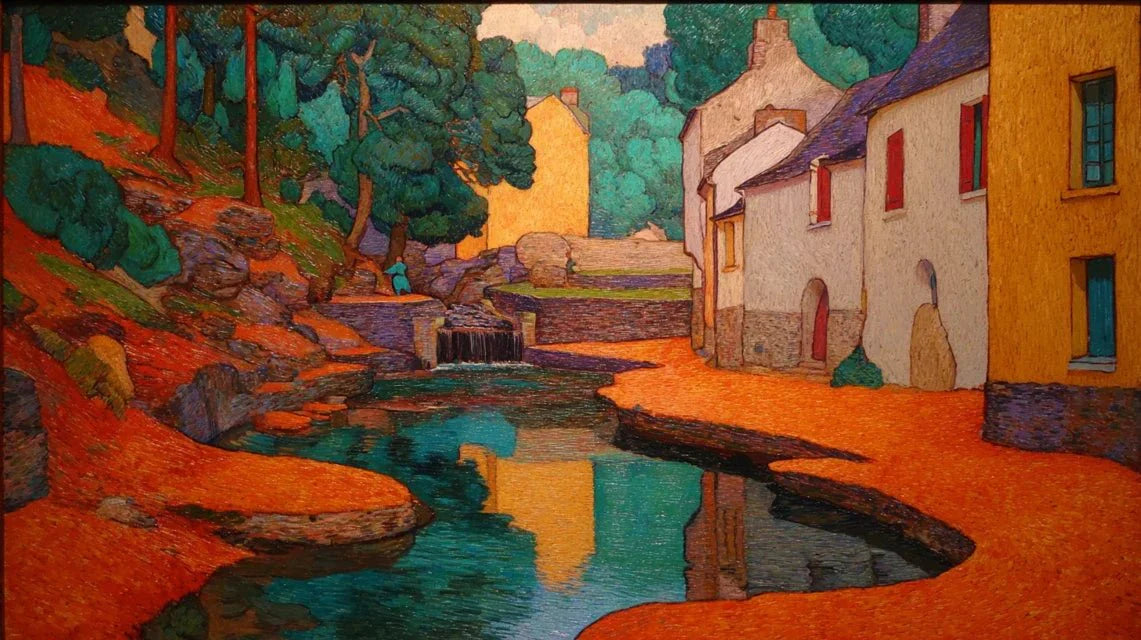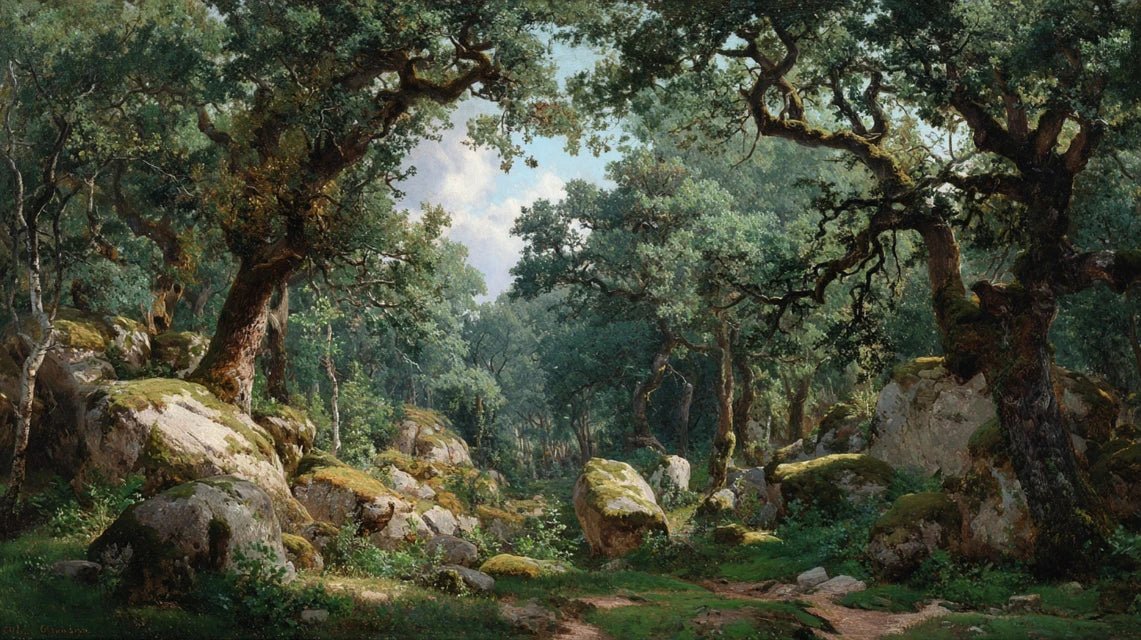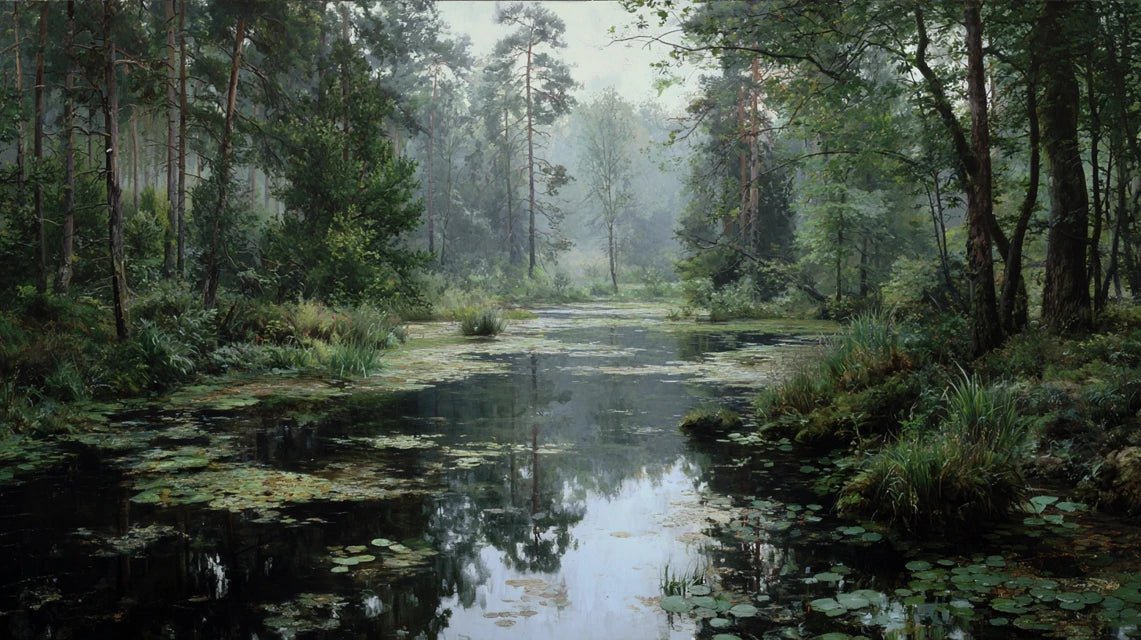
Peat bogs and marshes have fascinated artists for centuries with their mysterious atmosphere and melancholic beauty. These humid landscapes, often shrouded in mist, offer a palette of muted and subtle colors that defy traditional pictorial conventions. Between stagnant waters, dense vegetation, and diffused light, the artistic representation of wetlands is a technically demanding exercise that reveals the creator's sensitivity. From Nordic romanticism to contemporary interpretations, marshes in painting embody both contemplative solitude and a wild, untamed nature. Let us discover how artists capture the essence of these unique aquatic territories.
The specific color palette for marsh landscapes
The representation of peat bogs requires artists to have a particular mastery of neutral tones and subtle nuances. Marsh landscapes are characterized by a predominance of olive greens, earthy browns, and bluish grays that create a unique atmosphere. Painters primarily work with desaturated colors, far from the vibrant hues of Mediterranean landscapes.
Reflections in the water pose a major challenge: they require careful observation of variations in light and mirror effects on the stagnant surface. Artists often use superimposed glazes to restore the troubled depth of these waters laden with organic matter. The specific vegetation – reeds, sedges, sphagnum moss – also requires particular attention to rendering textures.
For collectors looking to enrich their decorative universe, wall art depicting these wetlands brings a touch of melancholic serenity to contemporary interiors. These works invite contemplation and create a soothing atmosphere in living spaces.
Pictorial techniques adapted to humid atmospheres
Painting of peat bogs requires specific technical approaches to translate the ambient humidity and characteristic mist of these environments. Artists often favor the technique of sfumato, which consists of blurring contours to create vaporous transitions between planes. This method, inherited from the Renaissance, is particularly effective in rendering the water-saturated atmosphere of marshes.
Watercolor naturally finds its place in the representation of wetlands, its fluidity perfectly echoing the aquatic character of the subject. Successive washes allow to gradually construct the atmospheric depth typical of these landscapes. In oils, artists work in translucent layers, creating veils of paint that evoke the morning mist floating above dormant waters.
Mixed techniques are also gaining popularity, combining drawing, painting and sometimes collage to restore the textural richness of marsh vegetation and the visual complexity of these particular ecosystems.
The legacy of Nordic masters in the representation of peat bogs
Nordic painters indelibly marked the art of bog landscapes with their contemplative approach and sensitivity to diffused light. Dutch Golden Age artists, confronted daily with the marshy landscapes of their territory, developed a remarkable expertise in rendering the low skies and flat horizons characteristic of these regions.
Jacob van Ruisdael excelled in the representation of marshes, capturing the drama of threatening clouds above waterlogged lands. 19th-century Scandinavian painters continued this tradition, imbuing their painted bogs with a romantic and sometimes melancholic dimension.
This Nordic tradition still influences contemporary artists who explore these wetlands today. Their works perpetuate a look imbued with respect for these fragile ecosystems, while developing renewed aesthetic approaches that dialogue with current environmental concerns.
The artistic symbolism of marsh landscapes
Beyond their purely aesthetic dimension, representations of bogs and marshes carry a profound symbolic charge in the history of art. These boundary landscapes, between land and water, traditionally embody spaces of transition, transformation, or even ambiguity. Romantic artists saw in them a reflection of melancholic states of mind and inner turmoil.
Marshes in art can evoke:
- Contemplative solitude and withdrawal from the world
- The fragility of ecosystems and ecological awareness
- Mystery and dreamlike atmosphere
- The memory of forgotten territories
- The austere beauty of marginal landscapes
In contemporary art, the representation of wetlands often takes on a documentary and militant dimension, alerting to the progressive disappearance of these essential biotopes. Artists thus become witnesses and guardians of threatened nature, transforming their canvases into silent manifestos for environmental preservation.
The challenges of composition in wetland landscapes
Composing a successful bog painting represents a stimulating artistic challenge, as these marshy landscapes are characterized by their horizontality and apparent monotony. The artist must create visual interest in an environment often lacking obvious focal points. The low horizon line, typical of these representations, accentuates the importance of the sky which generally occupies two-thirds of the composition.
Artists play with verticals – dead tree trunks, reeds, reflections – to break up the dominant horizontality and create rhythm in the composition. The balance between detailed areas and blurred spaces guides the viewer's gaze through the marsh landscape. Depth is achieved by superimposing successive planes that gradually fade into the mist.
Managing negative space becomes crucial: areas of calm water, misty veils, uniform skies are not voids but essential breaths for the balance of the work. This economy of means paradoxically brings 'swamp art' closer to certain principles of traditional Asian painting, where emptiness fully participates in the composition.
Conclusion
The artistic representation of swamps and marshes constitutes a genre in its own right, requiring sensitivity, technicality and depth of vision. These wetland landscapes offer artists an inexhaustible field of exploration where subtle chromaticism and contemplative atmosphere combine to create works imbued with poetry. Whether they are rooted in Nordic tradition or explore contemporary paths, creators dedicated to these aquatic territories invite us to take a renewed look at these fragile ecosystems and their unique beauty.
Frequently Asked Questions
What colors dominate in paintings of bogs?
Bogs are characterized by a palette of neutral and desaturated tones: olive greens, earthy browns, bluish grays and muted ochres. These colors evoke the ambient humidity and create a melancholic atmosphere. Artists rarely use bright hues, preferring subtle nuances that translate diffuse light and troubled reflections in stagnant water.
Which painting technique is best suited to marsh landscapes?
Watercolor and oil glazing are particularly well-suited to marshes. These techniques allow for the creation of transparencies and superimpositions evoking mist and humidity. Sfumato, which softens contours, perfectly reproduces the vaporous atmosphere. Mixed techniques are also gaining popularity to render the textural richness of vegetation in wetlands.
Why are artists attracted to bog landscapes?
Bogs offer a unique atmosphere conducive to artistic expression: mystery, melancholy, contemplative solitude. These borderlands between land and water embody spaces of transition rich in symbolism. Today, they also allow artists to raise awareness of the fragility of these threatened ecosystems, adding an ecological dimension to their creative approach.