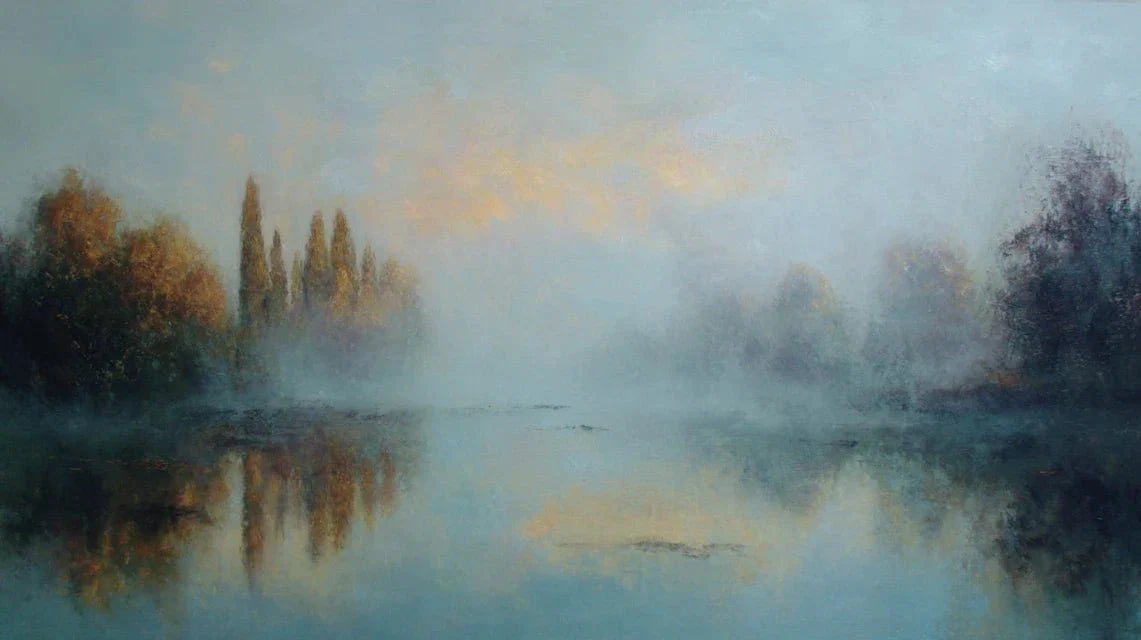
Imagine facing your canvas, on an October morning. Through the window, the valley disappears beneath a veil of mist. How to capture this fleeting atmosphere, this moment when nature hesitates between revelation and mystery? Painting the morning mist means accepting the intangible, making technique and emotion converse. This artistic quest blends landscape painting and exploration of atmospheric effects.
Painting techniques to reproduce the morning mist
Let's start with the fundamental gesture: a dry brush. Imagine skimming your canvas as you would caress a water surface. These light touches create the blur that signifies the mist. The secret? Use zinc white rather than classic titanium. Its natural transparency perfectly imitates the suspended water vapor in the air. If you don't have any, dilute your titanium white with painting medium until you achieve this same lightness.
Wet-on-wet technique changes everything. Mix fast-drying alkyd oils with your traditional oils. After about an hour, you can already layer them. It’s like building the mist in successive layers, each stratum adding atmospheric depth to your landscape painting.
Watercolor tells another story for painting fog. First moisten your paper, then let the pigments dance on the surface. The colors diffuse by themselves, creating those soft transitions that make all the magic of the mist. Favor cool tones: cobalt blue for the fresh dawn, Payne's gray for denser areas, Naples beige for those moments when diffused light begins to break through.
Looking for inspiration for your misty landscapes? Our collection of landscape paintings captures these morning atmospheres with accuracy.
The palette can remain minimalist. Three colors are sometimes enough: yellow ochre, burnt sienna, cobalt blue. Add black and white. This economy of means paradoxically reinforces the atmosphere. The contrast between warm and cool values gives structure to the composition without breaking the harmony of the misty veil.
Essential tools for painting the morning mist
- Soft-bristled brushes for light, vaporous touches
- Zinc white for its natural transparency
- Alkyd oils for fast drying
- Painting medium for glazes
- Sponges and cloths for texture effects
Morning mist and symbolism in pictorial art
The mist carries centuries of meanings within it. In ancient China, it embodied the vital breath of the universe. Painters of the Song dynasty could not conceive of a landscape without it. Guo Xi wrote that a mountain without mist lacks elegance, like a body deprived of its blood. For them, the mist was the landscape's spiritual glow, its invisible but essential dimension.
The West developed a different but equally rich vision. In the Bible, God speaks to Moses from within the thickness of the cloud. The mist then becomes the veil between the divine and the human. 19th-century Romantics exploited this idea, making the mist the territory of the unknown, that space where the visible turns into the invisible.
Mist also speaks of fragility. It reminds us that everything passes, that nothing lasts. This melancholic dimension runs through Symbolist art: in their paintings, the mist envelops landscapes with a timeless nostalgia, like a sigh from nature itself.
Glazing and transparency techniques for morning mist
Glazing is the key technique for mist. Imagine applying a transparent veil over your already painted landscape. This thin layer of diluted titanium white or cobalt blue transforms everything. Suddenly, your scene shifts into that particular misty atmosphere so characteristic of foggy mornings.
Scumbling complements the effect. Apply a thin film of paint and then remove the excess with a cloth. The movements remain light, almost hesitant. This approach creates a random texture, as if the mist had settled on the canvas itself.
Sfumato, inherited from Leonardo da Vinci, finds its full meaning here. Mix your colors in soft touches. Erase the edges with a cloth. The shapes blend into one another, creating those imperceptible transitions that create the magic of misty landscapes.
Sponges and cloths become your allies. Gently dab the surface to create areas of varying density. Here the mist thickens, there it dissipates. Your painting breathes, lives, changes like real mist gliding over the hills with the wind.
The symbolism of morning mist in Impressionist masters
Turner changed everything in Impressionist art. In his views of the misty Thames, forms dissolve into light. He doesn't paint the mist, he paints with it, transforming it into pure pictorial matter. His paintings anticipate Impressionism with their chromatic boldness and rejection of detail.
Then comes Monet. *Impression, soleil levant* (1872) captures the port of Le Havre drowned in mist. This painting will give its name to a whole movement. Monet seizes the exact moment when the sun pierces the humid veil. A few touches suffice: ghostly boats, orange reflections on the water, the fleeting impression of a world suspended.
Between 1899 and 1901, Monet obsessively revisits the misty Thames. He multiplies canvases, seeking to capture each variation of diffused light, every atmospheric nuance. This serial approach reveals a true scientific quest: how does mist change our perception at every moment of the day?
The story comes full circle: during his stay in London in 1871, Monet discovered Turner's mists. This posthumous encounter shakes up his vision. The lessons of the English master will now guide his exploration of atmospheric phenomena, transforming mist into a major pictorial subject of Impressionism.
FAQ: Painting morning mist
What is the best technique to start painting morning mist?
To begin, prioritize the dry oil brush or wet-on-wet watercolor technique. These approaches are accessible and quickly yield convincing results. Start with a simple palette of three cool colors and work in light strokes.
Why is fog such an important subject in Impressionist art?
Fog perfectly embodies the Impressionist philosophy: capturing the ephemeral and changing effects of light. Turner and Monet made fog a major subject because it allows exploring the dissolution of forms in the atmosphere and the relativity of visual perception.
What is the difference between painting mist with oil and watercolor?
Oil allows working in successive layers with glazes and offers more control over transitions. Watercolor creates more spontaneous and airy effects thanks to the natural diffusion of pigments. Each medium brings its own sensitivity to the representation of fog.