Imagine yourself before The Traveler contemplating a sea of clouds. A solitary man, perched on a rock, hair blowing in the wind. Before him stretches an impenetrable ocean of mist. This iconic image alone sums up what the 19th century brought to mountain painting: a revolution in perspective.
Before this period, the Alps inspired mainly fear. But between 1800 and 1900, something shifts. Swiss and German painters transform these dreaded peaks into natural cathedrals. The mountain becomes the setting for a spiritual quest, a mirror of the human soul.
Swiss Masters of Mountain Landscape Painting in the 19th Century
In Geneva, two names dominate the scene: François Diday and his student Alexandre Calame. Their story begins modestly. Calame loses an eye in childhood and works as a bank clerk to support his widowed mother. But banker Diodati recognizes his talent and finances his lessons with Diday.
The turning point comes in 1839. Calame presents Storm at the Handeck at the Louvre Salon. The painting creates a sensation. It depicts a raging torrent, monumental rocks, a dramatic light piercing the clouds. This is the birth of what Geneva critics call a "national painting".
His method? Every summer, Calame goes to the Bernese Oberland with his sketchbook. He draws from life, capturing details: the texture of a rock, the movement of a waterfall, the precise angle of a pine tree twisted by the wind. Back in his studio, he composes his large canvases. The result: more than 400 monumental paintings (Source: Valentina Anker, Geneva art historian), 250 watercolors, 670 drawings.
Collectors snap them up. The Russian imperial family commissions his works. King Louis-Philippe buys his canvases. Why such success? Because Calame does not simply reproduce the mountain: he reveals its soul. His compositions always combine three elements:
- Majestic pines in the foreground that anchor the composition
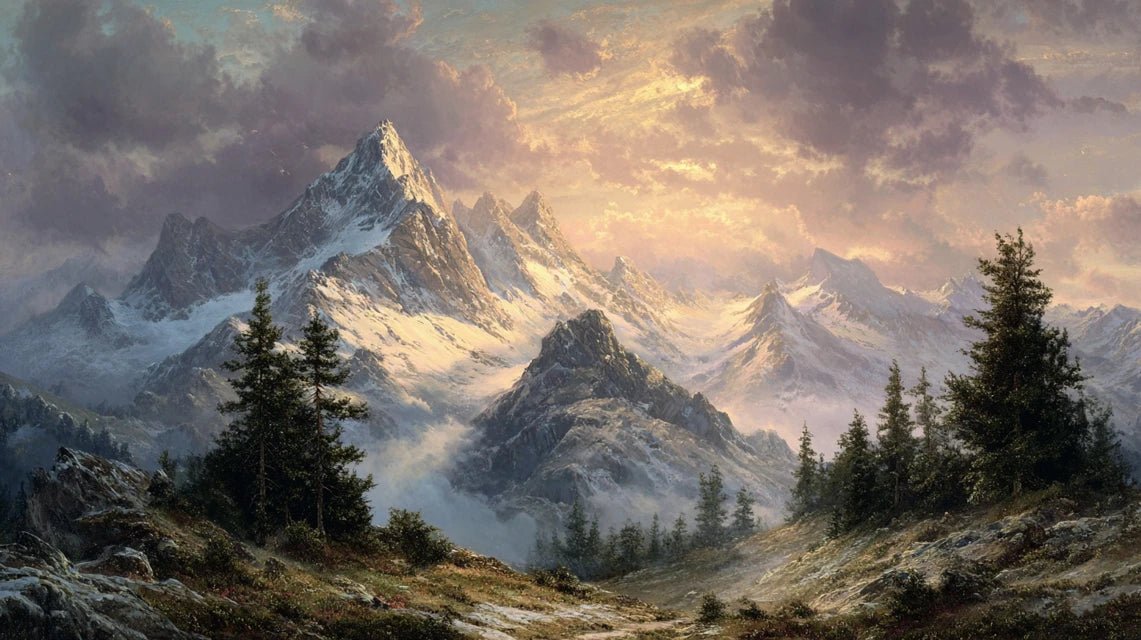
- Snowy peaks with angular silhouettes forming a dramatic background
- A light that sculpts the landscape and creates striking contrasts
François Diday, his master, develops a complementary approach. More dramatic, more spectacular. Between these two friendly rivals, the Geneva school invents a new visual language for the Alps. If you are looking to recapture this power of wall art landscapes in your interior, this tradition offers fascinating perspectives.
Caspar David Friedrich and the German Romantic Mountain
1,200 kilometers from Geneva, in Dresden, another painter revolutionizes landscape art. Caspar David Friedrich did not have an easy life. At seven years old, he loses his mother. At thirteen, he sees his brother drown under the ice while trying to save him. These traumas permeate all of his work.
Friedrich paints the mountain differently. Where Calame seeks realistic detail, he seeks pure emotion. His peaks emerge from mysterious mists. His skies are tormented. His characters appear tiny, often from behind, contemplating immensity.
His philosophy? "The painter must represent not only what he sees before him, but what he sees within himself." Each mountain becomes a symbol. The unknown. Transcendence. The solitude of man facing infinity.
Take
His techniques are clearly distinct:
- Figures silhouetted against dramatic skies, creating a sense of mystery and introspection
- Extreme reduction of human scale to emphasize the immensity of nature
- Bare trees and ruins symbolizing mortality and the passage of time
- Purified palette playing on contrasts of light and shadow
Friedrich achieves international fame during his lifetime. Then comes oblivion. It takes until the 1970s for his genius to be fully recognized. Today, he embodies German Romanticism and still influences contemporary landscape photography.
Pictorial techniques of Swiss and German mountain landscapes
How do you paint a mountain? The question may seem simple, but the answers differ radically.
On the Swiss side, Calame adopts the approach of 17th-century Dutch masters. In 1838, he traveled to the Netherlands to study Jacob van Ruisdael and Meindert Hobbema. He discovered their secret: a meticulous rendering of details combined with skillful plays of light and shadow.
Imagine one of his views of Lake Brienz. In the foreground, rocky blocks capture the sunlight. Every crevice is visible, every color variation rendered with precision. In the background, the green of the pastures contrasts with the clear blue of the lake. In the distance, snow-capped peaks blend into a delicate mist. Three planes perfectly orchestrated to create a striking depth.
Calame doesn't limit himself to painting. He also masters etching, a copper engraving technique. Between 1838 and 1845, he produced three series of prints of exceptional virtuosity. In these engravings, he must abandon color. So be it: he plays on contrasts of black, gray and white with a mastery that recalls Rembrandt. These engravings widely disseminate his art, making his compositions accessible to a much larger audience.
Friedrich, on the other hand, simplifies. No superfluous details. His mountains do not seek photographic realism but emotional intensity. He works in broad strokes, creates hazy atmospheres, uses skies with unreal colors. Some of his works appear almost abstract – an amazing modernity for the time.
This divergence of approach considerably enriches the 19th-century alpine representation. Between Swiss precision and German introspection, the mountain becomes a major artistic experimentation ground.
The reciprocal influence between Swiss and German painters of the 19th century
Art knows no borders. In 1838, Calame crossed Germany and discovered the Düsseldorf school. He became an ardent admirer. Artists circulate, exchange, and inspire each other.
This influence crosses the Atlantic. American painters travel to Europe to study. Albert Bierstadt visits Switzerland several times before tackling the Rockies. He draws direct inspiration from Calame for his grand American panoramas. Thomas Cole, Frederic Edwin Church, John Singer Sargent follow the same path. For them, the Alps constitute an indispensable school before painting their own continent.
The influence extends to Russia. In 1820, the future Tsar Nicholas I visits Friedrich's studio in Dresden. In the 1870s, the Vasnetsov brothers study and meticulously copy Calame’s works. A transnational network is woven around alpine art.
The phenomenon takes on a surprising scale. In the 19th century, 116 regions worldwide (Source: Cairn Info, Revue d'histoire moderne et contemporaine) adopt the label "Switzerland". Normandy Switzerland in France. Saxon Switzerland in Germany. Bohemian Switzerland in Czechia. Everywhere, there is a search to find locally this alpine beauty that has become a universal reference.
This dissemination reveals the considerable impact of Calame, Diday, Friedrich and their contemporaries. They did not only paint mountains: they created an aesthetic archetype that transcends borders. The Alps become the very symbol of beautiful nature, the benchmark against which every grand landscape is measured.
FAQ: Mountain landscapes in Swiss and German art
Q1: What is the main difference between 19th-century Swiss and German landscape painters?
Swiss painters like Alexandre Calame favor meticulous realism inspired by Dutch masters, with extreme attention to natural details. German artists like Caspar David Friedrich adopt a more symbolic and introspective approach, where the mountain becomes a mirror of the human soul and romantic sublimity.
Q2: Why is Alexandre Calame considered the master of Swiss alpine landscape?
Calame revolutionizes alpine painting in 1839 with his painting Storm at the Handeck, awarded at the Louvre Salon. He produces more than 400 monumental paintings and develops a technique that combines direct observation on site and masterful composition in the studio. His international renown and the influence he exerts on American and Russian painters make him the essential reference of the genre.
Q3: How did the works of these painters spread beyond Europe?
The diffusion occurs through several channels: Calame’s engravings and etchings make his compositions accessible to a wide audience, international exhibitions (Paris, Berlin, London) attract collectors and artists from all over the world, and American painters like Bierstadt visit the Alps before transposing these techniques to the Rockies. In the 19th century, 116 regions worldwide even adopt the label "Switzerland", testifying to this global influence.