The landscapes of Catalonia possess something unique. Between the Mediterranean and the Pyrenees, this northeastern Spanish region reveals almost lunar scenery, sculpted by the tramontane, that violent wind which sweeps everything before it. It was in these harsh lands that Salvador Dalí found inspiration for his entire life. Born in Figueres in 1904, the painter never really left his native Catalonia. Every rock, every bay, every geological formation became raw material for his hallucinatory canvases.
Catalan landscapes transformed into surreal visions by Dalí
Dalí's genius? To transform reality into a waking dream without ever losing geographical anchoring. Take The Persistence of Memory (1931), his most famous painting. In the background, one recognizes the golden cliffs of Port Lligat, bathed in authentic Mediterranean light. But in the foreground, these famous melting clocks defy all logic. This coexistence between a recognizable Catalan landscape and surreal elements creates a fascinating visual tension.
The rocks of Cap de Creus become under his brush organic sculptures with ambiguous shapes. Dalí declared: "This country is my permanent inspiration. I am inseparable from this sky, this sea, these rocks." The granite formations of Cap de Creus, shaped by the tramontane, already possessed a natural surreal dimension. The artist only had to reinterpret them.
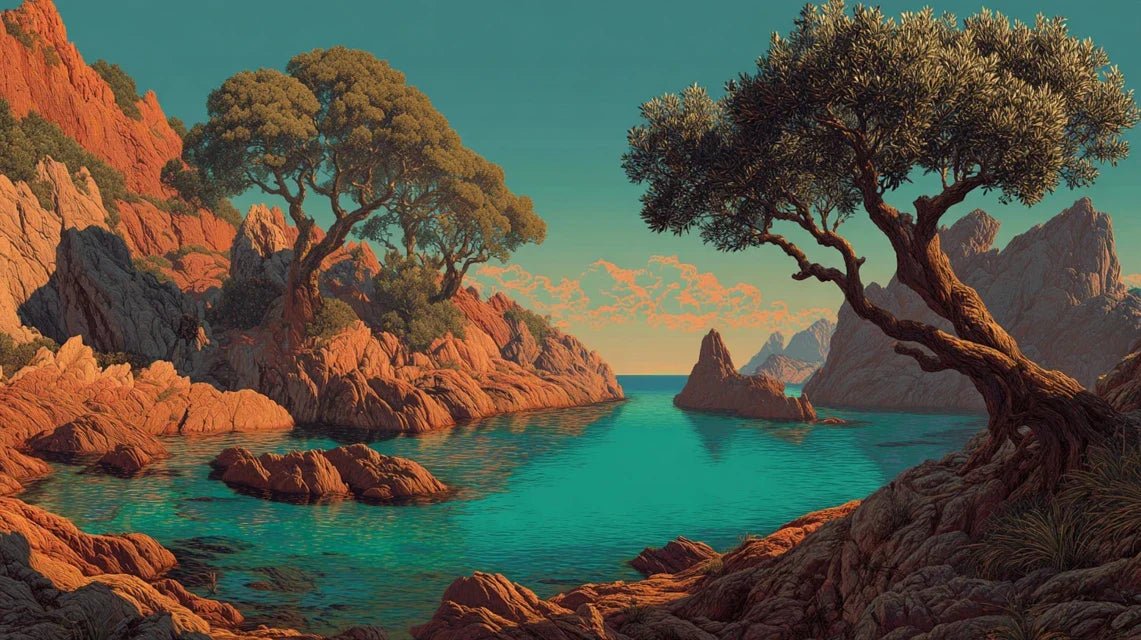
The white village of Cadaqués appears fragmented in several of his compositions. Dalí deconstructs traditional architecture to recombine it according to a mental geometry. Coves with crystalline waters become liquid mirrors reflecting parallel realities. This collection of landscape paintings shows how contemporary artists perpetuate this tradition of reinterpreting natural territories.
Cap de Creus and Port Lligat: geological metamorphoses in Dalí's landscapes
Cap de Creus, the first maritime and terrestrial natural park in Catalonia, constitutes the geographical epicenter of Dalí's imagination. Its metamorphic rocks, millions of years old, present twisted strata, folded by tectonic movements. These natural geological deformations fascinate Dalí. He sees them as a frozen organic metamorphosis in stone.
In Port Lligat, a small fishing hamlet one kilometer from Cadaqués, Dalí installs his artist's studio in 1930. The sheltered bay offers a panorama of rocks with almost human shapes. These mineral silhouettes appear in The Great Masturbator (1929) and The Enigma of Desire (1929). The painter literally transposes the topography into anatomy. Cliffs become bodies, cavities orifices.
Here's how this geological metamorphosis takes place:
- Eroded rocks transformed into faces and humanoid figures
- Horizontal strata becoming superimposed planes of reality
- Isolated coves metamorphosed into mental theaters
- Marine horizon used as a demarcation line between conscious and unconscious
The specific light of the Costa Brava plays a crucial role. With its 300 days of sunshine per year (Source: Catalunya Tourism Board), it creates dramatic contrasts that Dalí masterfully exploits. Shadows cast on the rocks change their appearance according to the hours. The artist incorporates this phenomenon into his famous paranoid-critical method.
Techniques of metamorphosis: how Dalí transforms Catalan nature
The paranoid-critical method developed by Dalí is his main tool for visual metamorphosis. The principle? To see several images simultaneously in the same form. A Catalan rock becomes both mineral, face and anatomical body. This multiplicity of perception turns the landscape into a permanent enigma.
The painter uses several techniques to transform nature:
Liquefaction of solid forms: rigid cliffs acquire soft textures, like melting clocks. This wet/dry inversion overturns our usual perception of matter.
Fragmentation and recomposition: Dalí decomposes the Catalan panoramas into isolated elements and then reassembles them according to a dreamlike logic. Rocks float, horizons double.
Destabilizing hyperrealism: The photographic precision of the rendering makes the surreal elements even more disturbing. Shadows perfectly calculated anchor the impossible in the believable.
Recurring dream symbolism: certain Catalan elements become obsessive motifs. The barren olive tree represents death. Giant eggs (visible on the roof of his house-museum) symbolize birth. These symbols transform the Catalan landscape into a codified visual vocabulary.
The Salvador Dalí Theatre-Museum in Figueres, designed by the artist himself, attracts more than 1.5 million visitors each year (Source: Gala-Salvador Dalí Foundation). This building embodies the ultimate metamorphosis: an old municipal theater transformed into a surrealist cathedral, with its pink facade and giant eggs.
Rocks, sea and tramontane: Catalan elements transformed in surreal landscapes
The three natural forces that shape the coastal Catalonia become, at Dalí's, agents of dreamlike transformation. The tramontane, this violent north wind, sweeps across Cap de Creus with gusts sometimes exceeding 100 km/h. This wind power distorts vegetation, creating twisted shrubs that Dalí reproduces before exaggerating them.
Granitic and metamorphic rocks naturally present strange shapes. Marine erosion carves out cavities, the sun creates games of shadows. Dalí amplifies these natural phenomena to hallucination. In several paintings, rock formations become impossible architectures or petrified creatures.
The Mediterranean itself undergoes dalinian metamorphoses. Sometimes a perfect mirror reflecting a surreal sky, sometimes a choppy surface revealing psychic depths. In Dalí raising the skin of the Mediterranean (1978), the sea literally becomes a membrane that can be lifted.
The artist declared that Port Lligat was "the place of achievements," the perfect spot for his work. This sheltered bay offered a microcosm of Catalan nature: tormented rocks, calm waters, intense light. Dalí lived there until Gala's death in 1982, transforming the real landscape into painted visions every day.
The Dalinian triangle - Figueres, Port Lligat, Púbol - now allows visitors to physically explore the source territories of these metamorphoses. Visitors can see how much the actual rocks of Cap de Creus resemble the surreal formations in his paintings. Catalan nature already possessed a dreamlike dimension that Dalí simply revealed, amplified, and transformed into a masterpiece of Catalan art.
FAQ: Dalí's Surreal Landscapes
Where did Dalí draw inspiration for his surreal landscapes?
Salvador Dalí was mainly inspired by the landscapes of his native Catalonia, particularly Cap de Creus, Port Lligat, and Cadaqués. These territories with tormented rocky formations shaped by the tramontane wind and intense Mediterranean light form the geographical basis of his surreal metamorphoses.
What technique did Dalí use to transform nature into a surreal work?
Dalí employed his "paranoiac-critical method," which involves perceiving multiple images in the same form simultaneously. He combined this approach with pictorial techniques such as liquefying solid forms, hyperrealism, and recurring symbolism to transform Catalan landscapes into dreamlike visions.
Can you visit the places that inspired Dalí's landscapes?
Yes, the "Dalinian triangle" allows you to discover the three major sites: the Dalí Theatre-Museum in Figueres, the house-studio in Port Lligat, and Pubol Castle. Cap de Creus Natural Park also offers the opportunity to explore the rocky formations that appear in his paintings.