Painting snow is one of the most demanding exercises for an artist. Far from being a simple expanse of white, it reveals an unsuspected chromatic complexity that transforms each winter landscape into a laboratory of light. The Impressionists understood this: Monet, Sisley and Pissarro dedicated dozens of canvases to these "snow effects" which allowed them to explore the infinite nuances of white.
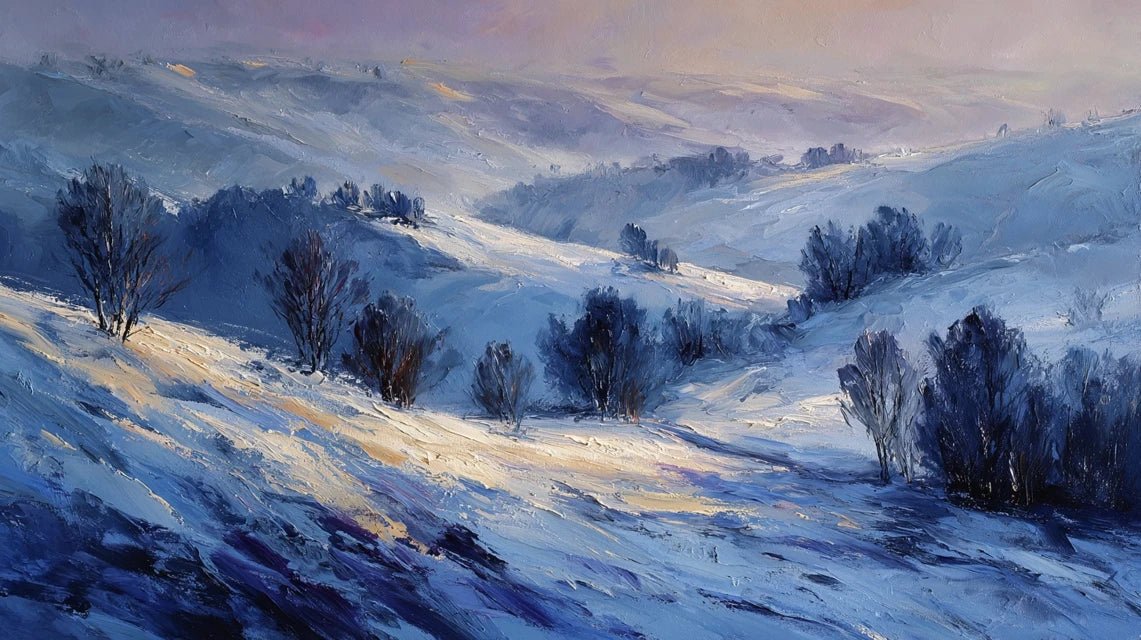
When you observe a snow cover under different lighting conditions, you discover that there is no pure white. Snow in sunlight tends towards ochre or pale yellow, while shaded areas are adorned with mauve, deep blues or subtle violets. This chromatic reality represents the first major technical challenge for any winter landscape painter.
Snow in painting: understanding the technical challenges of light
Winter light has unique characteristics. In winter, the sun remains low on the horizon, even at noon, which creates elongated shadows and a grazing light that accentuates reliefs. This particular position causes the rays to travel longer in the atmosphere, shifting the color towards reddish and orange tones at the end of the day.
The main trap is to paint the snow in uniform white in the lighted areas and in gray in the shadows. This approach inevitably produces a flat and lifeless result. The master Impressionists applied a fundamental rule: warm light, cold shadow — and vice versa. Thus, if your snow in sunlight has yellow or orange tones, the shadows must be rendered with blues or mauves.
This complementarity creates the relief and depth necessary. In Monet's "The Jay", the snow never appears white: it oscillates between bright ochre and shaded mauve. This restricted but skillfully orchestrated palette generates a luminous vibration that literally brings the landscape to life.
Snow landscapes: mastering contrasts between shadows and lights
Contrast is the soul of successful snowy landscapes. The greater the difference between dark and light areas, the more volume emerges naturally. Artists who work with snow must learn to force contrasts beyond what their eye initially perceives.
Here are the essential principles for building effective contrasts in your snow landscapes:
- Observe the temperature of the light: a warm afternoon light imposes intense bluish shadows
- Vary colored grays: from mauve-gray to blue-gray to green-gray, each nuance enriches the palette
- Create custom blacks: mix burnt umber and ultramarine blue rather than using industrial black
- Add warm accents: a few touches of ochre or yellow in bright whites reinforce the solar warmth effect
- Graduate transitions: passages between light and shadow sometimes reveal accent colors (orange, violet, red) along the contours
Gustave Courbet, in his "Effect of Snow" painted in 1866, masterfully demonstrates this mastery of contrasts. The dark stone in the foreground violently contrasts with the brilliance of the snow cover, while sunny areas differ radically from shaded slopes. This orchestration of values creates a striking spatial depth.
For contemporary artists, a common mistake is to underestimate the power of shadows. Beginners tend to lighten them for fear of "too dark." However, it is precisely the intensity of the shadows that makes the brilliance of the snow stand out. If your shadows remain too pale, your whites will have no visual impact.
Capturing the Winter Poetry of Snowy Landscapes
Beyond pure technique, snowy landscapes convey a unique emotional dimension. This winter poetry is born from the particular atmosphere created by the white blanket: muffled silence, crystalline light, purity of simplified forms.
The Impressionists sought precisely this capture of fleeting moments. Monet sometimes restarted the same canvas several times when the luminosity changed during a session. This obsession with authenticity of visual sensation distinguishes great winter works from simple descriptive representations.
Snow radically transforms the perception of the landscape. It simplifies forms, erases superfluous details, creates purified masses. A tree becomes a graphic silhouette, a hill is reduced to a gentle curve. This natural stylization allows artists to focus on the essential: the quality of light and the emotion it evokes.
To enrich your snowy landscape compositions, you can consult a collection of landscape paintings that illustrate different aesthetic approaches to the winter scene. Observing how other artists have solved technical challenges will help you develop your own sensitivity.
Clarence Gagnon, a Quebec painter trained in France, excelled in this poetic translation of Canadian winter. In "La Carriole rouge" (1924-1925), he uses a restricted palette of yellows, reds and blues where the snow appears in yellowish blocks. The bright red of the sleigh becomes the focal point that immediately attracts the eye, creating a color contrast that energizes the entire composition.
Snow Techniques: Textures and Atmospheric Effects in Landscapes
The texture of snow varies considerably depending on its nature and state. Fresh snow, packed snow, frozen snow, wet snow: each type requires a different technical approach. Experienced artists know how to adapt their touch and material to render these variations.
To create a realistic snow texture, several techniques are available to you. Application in impasto, with a palette knife or a loaded brush, suggests the thickness and relief of the snow cover. Glazes, on the other hand, are suitable for representations of wet or melted snow.
Atmospheric effects play a crucial role in snow landscapes. The winter air, often laden with moisture or ice crystals, creates a characteristic haze that softens distant contours and increases the sense of depth. Nearby objects remain sharp and detailed, while the background dissolves into lighter, less contrasting values.
Alfred Sisley perfectly mastered these atmospheric subtleties. In "Effects of Snow at Argenteuil" (1874), observe the multitude of successive touches that form the snow cover. Each brushstroke captures a different nuance: shadow, sun, hollow, bump. This fragmentation of the touch, characteristic of Impressionism, restores the luminous vibration of the scene.
For snowflakes in suspension, use semi-transparent touches slightly lighter than the snow on the ground, but never darker than the background. Only a snowflake passing in front of a light source will appear naturally darker. This seemingly simple rule radically transforms the realism of your snowfall scenes.
Snow reflects approximately 80% of the light it receives, which considerably illuminates the entire landscape and softens shadows. This physical property explains why winter scenes possess a particular luminosity that you must integrate into your compositions. Cast shadows on snow are never totally black: they capture the light reflected by the snowy environment.
Frequently Asked Questions about Snow Landscapes in Painting
What colors should I use to paint snow realistically?
Snow is never pure white. Use white mixed with yellow ochre or Naples yellow for sunlit areas. For shadows, create colored grays by mixing white with ultramarine blue and a touch of red (to obtain purples) or cobalt blue. Avoid industrial black which "dirties" the colors: prefer a mixture of burnt umber and ultramarine blue for your darkest tones.
How do I create depth in a snowy landscape?
Depth is achieved through several complementary means: increase contrasts in the foreground (sharp details, very contrasting values) and gradually soften them towards the background. Use atmospheric perspective by making distant elements lighter, less saturated, and bluer. Also vary the size and precision of the touches: large and defined in front, small and blurred behind.
Why do my snow landscapes appear flat and lifeless?
This impression generally comes from a lack of contrast and a too-poor palette. If you paint the snow in pure white and the shadows in neutral gray, the result will indeed be flat. The solution: force contrasts beyond what you observe, enrich your palette with warm colors in the lights and cool colors in the shadows, and don't be afraid to darken considerably your shadow areas to make the snow shine.