


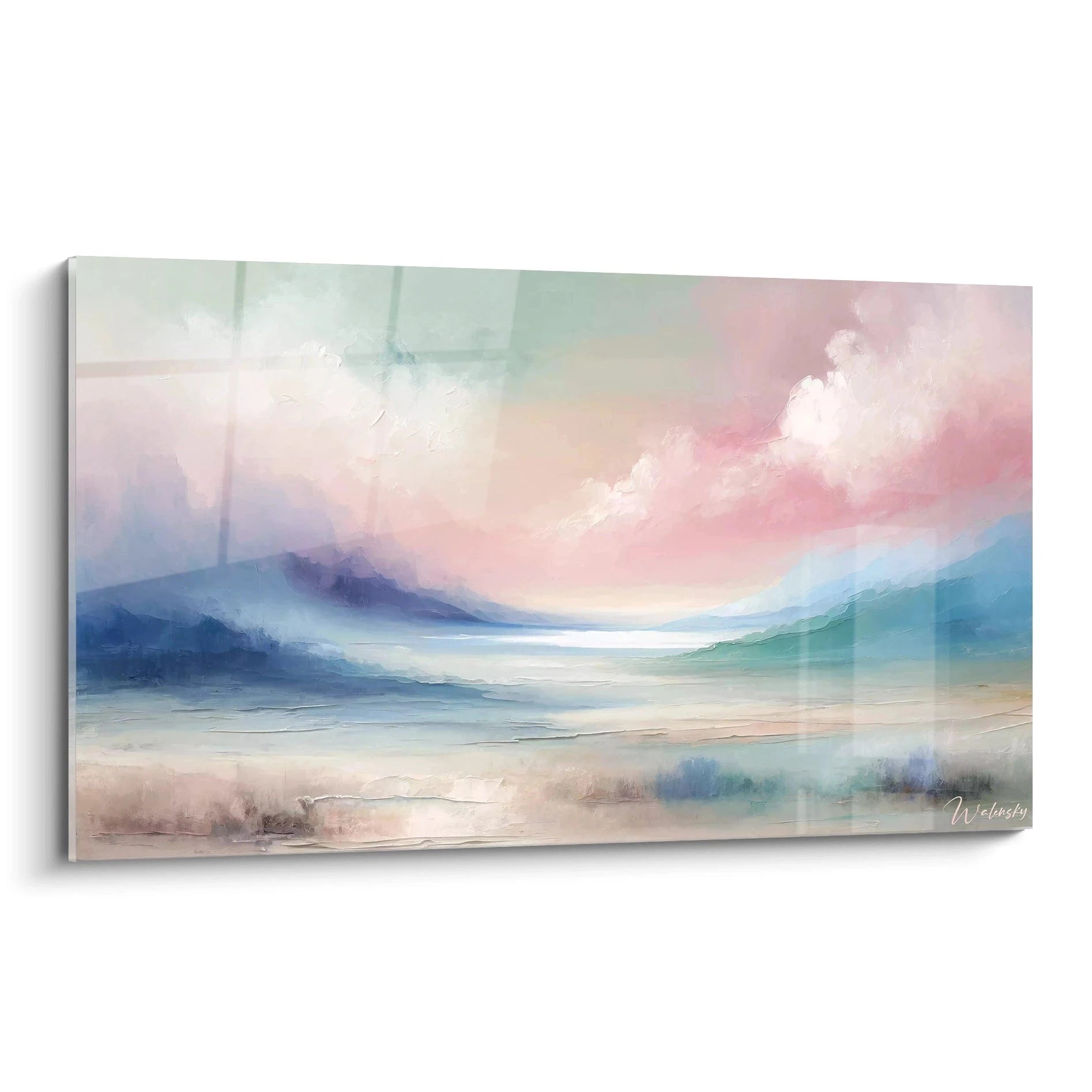

Sisley’s Landscapes: Subtle Chromaticism and Natural Harmony
October 11, 2025 · 5 min read · by Walensky
Imagine yourself standing before a Sisley painting. What strikes you first is this soft, almost vaporous light that seems to float over the landscape. Alfred Sisley, this Franco-British painter born in Paris in 1839, dedicated his entire life to capturing the soul of French landscapes. And unlike his famous friends Monet or Renoir, he never deviated from his passion: outdoor landscape painting, period. Of his 900 works recorded, not a single exception. A major figure in French Impressionism, he remains the most constant in his devotion to the natural landscape.
The color palette of Sisley's landscapes
Sisley didn't shout with his colors. He whispered. His landscapes display a palette of pastel tones: pale greens, pearly pinks, delicate mauves, powdery blues. You might think it’s monotonous at first glance, but it's quite the opposite. Each canvas reveals an unsuspected richness of nuances, like a conversation that unfolds gently.
Take his views of the Seine or the Loing. The water becomes a magical mirror where dance:
- The silvery blues of the sky reflected
- The emerald greens of the riverside trees
- The tender pinks of dawn
- The mauves of dusk
A revealing detail: Sisley mainly painted at sunrise or sunset. Those moments when the Impressionist light softens, where violent contrasts disappear in favor of subtle transitions. This is what gives his works that so recognizable atmosphere, almost meditative. And his snowy landscapes? A chromatic feat. Where others would see only white, Sisley extracts a symphony of blues and pinks – a technique that will even inspire the Fauves decades later.

Natural harmony in Sisley's landscapes
Harmony at Sisley is not a happy accident. It’s a thought-out, architected construction. Unlike Monet who sought the pure spontaneity of the moment, Sisley respected the structure of the landscape as an architect respects the laws of gravity. A winding path, a river flowing, a row of poplars guiding the eye – everything is in its place.
Look at his large skies. They often occupy two-thirds of the canvas. This proportion is not insignificant: it creates a dialogue between earth and sky, a visual breath that characterizes the Île-de-France he painted for 30 consecutive years (Source: Musée d'Orsay). It is this fidelity to a territory that allowed him to grasp all its secrets, all its variations.
His subjects? Of disarming simplicity. A sleeping village, a deserted country road, a few trees by the water’s edge. But behind this simplicity lies an extraordinary sensitivity to the rhythms of nature. His seasonal series show the same place transformed by light, weather, and seasons – a kind of intimate journal of nature.
Chromatic subtlety at the service of landscape harmony
This is where everything happens. Sisley merges his mastery of color with a sense of natural harmony. His brushstrokes – controlled but never rigid – create a luminous vibration that animates the canvas without fragmenting it. The historian Robert Rosenblum even called him the creator of the "perfect Impressionist landscape" (Source: Art Institute of Chicago). That's quite something.
He excelled particularly in two formidable exercises: changing skies and reflections on water. These two elements require an intuitive understanding of colors, their interactions, and their infinite nuances. Between the sky and its reflection in the water, Sisley created a harmonious continuity that unifies the composition.
Let's take his famous floods at Port-Marly. Water engulfs everything, but instead of a dramatic spectacle, Sisley paints an almost contemplative scene. The gray-blue tones of the water converse with the ochres of the buildings and the pale pinks of the sky. Melancholy and serenity coexist. It is this ability to transform a violent event into a poetic moment that defines the uniqueness of his gaze.
This tradition of sensitive landscape continues to inspire contemporary art. You can explore how this legacy endures in this collection of landscape paintings which perpetuates the spirit of the Impressionist masters.
— Our selection


Sisley's pictorial techniques to capture the natural light of landscapes
As early as 1862, Sisley practiced plein air painting with his fellow students from the Gleyre studio: Monet, Renoir, Bazille. Headed to the Fontainebleau forest, easel on shoulder, following in the footsteps of the Barbizon school which had paved the way decades earlier. There was no question of painting in the comfort of a workshop. He needed to be there, in nature, to capture the light in its truth.
And he spent hours there. In all weathers. Rain, wind, cold – it didn't matter. This perseverance also contrasts with his late recognition: his works only achieved significant prices after his death in 1899 (Source: World History Encyclopedia). An injustice that history has fortunately corrected.
Later, he settled in Moret-sur-Loing, this picturesque medieval village which became his favorite artistic playground. He devoted the last years of his life there, multiplying views of the bridge, the church, the banks of the Loing under all possible lights. This geographical fidelity allowed him to deepen his understanding of natural lighting effects.
His technique required constant reactivity. The light changes, the clouds pass, the wind rustles the leaves – he had to adjust his palette in real time, modify his brushstrokes to follow these incessant transformations. An impressive mastery of controlled spontaneity.
His brushstrokes were more measured than those of his contemporaries. No excessive fragmentation. Each touch restores the matter – water, foliage, stone – while preserving the readability of the whole. The eye instantly understands that it is a tree, a river, a house, but the Impressionist magic operates.
Today, his paintings preserved at the Musée d'Orsay, the Musée de l'Orangerie in Paris or the Art Institute of Chicago continue to embody this perfect balance between naturalist observation and poetic interpretation. Sisley proved that a discreet palette can convey an emotion as powerful as the most daring contrasts. Perhaps this is his greatest legacy: having demonstrated that subtlety is never a weakness, but a quiet strength.
FAQ : Understanding Sisley's landscapes
What characterizes Sisley’s color palette?
Sisley’s palette is distinguished by its softness and subtle pastel tones. He favored pale shades – greens, pinks, mauves, powder blues – which he mainly captured in the subdued light of morning or evening. This chromatic approach allowed him to create infinite nuances and a unique contemplative atmosphere in French Impressionism.
Why is Sisley considered the painter of natural harmony?
Sisley rigorously respected the structure of natural landscapes in his compositions. Unlike other more spontaneous Impressionists, he carefully constructed his paintings around clear guidelines and balanced proportions, especially with his skies which often occupy two-thirds of the canvas. This architectural approach created a characteristic natural geometric harmony.
What technique did Sisley use to capture light?
Sisley practiced exclusively plein air painting, spending countless hours outdoors in all weathers. This direct immersion in nature allowed him to grasp the transient effects of light with authenticity. He constantly adjusted his palette and brushstrokes to reflect subtle changes in the environment, demonstrating an exceptional mastery of Impressionist pictorial responsiveness.

You may also like
The Art of Water Painting - Marine Landscape Edition
233,90€
Discover this artwork →Explore our collections


