Nicolas Poussin (1594-1665) embodies French classicism in the 17th century. This philosopher painter revolutionizes the representation of nature by applying rigorous geometric principles to his compositions. His landscapes do not copy reality but transform it according to an ideal that combines mathematical order and poetic emotion. From "Landscape in Calm Weather" to the monumental Four Seasons, Poussin creates a vision where man finds his place in a universe governed by eternal laws. Let's discover how this Louvre master shaped a new genre: heroic and idealized landscape.
Geometric composition in Poussin’s landscapes
Imagine a painter who transforms nature into a perfect equation. That is exactly what Nicolas Poussin, master of French classical painting, does in the 17th century. His revolution? To apply a rigorous classic order to every branch, every cloud, every rock in his landscapes.
His secret lies in a geometric alphabet: five simple shapes (square, circle, triangle, oval, rectangle) which he assembles like puzzle pieces. Nothing is left to chance. Each tree finds its place in an invisible grid, creating a symmetrical composition that seems natural but results from careful calculation.
This approach recalls Descartes introducing algebra into geometry. Poussin does the same with painting, creating a new order of imagination. The result? Landscape paintings where geometry guides the gaze without ever showing itself, like an invisible musical score that produces a visual symphony.
Idealized nature and Poussin’s landscapes: classical harmony
Forget Flemish landscapes that faithfully copy reality. Poussin plays in another category. He does not paint what he sees, but what nature should be in a perfect world, creating what will be called the heroic landscape.
Take "Landscape in Calm Weather" (1651). No peasants at work, but Arcadian shepherds who seem to have come from an ancient dream. Every element breathes absolute calm. It is an idealized nature that expresses pure emotions: the gentle nostalgia in “Landscape with Polyphemus,” the violent tragedy in “Landscape with Pyramus and Thisbe.”
From 1630, collectors noticed it. His landscapes are worth more than those of Paul Bril, a benchmark of the time. Why? Because this Louvre master sublimates reality without betraying it. He observes the effects of light, captures atmospheres, then reorganizes them according to an ideal. This naturalistic accuracy combined with intellectual construction creates something unique: landscapes that seem more real than nature.
Classical order in landscapes: architecture and nature
Look at "Landscape with the Funeral of Phocion" (1648). Three stories intertwine. History first: the ashes of a general unjustly banished. Architecture next: a majestic temple seen head-on. Nature finally: rocks, clouds and trees treated as sculptures. These three elements converge towards the center in a universal arrangement that seems inevitable.
The technique is meticulous. The trees strictly frame the scene. Horizontal planes follow each other with precision. Poussin often opposes a domesticated nature (gardens, paths) to a wild nature (forests, torrents), embodying the pictorial stoicism that characterizes his philosophical vision of the world.
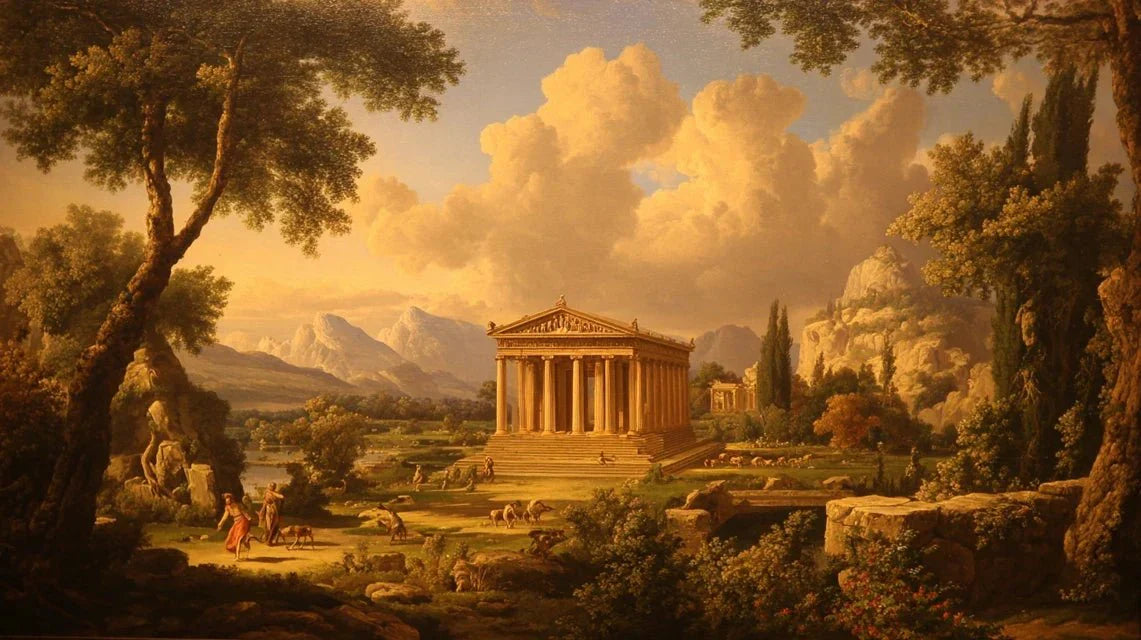
Ancient temples and ruins are not mere decorations in this 17th-century painting. They dialogue with the vegetation, creating a visual language where stone and foliage respond to each other. Poussin applies the same geometric principles to architecture and nature, unifying his vision in a remarkable coherence.
The cycles of nature in Poussin's landscapes
The Four Seasons (1660-1664) crown the master’s career. Painted for the Duke of Richelieu between 60 and 70 years old, these works blend landscapes, agricultural work, and biblical narratives in a spectacular synthesis.
"Summer" shows Ruth and Boaz in golden fields. "Winter" represents the Flood with Noah's ark barely emerging from the dark waters. In the latter, cool colors and a threatening sky express something profound: life goes on despite everything, nature is stronger than man.
Poussin meditates on the eternal cycle. In his paintings, mythological characters die and are reborn as flowers. This transformation symbolizes our acceptance of natural mutations. The series offers a double temporal reading: the time of seasons that return each year, and the sacred time of biblical episodes that give meaning to existence.
Techniques of composition in Poussin's classical landscapes
Here is where Poussin truly becomes modern: he makes man disappear. The small silhouettes lost in his late landscapes are no longer the heroes but simple witnesses. Nature becomes the true subject.
His creative process fascinates. No painting from nature. He first builds three-dimensional models with wax figures that he moves like a stage director. This method involves several steps:
- Construction of mockups with wax figurines to test compositions
- Moving the characters until perfect balance is found
- Sketches enhanced with washes to fix lights and shadows
- Slow execution of the painting without ever painting from nature
- Observation of human models only when necessary
The color scheme remains restrained: subdued colors, a few calculated bright accents, this powdery light so characteristic. In ultimate works such as "Landscape with Blind Orion" (1658), lush vegetation invades everything. The work becomes an allegory of clouds, a meditation on the eternal forces of nature.
Poussin does not copy, he thinks. And this visual thinking places him at the top of 17th-century landscape painters.
FAQ
What characterizes classical order in Poussin's landscapes?
Poussin’s classical order rests on a rigorous geometric composition using an alphabet of five shapes (square, circle, triangle, oval, rectangle). This mathematical structure organizes each element of the landscape according to principles of symmetry and harmony, creating an idealized nature rather than a copy of reality.
Why do we talk about idealized nature in Poussin’s work?
Unlike realist landscapists, Poussin does not paint what he sees but intellectually recomposes nature according to a classical ideal. He places Arcadian shepherds in ancient mythological settings, transforming each landscape into a philosophical meditation on the harmony between man and nature.
What is the importance of the Four Seasons in Poussin’s work?
The Four Seasons (1660-1664) represent Poussin’s artistic testament. These paintings associate the natural cycles of the seasons with biblical episodes, expressing a double temporality. They embody the painter's mature vision of the eternal laws of nature and man's place in the universe.