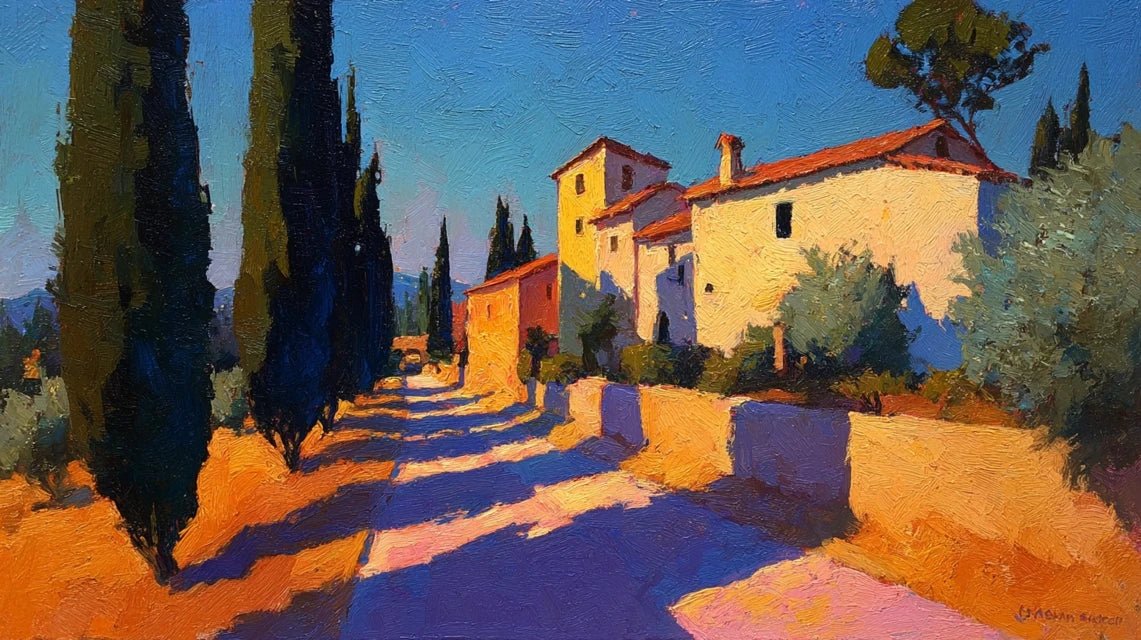
Imagine yourself facing a Provençal landscape in the middle of a summer afternoon. The sun is shining brightly, and suddenly you notice these graphic shadows that cut the ground into fascinating geometric shapes. This is exactly what makes cast shadows so captivating in Mediterranean landscapes.
Understanding cast shadows in Mediterranean landscapes
When a cypress tree, an olive tree or a white wall blocks the Mediterranean light, it projects its shadow onto the ground. Simple in appearance, but this projection tells the whole story of the local climate. The intense light of the South creates shadows with ultra-defined contours, almost sharp.
Around noon, these shadows curl up under the trees. They become short and compact. But wait until morning or evening: they stretch out enormously, transforming a simple cypress tree into a giant lying on the ground. This dance of cast shadows rhythms your compositions and brings life to your canvases.
The parasol pines, so typical of the coast, project recognizable shapes. Their cast shadows create a natural depth that instantly structures your landscape. An astute artist knows that these projections are not just details: they become the true architects of the composition.
Painting techniques for cast shadows in Mediterranean light
First rule of gold: identify where the sun is coming from. This light source dictates everything else. In the Mediterranean, direct sunlight reigns supreme, creating those characteristic sharp edges.
Here's how to proceed:
- Sketch the direction of the shadows according to the solar angle
- Apply a first translucent layer
- Gradually intensify without brutality
- Slightly soften the distant edges of the object
Take the example of a hundred-year-old olive tree. Its gnarled trunk close to the ground projects a shadow with precise contours. But its high branches, several meters above the ground, generate more diffuse shadows. This technical nuance makes all the difference between a flat painting and a work that breathes. Explore different approaches with landscape paintings to refine your technique.
Colors and mixtures for Mediterranean cast shadows
Forget black! Under the Mediterranean sun, cast shadows are adorned with absolutely magnificent blue violets. This cool temperature contrasts with the ambient warmth and creates that visual harmony you are looking for.
Test these color recipes:
- Base: ultramarine blue mixed with burnt umber
- Fresh variation: add a touch of violet
- Local harmony: incorporate a hint of ochre to recall the soil
The support changes everything. Imagine a shadow falling on the yellowed grass of July versus the same shadow on a whitewashed wall. In the first case, you will integrate warm reflections. In the second, the shadow reveals its full blue-mauve intensity. This interaction between the shadow and its receiving surface captures the very essence of the Mediterranean.
Contours and shapes of cast shadows in landscapes
The Mediterranean sun sculpts shadows with crisp edges. No artistic blur here, but a sharpness that cuts the space like a knife. This precision becomes your best ally in structuring the composition.
Take a moment to observe: the shadow takes on the exact silhouette of what projects it, but transformed by the angle of light. This cypress tree? Its morning shadow stretches up to triple its apparent length. Its needles merge into a simplified, almost abstract form.
These cast shadows create a natural geometry that segments your canvas. They establish the planes, mark distances, and guide the eye. A slightly open shutter, a trellis shading a wall, a row of olive trees: each element projects its dark signature and tells the story of the place.
Light-shadow contrast in Mediterranean landscapes
Here's the secret of the masters: contrast makes colors sing. In a Mediterranean landscape, the opposition between dazzling light and intense cast shadows creates that unforgettable visual vibration.
Technique in three steps:
- Place your most extreme blacks and whites
- Massively enrich the shadow areas
- Soften towards the horizon for perspective
Paradoxically, the fewer luminous zones you have, the more they shine. Concentrate light on a few key elements: a facade, a path, rocks. The rest bathes in generous cast shadows that amplify the brightness of the sunlit areas.
The hour transforms everything. At noon, the contrast reaches its peak. Shadows become almost black, the light blinding. But at dusk, the contrasts soften, the cast shadows lengthen and are tinted with orange reflections. Your Mediterranean landscape then goes from brute force to a golden softness.
FAQ: Painting Mediterranean cast shadows
How to paint cast shadows in full Mediterranean sun?
Under direct Mediterranean light, favor crisp outlines and cool colors (blue-violet). Observe the angle of the sun to determine the length and orientation of the shadows, then work in successive layers gradually increasing intensity.
What colors should be used for shadows in a Provençal landscape?
Avoid pure black. Mix ultramarine blue with burnt umber, then add a touch of violet to obtain this characteristic cool tone. Adjust slightly according to the surface: add a hint of ochre for shadows on Mediterranean soil.
Why do Mediterranean shadows have such crisp outlines?
The exceptional intensity of sunlight in the Mediterranean creates a direct and powerful light source. This clarity generates cast shadows with sharp edges, unlike diffuse shadows produced by an overcast sky or indirect light.