Imagine standing before
Between 1888 and 1890, in the burning landscapes of Arles and the hills of Saint-Rémy-de-Provence, Van Gogh invented a new way of seeing the world. His canvases vibrate with an energy that no one had dared to represent before. Movement, emotion and cosmic energy: this is what inhabits each of his landscapes.
Van Gogh's Landscapes: Capturing Movement Through Swirling Brushstrokes
When Van Gogh places his brush on the canvas, nothing remains still. The fields of wheat bow under the Mistral wind. The cypresses soar like green flames piercing the sky. The clouds twist into spirals worthy of a distant galaxy.
His technique? Impasto. Van Gogh loads his brush with thick paint and applies it in generous layers. The result: an almost sculptural texture that you want to touch. His brushstrokes are quick, energetic, sometimes circular. They give the impression that everything moves, that everything lives.
Van Gogh writes to his brother Theo: “
Emotion in Van Gogh's Landscapes: From Inner Agitation to Transcendence
Van Gogh’s landscapes are mirrors. They reflect his joys, his anxieties, his moments of grace. Each canvas is an emotional self-portrait disguised as a field of wheat or a night sky.
His colors speak for him. The intense yellow? It's hope, emotional truth, spiritual light. When Van Gogh floods his fields of wheat with a dazzling golden yellow, he expresses his wonder at the beauty of the world. But when deep blues invade
Van Gogh himself says: “
Look at the cypress tree, this black tree that constantly reappears in his Provençal landscapes. Traditionally associated with cemeteries and death, it becomes under Van Gogh's brush a bridge between earth and sky. A link between the mortal and the eternal.
Each natural element carries a symbol:
- The cypresses = spiritual elevation and transcendence
- The wheat fields = fertility, cycle of life, hope
- The night sky = window to infinity
- The olive trees with bluish hues = softness and appeasement
During his year in Saint-Rémy, Van Gogh created more than 150 paintings (Source: SAMA For All). A staggering creative frenzy. Each brushstroke expresses the urgency of his emotion. And this intensity, we still feel it today when looking at his canvases. That's why his landscapes touch millions of visitors each year: they speak the universal language of the human soul.
This raw emotion opens the door to something even greater: a connection with the invisible forces that animate the cosmos.
The cosmic energy of Van Gogh’s landscapes: celestial spirals and universal turbulence
Here's the craziest thing: Van Gogh painted the invisible. Without any scientific training, he captured on his canvas real cosmic forces.
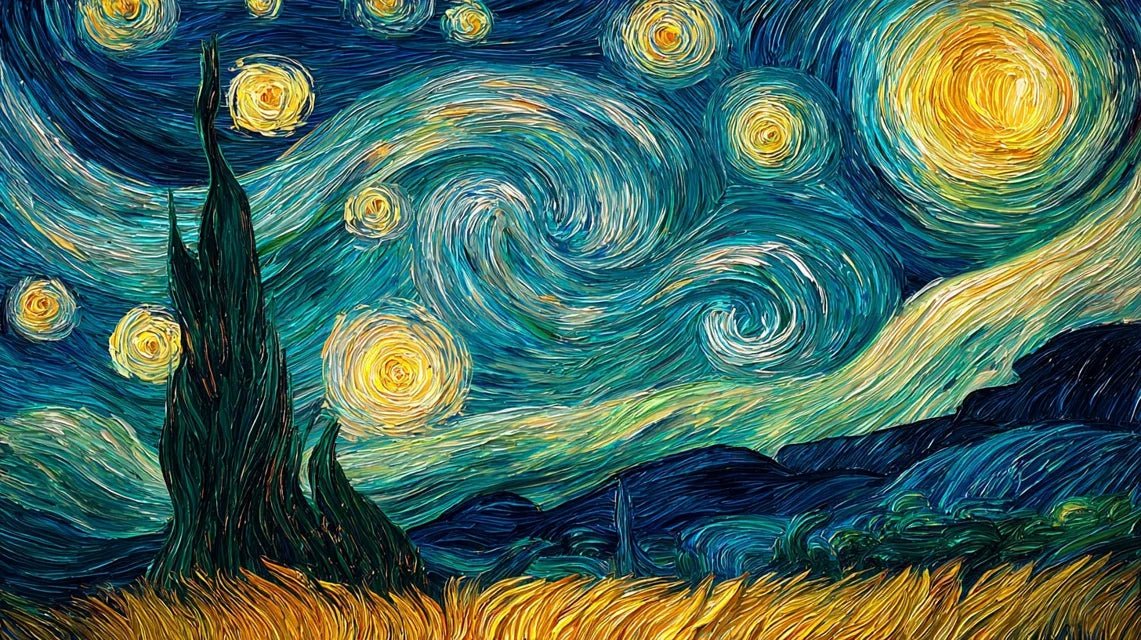
In 2024, researchers publish a study in Physics of Fluids that creates a sensation. The spirals of The Starry Night follow Kolmogorov’s law (Source: Physics of Fluids), an equation that describes turbulence in fluids. In other words, Van Gogh reproduced with a disturbing accuracy the turbulence that really exists in interstellar space.
Even more striking: in 2004, NASA publishes a photo taken by Hubble. It shows clouds of cosmic dust around star V838 Monocerotis. The resemblance to the spirals of Van Gogh is striking (Source: NASA). The space agency itself acknowledges it.
How did he do it? Van Gogh was passionate about astronomy. In 1845, William Parsons discovered spiral galaxies. Scientific journals of the time publish the first drawings of these “spiral nebulae”. Van Gogh studied them. Astrophysicist Jean-Pierre Luminet believes that these images nourished his imagination (Source: Konbini Arts).
But Van Gogh goes further than simple observation. In his letters, he writes: “Why would the spots of light in the firmament be less accessible to us than the black points on the map of France?” For him, the stars are a spiritual destination. A promise of eternity. His nocturnal landscapes become gateways to infinity.
Movement and energy in Provençal landscapes: cypresses, wheat fields and vibrant sky
Provence is the perfect setting for Van Gogh's vision. The dazzling light of the Midi, the Mistral that dances through the fields, the cypresses that pierce the sky: everything becomes an actor in a natural choreography.
In Wheatfield with Cypresses, Van Gogh composes like a conductor. Foreground: circular touches depict the wheat and capture the breath of the wind. Center ground: the dark green cypresses, veritable vegetal flames, vertically connect earth and sky. Background: the bluish olive trees and mountains stabilize the composition.
This dialogue between elements creates a magical balance between chaos and harmony. You feel both the agitation of the mistral and the eternal solidity of the landscape. Van Gogh plays on contrasts: blue-violet against yellow-orange, long touches against short touches, spiraled movement against mineral rigidity.
And then there's the light. Van Gogh wrote that night is « more alive and colorful than day ». In his nocturnal landscapes, the sky pulsates with an almost supernatural intensity. The stars are not just white dots. They are sources of radiant energy surrounded by vibrant halos.
Landscape paintings by Van Gogh go beyond simple representation. They become total sensory experiences. In front of his canvases, you no longer look passively. You physically feel the wind running through the fields. You share the artist's raw emotion. You perceive the energy that traverses the cosmos.
This unique fusion between observation and inner vision, between technique and emotion, between earth and cosmos makes Van Gogh’s landscapes eternally modern works. More than 130 years later, they continue to question us about our place in the universe. And they remind us that beauty can emerge from the most unexpected places - even from an asylum facing the hills of Provence.
FAQ: Van Gogh's Landscapes
Why do Van Gogh’s landscapes seem to be in motion?
Van Gogh uses a technique called impasto: he applies paint in thick layers with swirling and energetic brushstrokes. This method creates an almost sculptural texture that gives the impression that the cypresses, wheat fields, and skies are animated with their own life. His circular and rapid touches capture the movement of the Provençal wind and the cosmic energy that traverses his compositions.
Are the swirls in The Starry Night scientifically accurate?
Surprisingly, yes. In 2024, a study published in Physics of Fluids revealed that the spirals in The Starry Night follow Kolmogorov's law, which describes real turbulence in fluid mechanics. Without scientific training, Van Gogh reproduced with a disturbing accuracy the turbulence that exists in interstellar space. NASA even recognized the resemblance between his swirls and the cosmic clouds photographed by Hubble.
What do the cypresses symbolize in Van Gogh’s landscapes?
The cypresses occupy a central place in Van Gogh's Provençal landscapes. Traditionally associated with cemeteries and death, they become under his brush symbols of spiritual elevation. These « green flames » vertically connect earth to sky, embodying the bridge between mortal and eternal. Van Gogh gives them a mystical dimension that reflects his quest for transcendence and his desire to touch infinity.