In 1892, Paul Signac dropped anchor in Saint-Tropez aboard his yacht, the Olympia. On his canvas, there was no room for improvisation: each touch of color obeyed a precise equation. The painter did not simply capture a landscape; he reconstructed it scientifically, point by point, according to the principles of Neo-Impressionism.
Divisionism in Signac's Landscapes
Imagine a painter who refuses to mix his colors on his palette. Signac deposits pure blue, pure yellow, pure orange touches onto his canvas. It is your eye, at a distance, that creates the green, the violet, the orangey hues. This pictorial revolution, developed with Georges Seurat, is called Divisionism.
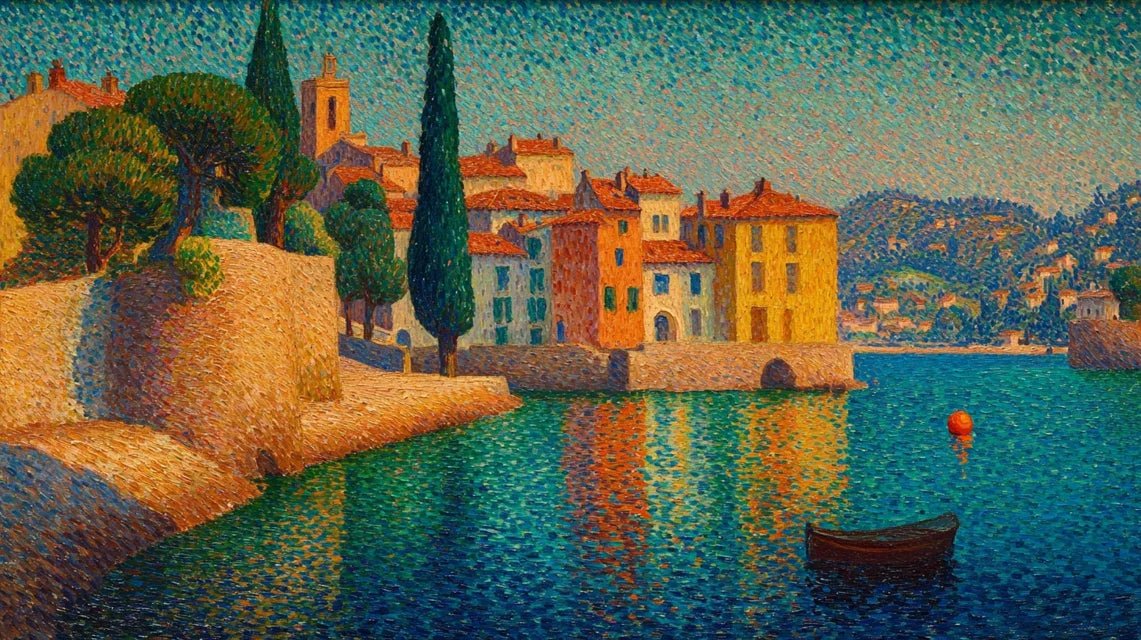
In The Red Buoy, Saint-Tropez (1895), the water of the port becomes a vibrant mosaic. Hundreds of bluish, purplish, greenish touches coexist. In the foreground, an orange-red buoy explodes against the blue. The contrast is not accidental: it responds to the laws of complementary colors. Each touch dialogues with its neighbor according to a calculated choreography, perfectly illustrating this revolutionary painting technique.
The Scientific Foundations of Color in Signac's Work
In 1884, Signac knocked on the door of the Gobelins to meet Michel-Eugène Chevreul, a chemist aged 98. This visit changed his life. "This was our initiation into the science of color," he would write (Source: Paul Signac, From Eugène Delacroix to Neo-Impressionism, 1899). Chevreul revealed an optical truth to him: two colors placed side by side do not behave like two isolated colors. They influence each other, transform each other.
Signac became a passionate student of French painting science. He devoured the theories that underpin Neo-Impressionism:
- Michel-Eugène Chevreul taught him simultaneous color contrast, a law stated in 1839 which explains how adjacent hues influence each other
- Ogden Rood explained the crucial difference between additive mixing (light) and subtractive mixing (pigments) in his work The Scientific Theory of Colors (1881)
- Charles Blanc revealed the concept of optical blending and color harmonies in his Grammar of Arts and Drawing (1867)
In 1899, he published From Eugène Delacroix to Neo-Impressionism, a true manifesto of the movement. For Signac, science does not stifle creativity; it liberates it. No more Impressionist groping, but rigorous method that will characterize modern art.
The Divisionist Technique in Marine Landscapes
In Saint-Tropez, Signac perfected his working protocol. In the morning, watercolor and sketches facing the subject. In the afternoon, execution in oil in the studio. This methodical discipline allows to rigorously apply divisionist principles to landscapes of the Mediterranean.
His pictorial technique evolves with the years. In 1886, in Les Andelys, La Berge, the touches are minuscule, almost pointillist. The critic Gustave Kahn marvels: "It is the brilliance of midday sun that is captured in these landscapes" (Source: Gustave Kahn, La Vie moderne, 1887). Ten years later, the touches widen, becoming rectangular or mosaic-shaped. Signac even adapts their direction according to the elements represented: oblique for slopes, vertical for trees, horizontal for the sky and sea.
Marine landscapes require a particular virtuosity. Reflections on the water decompose into dozens of complementary shades. A deep blue receives a touch of orange. A green is enriched with a violet. Each pure "color-light" participates in the overall illusion, creating a luminous vibration impossible to obtain by traditional pigment mixing.
Landscapes of Saint-Tropez: laboratory of divisionism
"I have here enough to work for my entire existence, it is the happiness I have just discovered." Signac has found his creative paradise. Saint-Tropez offers everything that divisionism seeks: dazzling light, marked contrasts between sea and architecture, complex reflections on water. The small fishing port becomes his open-air experimental laboratory.
In The Path of Customs (1905), the method reaches its technical perfection. The coastal path winds through a skillfully orchestrated chromatic symphony. The cypresses, parasol pines, ochre facades are fragmented into pure color units. It is divisionism in its purest form, masterfully applied to the Mediterranean nature according to the teachings of Georges Seurat.
The Tropézienne experience attracts young talents from French painting. In 1904, Henri Matisse arrives at Signac's villa. Under the watchful eye of the master, he paints Luxury, Calm and Volupté applying divisionist principles. Signac is delighted with this application of the science of color. He doesn’t yet know that his student will soon transcend these rules to invent Fauvism.
This tradition of colorful and scientific landscape representation endures today, as evidenced by contemporary landscape paintings which perpetuate this chromatic heritage. landscape paintings
The evolution of the divisionist technique in Signac's landscapes
Around 1902, something loosens in Signac’s practice. His watercolors gain freedom and spontaneity. The touches widen, color breathes more. Strict pointillism gradually gives way to personal expression. His oils remain faithful to the divisionist method, but a new freshness appears in his palette.
This creative tension between scientific rigor and artistic freedom runs through Signac's late work. Signac refuses to choose between method and instinct. Science remains his theoretical foundation, but it no longer stifles the spontaneity of gesture. His later landscapes of Corsica, painted in 1935 a few months before his death, retain the division of tones while expressing a new vitality.
The legacy of Signac's divisionism extends far beyond the circle of neo-impressionism. Robert Delaunay creates orphism drawing directly on Chevreul's theories transmitted by Signac. Vassily Kandinsky, Paul Klee and Piet Mondrian openly acknowledge their debt to this scientific approach. Divisionism has demonstrated that space and light could be created through the methodical organization of color alone, without traditional perspective or naturalistic model. This fundamental discovery opens the way to modern art and abstraction.
Frequently asked questions about Signac's divisionist landscapes
What is divisionism in Signac's landscapes?
Divisionism is a painting technique that consists of juxtaposing pure color touches on the canvas, without mixing them on the palette. It is the viewer's eye that performs the optical mixture at a distance. Signac applies this scientific method to his Mediterranean landscapes, creating vibrant effects of light based on the theories of Chevreul, Rood and Blanc.
Why was Saint-Tropez important for Signac?
Saint-Tropez offered ideal conditions for experimenting with divisionism: intense Mediterranean light, marked contrasts between sea and architecture, complex reflections. Signac set up his studio there in 1892 and painted his most accomplished landscapes, transforming the small fishing port into a laboratory of neo-impressionism. The site also attracted Matisse, Derain and other major artists of modern art.
How did Signac use color science in his landscapes?
Signac relied on precise scientific theories: Chevreul's law of simultaneous contrast, Charles Blanc's optical mixing, and Ogden Rood's distinction between additive and subtractive mixing. He applied these principles by juxtaposing complementary color touches to create vibration and luminosity. His method combined sketches on location and rigorous execution in the studio, a perfect synthesis between observation and color science.