Have you ever found yourself facing a high mountain landscape, dazzled by this almost unreal clarity? It is precisely this air transparency that makes alpine panoramas so fascinating. Capturing this unique atmospheric quality on canvas represents a real challenge for any artist in alpine landscape painting. Let's discover together how to achieve it with proven painting techniques.
Atmospheric perspective to paint the transparency of air in high mountains
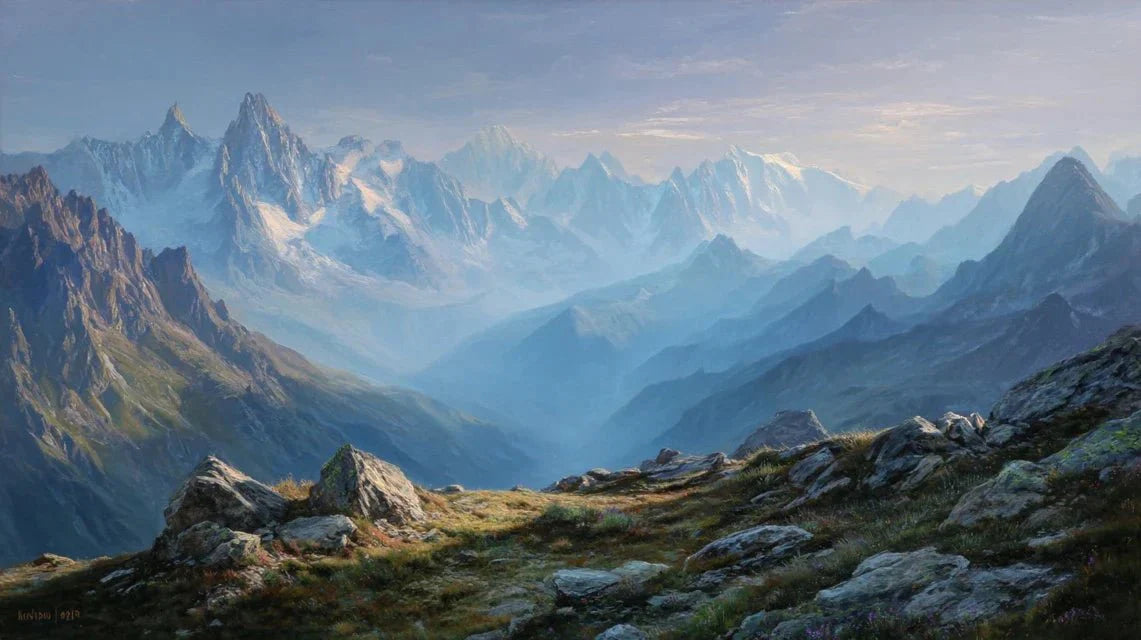
Let's start with the basics: atmospheric perspective. Imagine you are looking at several superimposed mountain ranges. The first appears clear and colorful, but as your gaze moves further away, the following become paler, bluer, almost ghostly.
This phenomenon is nothing magical. Light passes through the atmosphere and its thousands of microscopic particles, creating this progressive veiling effect. Leonardo da Vinci already understood it during the Renaissance! At high altitude, the effect is even more spectacular. The rarefied air contains fewer impurities, hence this exceptional transparency that allows you to distinguish peaks located 50 kilometers away.
To reproduce this atmospheric rendering on your canvas:
- Keep your strongest contrasts in the foreground, with bright and saturated colors
- Gradually reduce the intensity of the tones as you move away
- Switch to cool tones – light blues, bluish grays – for distant peaks
- Blur the details little by little, as if the mountain melted into the sky
This gradation visually translates the kilometers of air that separate your eye from the different reliefs. It is this that creates this vertiginous feeling of depth effect, signature of great alpine landscapes.
Glazing techniques to capture the clear air of high mountain landscapes
Once you master atmospheric perspective, glazing becomes your best ally. This ancestral painting technique consists of layering ultra-thin and transparent paint coats. Think of Instagram filters, but in Renaissance version!
The advantage? Light passes through each layer, bounces off those underneath and returns to your eye. This luminous ballet creates a depth impossible to obtain with opaque paint. It is exactly this chromatic vibration that evokes the ethereal atmosphere of altitude.
Specifically, mix a pinch of transparent pigment with your medium (linseed oil for mountain oil painting, acrylic medium for acrylic). Apply this mixture in an ultra-thin layer on your well-dried support. Patience! Wait for complete drying before adding the next one. You can stack ten to twenty layers without the paint thickening.
For your mountain skies and mountain backgrounds, opt for very diluted bluish glazes. Each pass subtly enriches the nuances, gradually building this particular clarity at the peaks.
Managing values and contrasts to paint the transparency of mountain air
Let's talk now about something essential but often overlooked: tonal values. Simply put, these are the nuances from light to dark, regardless of color. In high mountains, these values play a crucial role in creating a convincing atmospheric rendering.
In the foreground, don't hesitate: push the contrasts! Your rocks, your alpine vegetation should have frankly opposed values – deep blacks against bright whites. These dark areas highlight by contrast the incredible ambient luminosity of high-altitude landscapes.
Towards the background, do the opposite. Gradually compress these tonal differences. Distant peaks lose contrast: their shadows lighten, their lights soften. This compression visually translates the thickness of air traversed by your gaze.
A little pro tip: squint at your subject. You will immediately see the overall tonal structure revealed, like an x-ray of your landscape. These observations will guide your choices to faithfully reproduce this clear atmosphere characteristic of high altitudes.
Pigments suitable for transparent landscapes in high mountains
Not all tubes of paint are created equal when it comes to transparency. Some pigments are naturally opaque, others translucent. To capture the clear air of the summits, you need to know your colors.
Here are your best allies:
- Prussian Blue: transparent and powerful, perfect for deep mountain skies
- Ultramarine Blue: semi-transparent, ideal for distant mountains
- Emerald Green: transparent, great for glaciers and cool shadows
- Burnt Sienna Earth: transparent, useful for warming certain areas
Beware of the trap! Pure titanium white is your enemy in atmospheric glazes. It abruptly breaks the desired depth effect. Need to lighten? Add a medium instead.
Before you start, do a simple test: apply each color in a thin layer on black paper. Truly transparent pigments will allow the background to show through. You will then know exactly which shades to use to reproduce the crystalline atmosphere of your landscapes.
By the way, exploring landscapes paintings created by other artists can really enrich your understanding of these atmospheric effects.
Layering thin layers to represent transparent air at altitude
All these techniques culminate in one method: progressive construction through successive layers. It's like building a house – you start with the foundations, then build floor by floor.
Start with a monochrome sketch that establishes the entire tonal structure of your composition. This skeleton defines reliefs, planes of depth, light and dark areas. Let it dry completely - no rushing!
Next, apply your translucent color layers. In oil paint, follow the "fat over lean" rule: each layer must contain more binder than the previous one. Keep these passages extremely thin to preserve brightness and avoid unsightly impasto.
For areas representing the air between your different mountain planes, work in successive veils of diluted cool colors. These repeated applications naturally create this atmospheric depth, evoking the kilometers of transparent atmosphere separating the massifs. The progressive accumulation of these subtle layers faithfully reproduces the optical phenomenon observed in nature.
This method takes time and rigor, that's true. But the result? Impossible to achieve otherwise. Each layer enriches the nuances, intensifies spatial depth and gives your work that luminous quality found in the great masters of mountain painting. With practice, you will develop your own sensitivity to these atmospheric effects that transform a simple landscape into a captivating artwork.
FAQ: Painting the Transparency of Air in High Mountain
Q1: Can one paint the transparency of air in high mountain with acrylic?
Absolutely! Although oil paint is traditionally preferred for glazes, acrylic can also create convincing atmospheric transparency effects. Use an acrylic glazing medium or an acrylic varnish mixed with your paint. The advantage of acrylic is its fast drying time, allowing you to layer more quickly than with oil.
Q2: How long does it take to master atmospheric perspective in mountain painting?
Mastering atmospheric perspective takes regular practice. Allow several months of exercises to assimilate the basic principles – gradation of values, cooling of tones, attenuation of contrasts. Direct observation of mountain landscapes greatly accelerates learning. Start with simple compositions of two or three planes before tackling complex panoramas.
Q3: What are the most common mistakes when painting the transparency of mountain air?
Common errors include: maintaining too strong contrasts in the distances (which then appear as close as the foreground), using opaque pigments in atmospheric glazes (destroying the transparency effect), neglecting the progressive cooling of tones towards the background, and applying layers that are too thick which create impasto instead of transparency. Patience remains your best ally!