Imagine Courbet in 1869, installed in a small house in Etretat, facing the raging ocean. With a kitchen knife in hand, he attacks his canvas with a vigor that surprises his contemporaries. This radical gesture forever transforms the way the sea is painted.
Marine landscapes by Courbet: a break from pictorial realism
When Courbet discovers the ocean in Le Havre in 1841, he is 22 years old. This first encounter marks him, but it was only during a stay in Palavas on the shores of the Mediterranean in 1854 that he really began to paint the sea. And then, everything changes.
No more dramatic shipwreck scenes. No more heroic naval battles. Courbet invents what he calls "marine landscapes" - an expression that sounds like a manifesto. He doesn't paint marines, he paints the ocean itself, in its raw materiality.
Take The Shores of the Sea at Palavas: it is not really a traditional landscape. It is more of a exploration of matter. The foam, wet sand, and rolling waves blend in a play of colors ranging from blue-gray to greenish-blue. Courbet's realism does not photograph nature; it conveys its physical sensation.
Between 1865 and 1869, he became a regular visitor to Normandy: Honfleur, Trouville, Deauville, and especially Etretat. These Norman stays gave birth to some sixty paintings (Source: Institut Gustave Courbet). The ocean becomes his terrain for exploration to push the limits of realism. This quest finds a contemporary echo in the landscape paintings that perpetuate this tradition of powerful representation of nature.
The knife technique: materializing the power of the ocean
Courbet's true revolution takes place in the gesture. He gradually abandons the refined brush for the palette knife, a brutal tool that allows him to work the paint like a thick, almost sculptural material.
Maupassant, who observed him working, recounts a striking scene: "In a large bare room, a fat, greasy and dirty man was sticking white patches of color onto a large bare canvas with a kitchen knife. From time to time, he would press his face against the window and watch the storm."
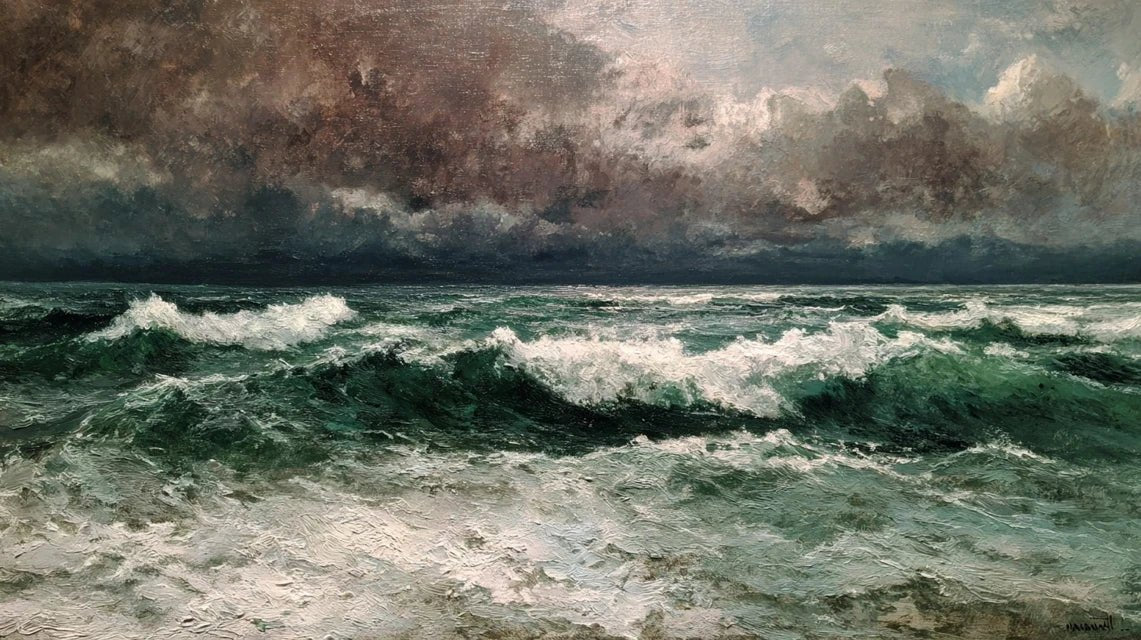
This radical method transforms the representation of the ocean. In The Wave of 1869, the blocks of color applied with a knife create unprecedented textural effects. Dark green tones cut through the white of the foam like a blade. The water takes on an almost mineral appearance, and the waves resemble rocky crests.
Courbet paints quickly, very quickly. This speed is not negligence; it is a strategy to capture the moment. He wants to seize the energy of the ocean before it evaporates, to restore the emotions he feels facing the unleashed elements. The stretched, scraped, and clawed pictorial matter becomes a tactile experience: you no longer simply look at the ocean, but physically feel its power.
The wave as an exclusive subject: realistic concentration on the ocean
Initially, Courbet still includes some narrative elements: stranded boats, sailboats on the horizon. But gradually, he empties it out. The boats disappear. The shores fade away. Only the essential remains: the wave and the sky.
This radical purification reaches its peak in the most accomplished versions of The Wave. No human references, barely a few rocks emerging. Émile Zola perfectly captures this approach in 1870: "Courbet simply painted a wave, a real wave breaking on the shore."
This apparent simplicity hides considerable ambition. Without a human scale, the ocean regains its primordial, almost archaic dimension. The wave becomes an archetype of natural power, freed from all anecdote, all picturesque.
It was precisely this negation of man that bothered Baudelaire in Courbet's realism. But it is also what makes these works so modern. They do not tell a story; they confront the viewer directly with the raw energy of the ocean. An immense technical challenge: how to render the fluidity of water, capture the perpetual movement of the wave, fix the elusive?
Composition and framing: the ocean without narrative in marine landscapes
Courbet breaks all the codes of academic composition. His canvases are divided into three horizontal bands: earth, ocean, sky. But unlike traditional seascapes, the horizon line connects nothing; it opposes everything.
This line creates a permanent visual tension. The gaze cannot circulate harmoniously; it collides with this brutal demarcation between sea and sky. Sometimes the sky occupies two-thirds of the canvas, sometimes it is reduced to make room for the unleashed ocean. This compositional choice is never neutral.
The close framing further amplifies this effect. In the most radical versions, such as The Wave at the Lyon museum, all spatial references are lost. No perspective, no distance. The diagonals formed by clouds and waves push our gaze towards the foamier part. We are immersed, almost drowned in the image.
This lack of perspective disorients viewers of the time. Where are we located? How far from the wave? Impossible to say. And that is exactly what Courbet seeks: a direct experience, without mediation, of oceanic power. An approach that foreshadows not only Impressionism but also certain abstractions of the 20th century.
The Etretat series: realistic variations on the power of the ocean
The summer of 1869 marks the peak of this pictorial adventure. Settled in a wind-battered house in Étretat, Normandy, Courbet produced about thirty waves (Source: Musée d'Orsay) as well as several views of the cliffs. From this intense production emerged two masterpieces presented at the Salon of 1870: The Stormy Sea and The Cliff of Etretat after the storm.
Working in series represents a major novelty. Courbet does not execute simple variations on the same theme; he systematically explores his subject from every angle. This method directly announces the series of Impressionists like Monet on the haystacks or Rouen Cathedral.
Each painting in the Étretat series has unique characteristics:
- A different framing, sometimes close-up on the wave, sometimes widened to the cliffs
- A particular light depending on the time and weather conditions
- A color palette ranging from dark green to blue-green, with brown or pink skies
- Various formats, from modest 60x73 cm to imposing 117x160 cm
- Variable degrees of human presence, up to total elimination
This colorful and compositional variation is a testament to a careful observation of the unleashed sea under different conditions. The large formats physically immerse the viewer, while the smaller ones concentrate the intensity of the wave into an almost abstract pattern.
These works enjoy immediate commercial success, encouraging Courbet to multiply versions. But beyond the mercantile aspect, they constitute a true experimental laboratory where the painter pushes the limits of realism to capture what seemed elusive: the living, moving, eternal power of the ocean.
FAQ : Courbet's Marine Landscapes
Why did Courbet call his works « marine landscapes »?
Courbet wanted to distinguish himself from traditional marine painting that told naval stories or shipwreck scenes. By speaking of « marine landscapes », he asserted that the ocean itself was the subject, without added narrative.
What technique did Courbet use to paint his waves?
Courbet mainly worked with a palette knife rather than a brush. This technique allowed him to apply a thick and vigorous material that gave the waves an almost mineral appearance and restored their physical power.
How many wave paintings did Courbet create?
During the period 1869-1870, particularly during his stay in Étretat, Courbet painted about 60 paintings on the theme of waves and the ocean, including around thirty during the summer of 1869 alone.