Gustave Courbet’s paintings caused a scandal. Imagine the scene: Paris, 1850, visitors to the Salon discover landscapes from the Franche-Comté region painted in dimensions usually reserved for Napoleonic battles. Rocks, trees, and rural valleys invade the walls.
Courbet’s Landscapes as a Manifesto of Social Realism
When Courbet paints the valley of the Loue, he is not trying to offer you a pretty view. He is waging an aesthetic and political battle. Every stroke in the paint affirms a conviction: the nature of ordinary people is as valuable as the noble subjects of the Academy.
Take The Oak of Flagey. A gigantic tree almost fills the entire canvas. No balanced composition, no romantic sky, just this centuries-old oak imposing itself on you. Courbet gives it the provocative subtitle "Oak of Vercingetorix," a direct jab at Napoleon III. The message is clear: this popular tree has more historical legitimacy than the emperor.
The critic Sabatier-Ungher immediately understands the scope of this revolution. He speaks of "democracy in art." For the first time, a French painter grants rural landscapes the dignity of grand historical scenes. The cliffs of Ornans become as important as Alexander’s battles.
This approach overturns the codes of the 19th century. Before Courbet, nature was painted in small formats, like a technical exercise. He transforms the genre into a political tool. His monumental landscapes shout: the territory of peasants deserves your attention, your respect, your recognition.
Popular Nature in Courbet’s Landscapes: Ornans and Franche-Comté
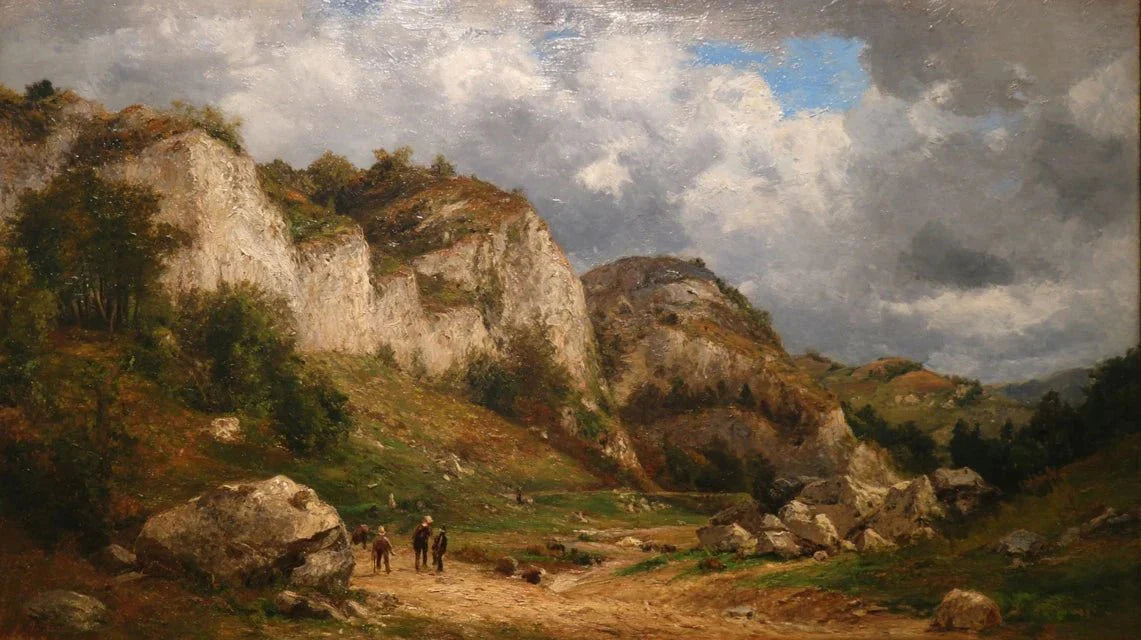
Courbet knows every rock in his native region. He has climbed these limestone cliffs, fished in the Loue, hunted in those forests. When he paints them, they are not generic landscapes but specific places, charged with collective memory.
"To paint a country, you must know it," he simply says. This sentence sums it all up. His academic contemporaries composed imaginary landscapes in their Parisian studios. He goes out with his easel, walks to the Source of the Loue, sets up his equipment and paints what he sees.
Result: his paintings become portraits of territory. The inhabitants of Ornans immediately recognize the gorges of Nouailles, the Puits Noir, la Brême. These sites are not tourist attractions but their daily working environment. To understand the radical originality of this approach to landscape painting, discover how modern wall art landscapes perpetuate this tradition of inhabited nature.
Characteristics of popular nature in Courbet’s work:
- Identifiable sites: each painted location corresponds to a real and precise geography
- Working presence: the characters work in the landscape rather than contemplate it
- Topographical fidelity: refusal of embellishment and recomposition
- Social anchoring: nature as a space for subsistence and daily labor
The characters in his landscapes are never decorative. Look at Les Casseurs de pierres (unfortunately destroyed in 1945): two workers break stones on a road. They turn their backs to us, anonymous, exhausted. Courbet saw them during a walk and had them come pose in his studio the next day.
This popular nature stands in direct opposition to the aristocratic nature of the gardens of Versailles or the mystical nature of the Romantics. With Courbet, one does not contemplate, one works. One gathers wood, hunts roe deer, cultivates vines. Nature is not a backdrop but a space for subsistence.
Painting technique and materiality in Courbet's realistic landscapes
Get close to a landscape by Courbet. You will see that the paint forms reliefs, ridges, valleys of matter. The painter applies his color with a knife, like a mason spreads his mortar. This technique shocks his contemporaries accustomed to the smooth and polished surfaces of academic paintings.
But this brutal gesture carries meaning. By making visible the work of the painter, Courbet affirms that art is a manual labor comparable to that of workers. He "bricks" his paintings, according to one critic. This worker metaphor is not innocent in the context of the realistic movement.
The rocks in his landscapes acquire an extraordinary physical density. You could almost touch them, feel their calcareous roughness. The thick impasto creates a tactile surface that engages the body as much as the eye. In front of these realistic paintings, one does not look through an illusionistic window, but experiences transformed matter.
His palette also contributes to this materialist realism. No sugary colors, no decorative harmonies. The greens, browns, and grays of Courbet come directly from the geology of Franche-Comté. This chromatic sobriety, judged "ugly" by lovers of the ideal beauty, affirms the primacy of reality over aesthetic conventions.
Courbet's landscapes facing academic conventions
The Academy of Fine Arts had established a strict hierarchy of artistic genres. At the top was historical painting with its battles and biblical scenes. Still lifes and landscapes languished at the bottom, considered as simple exercises in imitation.
Courbet blows up this pyramid. He paints rural valleys in formats six meters wide. He gives the rocks of Ornans the treatment reserved for the coronation of Napoleon. This transgression of formats is already a revolution that announces modern art.
But he goes further by ignoring compositional rules. The Academy taught three-plane construction, pyramidal organization, balance of masses. Courbet sits in front of nature and paints what he sees, even if it means placing a tree in the middle of the canvas or reducing the sky to a thin strip.
This freedom stems from his practice of painting from nature. By working directly in front of the landscape, he submits to the constraints of reality rather than the rules of the studio. The irregularity of nature dictates the structure of the painting. This method, which the Impressionists will adopt twenty years later, constitutes a methodological revolution.
His refusal of idealization further isolates him from conventions. Academic landscape painters systematically "corrected" nature, eliminating dead branches, softening overly abrupt reliefs. Courbet paints the cliffs of Ornans with their fractures, their visible geological strata, their anarchic vegetation. This raw fidelity to reality forms the modern value of his work.
Frequently Asked Questions about Courbet's Landscapes
Why did Courbet’s landscapes cause a scandal?
Courbet used monumental formats traditionally reserved for historical painting to represent simple landscapes from the Franche-Comté region. This transgression of academic hierarchies, combined with his brutal knife technique and refusal to idealize nature, shocked the bourgeois public and conservative critics of the 19th century.
What is the difference between a Romantic landscape and a realistic landscape by Courbet?
The Romantics painted a spiritualized, dramatic, and often imaginary nature, seeking the sublime and escape. Courbet represents a inhabited and worked nature, anchored in specific places in Franche-Comté, where peasants and workers evolve. His social realism makes the landscape a political and popular space.
Where can I see Courbet’s landscapes today?
The largest public collection of Courbet's landscapes is at the Musée Gustave Courbet in Ornans, his hometown. The Musée d'Orsay in Paris also holds several major works, including seascapes and forest scenes. Numerous international museums have the French painter's landscapes in their collections.