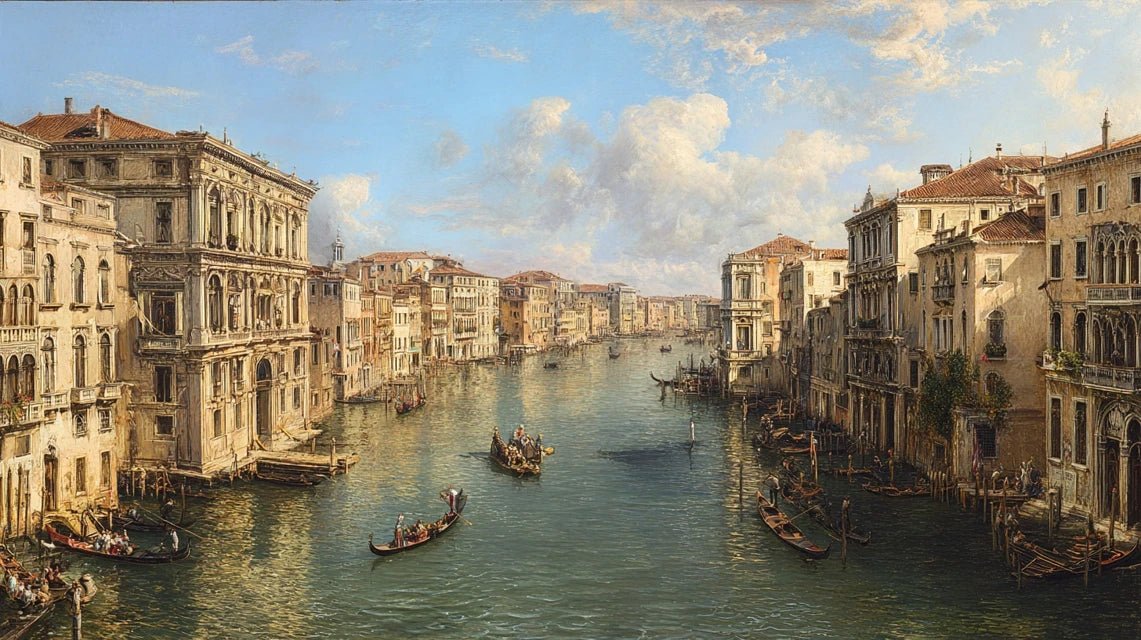
One summer morning on the quays of the Grand Canal, a Venetian fisherman watches a man installing a strange wooden box. "What are you doing?" he asks, intrigued. The artist smiles: "This isn't a box, it's a window to the truth of Venice." Giovanni Antonio Canal, known as Canaletto, then revolutionizes urban landscapes painting with an obsession: capturing architecture with the precision of a surveyor.
Canaletto and the architectural precision of Venetian urban landscapes
Canaletto transforms each Venetian view into a veritable architectural archive. His paintings never lie: every column of the Doge's Palace, every arcade of St. Mark's Square, every balustrade of the Rialto Bridge appears with astonishing architectural accuracy.
This rigor goes far beyond mere aesthetic concern. The painter measures, counts, verifies. In his "Piazza San Marco" created between 1725 and 1727, he documents with such precision the new white geometric paving by Andrea Tirali – completed in 1723 – that historians now use this painting to date the work.
Even more remarkably: Italian researchers Dario Camuffo and Giovanni Sturaro analyzed the algae lines on the facades of the palaces along the Grand Canal Venice in his paintings. Result? They were able to reconstruct the evolution of the Venetian sea level over three centuries (Source: Museo Correr). Canaletto's urban landscapes now serve as scientific instruments.
Trained as a theater decorator by his father Bernardo Canal, the artist applies this stagecraft expertise to the city. Each view becomes a set where architecture plays the leading role. Buildings are no longer mere backgrounds – they tell the story of Venice, stone by stone.
Perspective as a technical foundation of Canaletto's urban landscapes
Canaletto's perspective geometry defies conventions. Where his contemporaries let distant elements recede naturally, he does the opposite: the background seems to approach the viewer. This inversion creates a unique visual intensity.
His secret? Perspective ad angolo, directly inherited from theatrical stagecraft. In "The Grand Canal viewed from the Palazzo Balbi towards the Rialto" (1724), the shooting angle amplifies the monumentality of the Venetian palaces. The vanishing lines converge with a mathematical accuracy worthy of a Renaissance architect.
Canaletto also plays with the height of his gaze. To capture Piazza San Marco, he climbs to an upper window of the Procuratie Vecchie. This bird's-eye view reveals the complete geometry of the square – impossible to perceive from the ground. The urban space becomes a composed orchestration.
Each architectural element rigorously structures his paintings:
- Columns that guide the eye vertically
- Arches that create frames within frames
- Facades that rhythmically structure the space horizontally
- Reflections in the Grand Canal that double the perspective
This technical mastery transforms urban topography into an immersive experience. The viewer does not look at Venice – they enter it.
To discover how contemporary artists are reinventing this tradition of city views, explore landscape paintings that dialogue with the legacy of Canaletto.
Camera obscura and architectural precision: the tools of Canaletto
The camera obscura revolutionizes the Venetian master's approach. This ancestor of the camera – a closed box equipped with a lens and a mirror inclined at 45 degrees – projects the external image onto a surface where the artist can trace it. The Correr Museum in Venice carefully preserves a camera obscura bearing the inscription "A.CANAL".
Canaletto uses two types of instruments. A small portable camera obscura for quick sketches on site. And a larger tent-camera in which he installs himself for detailed studies. His notebook, kept at the Gallerie dell'Accademia, contains 140 pages of sketches made with this tool, raw material for his paintings from the 1730s (Source: Gallerie dell'Accademia).
But be warned: Canaletto is never a slave to his machine. Francesco Algarotti, Venetian scientist close to the painter, warns against blind trust in the instrument. The master corrects optical distortions, adjusts proportions, eliminates what "could offend the senses". His precision results from a dialogue between mechanical observation and artistic judgment.
Philip Steadman, a British researcher, has reconstructed an 18th-century camera obscura according to original plans. His experiments on the roof of Lambeth Palace – where Canaletto sketched the Thames in 1746 – reveal a fascinating technique: the artist combines several shots to create panoramas impossible to capture from a single point. A true "photomontage" before its time.
Architectural accuracy of monuments in urban landscapes
Each Venetian monument emerges with remarkable fidelity under Canaletto's brush. The Campanile di San Marco retains its exact proportions – even if the painter sometimes reduces the number of windows for visual clarity. The Santa Maria della Salute basilica exhibits its Baroque domes with their sculpted volutes.
The church of San Simeone Piccolo, recently completed in 1738, dominates his paintings. Canaletto slightly exaggerates its scale to accentuate its presence. Miniature gondoliers in the foreground contrast with the monumentality of the dome.
This accuracy extends to details that others would neglect:
- Sculpted balustrades of bridges, stone by stone
- Rugged textures of Istrian stone facades
- Alternation of light and shadow on the colonnades
- Wavy reflections of Renaissance architectures in the water
- Characteristic lines of Venetian roofs (altanas)
The painter even documents decay. In "Rio dei Mendicanti" (1724), crumbling walls and missing stones bear witness to a rare authenticity. No idealized Venice – the real city, alive and imperfect.
This almost photographic approach transforms his works into invaluable visual archives. When researchers want to understand the urban evolution of Venice in the 18th century, they consult Canaletto before contemporary plans.
Manipulation of perspective to sublimate urban landscapes
Fascinating paradox: Canaletto's meticulous precision coexists with an assumed creative freedom. The painter systematically adjusts reality to optimize his compositions. In "Campo Santi Giovanni e Paolo" (1735-1738), the Gothic church gains height thanks to artificially lowered viewpoint.
Transformations become signature:
- Relocation of towers to create visual openings along the canals
- Impossible widening of perspective by merging several angles
- Rotation of buildings: San Giorgio Maggiore pivots to face the viewer
- Spatial compression to bring distant monuments closer
In "The Basin of Saint Mark's", he juxtaposes views taken from different points on the Punta della Dogana. The visual field widens beyond natural optical limits. Result? A panorama that the human eye could never grasp in a single glance.
The British consul Joseph Smith, Canaletto's main patron, encourages this approach. Grand Tour collectors are not looking for arid topographic surveys. They want an "ideal Venice" – architecturally accurate but compositionally sublime.
This duality between technical rigor and artistic freedom defines the genius of Canaletto’s vedutismo. One hundred fifty years before the invention of photography, he creates images with architectural precision scientific while retaining the sensitivity of a painter-poet. His urban landscapes do not simply document Venice – they reinvent it.
Frequently Asked Questions
What technique did Canaletto use to achieve such architectural precision?
Canaletto combined the use of a camera obscura with on-site sketches and a deep knowledge of perspective geometry. He owned a portable camera obscura marked "A.CANAL" (preserved at the Correr Museum) and filled sketchbooks containing up to 140 pages of detailed architectural drawings.
Are Canaletto's urban landscapes faithful to reality?
Yes and no. While the architectural precision of the monuments is remarkable – to the point that his works now serve as scientific references for studying the evolution of Venice – Canaletto manipulated perspective and moved certain elements to improve his compositions. He created an "ideal Venice", architecturally accurate but artistically optimized.
Why does Canaletto's perspective seem different from other painters?
Canaletto reversed traditional depth of field: instead of letting distant elements recede, he brought them visually closer to the viewer. This technique, inherited from his training in theatrical design and called "perspective ad angolo", creates a unique visual intensity that literally immerses the viewer in the Venetian urban landscape.