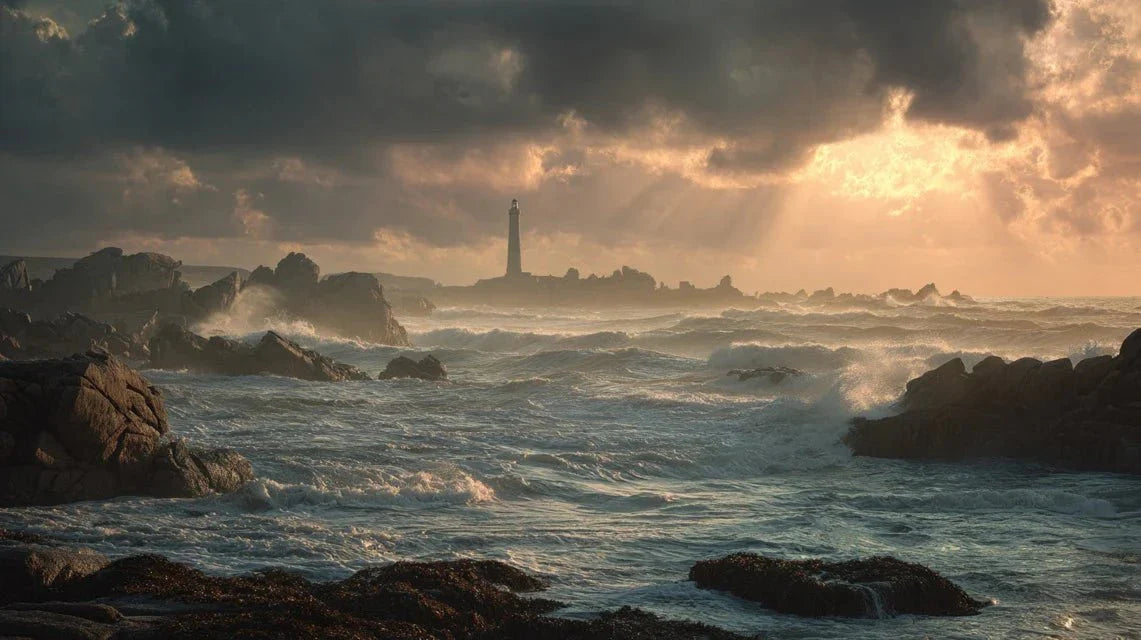
Imagine yourself facing the Atlantic Ocean, on a rocky promontory in Finistère. The salty wind whips your face. Before you, foamy waves crash against centuries-old rocks. The sky changes color every ten minutes. This is the very essence of Brittany's coastal landscapes – wild, changing, fascinating.
Capturing this unique atmosphere is an art in itself. It’s not simply pressing a shutter release. It's understanding how the light dances on the water, how mist envelops a solitary lighthouse, how the elements tell a story through marine photography.
The atmospheric characteristics of Brittany's coastal landscapes
Brittany has a visual personality found nowhere else. Take the Pink Granite Coast in Ploumanac’h: these rock formations change from gray to copper pink when the sun declines. A true spectacle of vibrant colors.
Or Pointe du Raz, classified as one of France's Great Sites. There, you feel the raw power of the ocean. The breakers exploding against the black cliffs create a deafening roar. White foam contrasts violently with the dark rock. It’s theatrical, almost intimidating.
But what really makes these landscapes unique is the humidity. Humidity levels regularly reach 80 to 90% on the coast (Source: Météo-France). The result? That famous Breton mist that filters light like a natural veil. It softens everything, creating subtle gradations between sky and sea. The lighthouses of Petit Minou or La Vieille emerge from this mist like mysterious sentinels.
And then there's the coastal weather. It changes mood faster than a capricious child. One minute, the sun floods everything. The next, a trailing sky descends on the coast. This instability creates golden opportunities to capture contrasting atmospheres:
- Clearings that break through the clouds and illuminate a portion of moorland
- Overcast skies offering an infinite palette of grays, from platinum to graphite
- Spectacular storms with waves several meters high
- Morning mists that envelop the inlets in total mystery
Techniques for capturing the atmosphere of Brittany's coastal landscapes
How to transform this vision into a memorable image? Several techniques work wonders on the Breton coast.
Long exposure, first. You install your camera on a sturdy tripod. You set the exposure between 10 and 30 seconds. And there, magic: the waves that break become a milky, dreamlike sheet. Movement transforms into texture. Agitation turns into serenity. It’s almost hypnotic.
Next, think foreground. A rock covered in brown seaweed that smells of iodine. A granite formation sculpted by millennia of erosion. The remains of an old fishing boat washed ashore. These elements tell a story. They anchor your image in Breton reality and create depth that draws the eye to the horizon.
The atmospheric perspective also plays a crucial role. Look into the distance: the rocky islets, the boats on the horizon, the distant peaks gradually fade away. The colors become cooler, the outlines less distinct. Accentuate this effect and you amplify the feeling of infinite space, that immensity which characterizes the ocean.
If you want to keep this connection with the Breton universe at home, landscape paintings extend this coastal emotion in your daily life.
The light in Breton coastal landscapes: key to the atmosphere
Let's talk about light. It’s everything.
The Breton golden hour is legendary. When the sun skims across the Atlantic, everything ignites. The schist cliffs take on hues of fire. Shadows lengthen, sculpt tormented reliefs. The contrast between this raking light and the cold tones of the ocean creates a fascinating visual tension.
Morning offers something else. A pure clarity that reveals every texture. The eroded granite, the brown algae on the rocks, the pools left by the receding tide which shimmer like golden mirrors. It's the light of truth, the one that doesn’t lie.
And cloudy days? Don't avoid them! This diffused light is perfect for capturing the typically Armorican coastal ambiance. Harsh shadows disappear. The entire range of grays and blues is revealed. Water particles suspended in the air act as a giant natural diffuser. It’s soft, it's melancholic, it's deeply Breton.
The backlighting near lighthouses creates dramatic silhouettes. A halo of light surrounds the structures. The graphic design is reinforced. An ordinary scene becomes a memorable composition.
Composing to enhance the atmosphere of Breton coastal landscapes
The maritime composition, it's about telling a story visually.
The rule of thirds works wonderfully on the coast. Place your horizon line at the top third to highlight marine elements. Or at the bottom third to give all the power to the sky filled with threatening clouds.
Use the natural lines. The GR34 trail winding along the cliffs. The alignments of rocks revealed at low tide. The streaks left by the receding waves. These lines guide the eye, create movement, reinforce depth.
Play with scale. A tiny hiker on a promontory battered by winds. A fisherman's house facing the oceanic immensity. These contrasts amplify the power of the maritime atmosphere. They transform your image into an emotional narrative.
Don't forget the Breton markers. The red and white striped lighthouses. The stacked crustacean boxes on the quays. The colorful boats in the ports. These details are not anecdotal. They anchor your image in a specific territory, tell a living culture.
Optimizing the atmospheric capture of Breton coastal landscapes
Optimization begins before you even leave home.
Check the tide times. Seriously. Low tide reveals another world: polished rocks, rock pools full of water, pebble beaches. High tide offers powerful waves against the cliffs. The same location, two completely different atmospheres.
Monitor the weather, but not to avoid bad weather. A high tidal coefficient gives spectacular surf. Thick fog turns lighthouses into ghostly apparitions. Every weather condition offers unique opportunities to capture the atmosphere of Brittany in all its diversity.
Timing? The transition moments are magical. The dawn slowly breaking through. The dusk setting everything ablaze. But also just before or after a shower, when the air saturated with water filters the light uniquely. These fleeting moments require you to be there, at the right time, ready to react.
Finally, the final atmospheric rendering. Stay subtle. Slightly increase the contrast of the clouds. Reveal the details in the shadows of the rocks. Gently cool the tones of the water. The goal? Intensify the atmosphere without betraying it. Faithfully convey this particular coastal atmosphere that makes up the identity of the Breton coastline and continues to fascinate all those who look at these exceptional marine landscapes.
FAQ - Capturing the Atmosphere of the Brittany Coast
Q1: What is the best time to photograph the Brittany coast?
The months of autumn and winter offer the most dramatic lights and the most changeable atmospheric conditions. Storms from September to March create spectacular atmospheres. However, summer mornings bring soft light and a light mist ideal for capturing the poetry of the coastline.
Q2: Should you prefer good weather or bad weather on the Brittany coast?
Both have their interest! Bad weather creates a dramatic atmosphere with mists, low clouds and powerful surf - the very essence of authentic Breton ambiance. Good weather offers golden lights and reflections on the water that sublimate the rocky formations. The ideal is to vary the conditions to enrich your vision of the coastal landscapes of Brittany.
Q3: What equipment is essential for capturing the Brittany coastal atmosphere?
A stable tripod is essential for long exposures and windy conditions. A polarizing filter helps manage reflections on water and intensify sky colors. Also, provide splash protection for your gear. Humidity and salt are enemies of lenses!