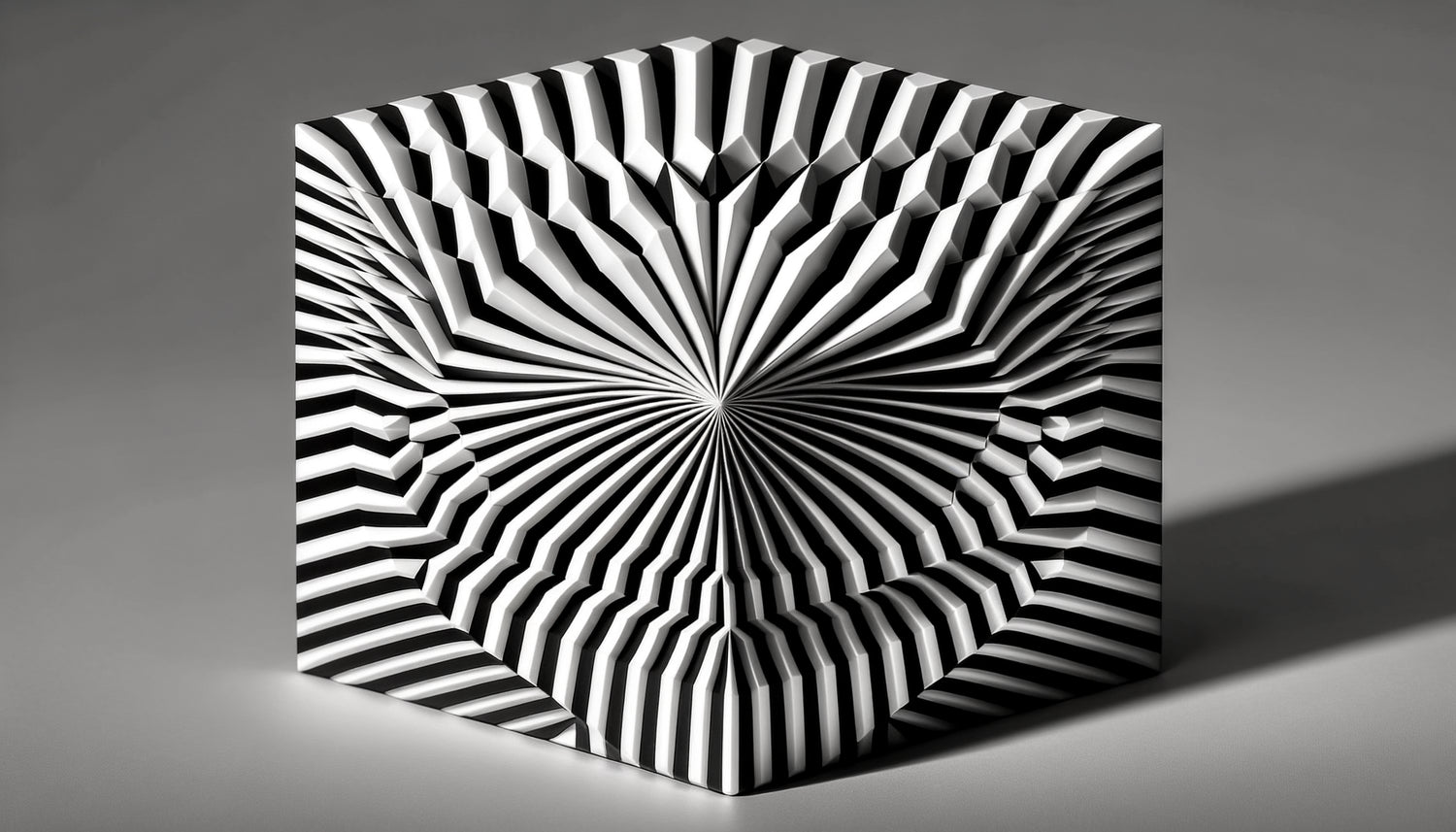
The vernissage was sublime. The monumental black and white work captivated everyone's attention. Then, after fifteen minutes, I saw this elegant woman raise her hand to her temple, close her eyes, and quickly leave the gallery. Later, she confided in me that she had felt flashes of light, shimmering zigzags in her field of vision. An ophthalmic migraine, triggered by the violent contrasts of the installation.
Here's what extreme black-and-white contrasts can trigger in some people: overstimulation of the visual cortex, chaotic neuronal discharges, and temporary visual disturbances that can evolve into full-blown migraines. Three neurological mechanisms that transform the aesthetic experience into a physical ordeal.
You love minimalist graphic art, those radical compositions where black and white dialogue in maximum tension. Yet, you've noticed these strange sensations after prolonged exposure: eye fatigue, persistent glare, sometimes even throbbing headaches. You wonder if your sensitivity is depriving you of these powerful works.
Rest assured: understanding the neurological mechanisms behind these reactions not only allows you to protect your well-being, but also to intelligently design your spaces. Chromatic balance does not exclude visual audacity.
I'm going to reveal why some brains react so intensely to extreme black-and-white contrasts, what the specific triggering factors are, and how to appreciate this aesthetic without compromising your neurological comfort.
When the brain overheats with black and white
Our visual cortex functions like an ultra-sophisticated processor that constantly analyzes light information. When you fixate on a white surface adjacent to an intense black area, your neurons must simultaneously process two extremes of the light spectrum. White reflects nearly 90% of the light, black absorbs more than 95%.
This creates an explosive neuronal activity. Ganglion cells in the retina transmit contradictory signals to the brain: maximum excitation on one side, deep inhibition on the other. The primary visual cortex, located at the back of the skull, must process this dichotomy in milliseconds.
In some predisposed individuals, this overload triggers what neurologists call an invading cortical depression. Imagine an electrical wave slowly spreading through the cortex, temporarily disrupting the normal functioning of neurons. This abnormal wave generates the characteristic symptoms: scintillating scotomas, broken lines, moving blind spots.
Extreme contrasts act as particularly powerful visual triggers. Unlike smooth transitions between shades, abrupt boundaries between black and white create light gradients that the brain struggles to modulate. It is this informational brutality that exhausts the neuronal circuits.
The phenomenon of retinal persistence amplified
Add to that a perverse effect: retinal persistence. After focusing on an intense black area, your photoreceptors remain temporarily inhibited. When your gaze shifts to white, these understimulated cells send a rebound signal, creating an over-perception of light. Your brain then receives conflicting information which amplifies neuronal desynchronization.
The patterns that trap the eye
Not all black and white contrasts are equal. Some geometric patterns become true neurological traps. High-frequency vertical stripes, tight checkerboards, alternating spirals: these compositions stimulate specific neuronal circuits involved in edge and motion detection.
I have observed that repetitive patterns between 3 and 20 cycles per degree of visual angle are particularly problematic. At this spatial frequency, neurons in the primary visual cortex enter resonance, mutually exciting each other in a positive feedback loop. This is exactly the mechanism sought by Op Art artists, but it's also what triggers ophthalmic migraines.
The works of Bridget Riley or the compositions of Victor Vasarely perfectly illustrate this phenomenon. Their genius lies precisely in their ability to push the visual system to its limits. But for a sensitive brain, this stimulation becomes aggression.
Shiny surfaces amplify the problem. A black and white painting under glass, illuminated by spotlights, creates secondary reflections that add unpredictable contrasts. Your eye then has to manage not only the chromatic opposition of the work, but also the parasitic glare that arises according to your angle of vision.
The critical size of the visual stimulus
The dimension of the artwork plays a crucial role. A small black and white contrast of 20 centimeters stimulates a restricted area of your visual field. But a three-meter fresco invades your peripheral vision, simultaneously activating millions of neurons. The larger the surface, the greater the risk of generalized neuronal discharge.

Photosensitivity: when genetics come into play
Why do some people walk through a graphic art gallery without flinching while others waver? The answer largely lies in individual photosensitivity, a partially hereditary neurological trait.
Photosensitive individuals have neurons with a lower excitation threshold. Their visual cortex reacts disproportionately to contrasting light stimuli. Electroencephalography studies show that their brain activity facing extreme contrasts presents peaks of amplitude two to three times higher than normal.
This hypersensitivity affects about 10 to 15% of the general population, but up to 60% of people suffering from chronic migraines. If you have a family history of migraines, your chances of being affected by violent black-and-white contrasts increase significantly.
Age and hormonal cycles also modulate this sensitivity. Fluctuations in estrogen levels in women influence neuronal excitability, making some periods of the month more vulnerable. Similarly, after 50 years old, changes in the lens and retina can paradoxically reduce contrast sensitivity.
The lighting environment as an amplifier
A black-and-white painting hanging in your living room does not produce the same effects depending on the ambient lighting. An overexposed room with cold white LEDs (6000K) amplifies the contrasts already present in the work. Your pupils contract to their maximum, reducing depth of field and accentuating the sharpness of black-and-white borders.
Conversely, a dimmed and warm light (2700-3000K) softens extreme contrasts. Your pupils dilate slightly, creating natural optical diffusion that attenuates brutal transitions. This is why sophisticated galleries use indirect and adjustable lighting.
Digital screens are a modern trap. A black-and-white pattern displayed on a monitor emits light directly into your eyes, unlike a physical artwork which reflects ambient light. The absolute luminous intensity is therefore much higher, even if the relative contrast seems identical. Add the imperceptible flicker of screens (even at 60Hz), and you get a perfect cocktail to trigger an ophthalmic migraine.
The cumulative effect of exposure
Your brain generally tolerates brief exposure to violent contrasts. But after 20 to 30 minutes of continuous exposure, the neuronal compensation mechanisms become exhausted. The inhibitory neurons that normally moderate excitation become less effective. This is when symptoms appear: visual auras, eye fatigue, onset of headache.

Arrangement strategies for sensitive brains
Do you have to give up the timeless elegance of black and white? Absolutely not. It is enough to apply a few principles of neurodesign to enjoy this aesthetic without risk.
Favor gradual contrasts rather than abrupt ones. A work where black gradually merges into white, with intermediate gray areas, stimulates the visual cortex much less violently. Gradients, textures and superimpositions create transitions that your brain processes effortlessly.
Integrate visual rest zones. If you opt for an intense graphic piece, surround it with neutral surfaces: a pearl grey wall, natural wood furniture, beige textiles. Your gaze can regularly turn away from the area of maximum contrast to recover. This alternation prevents cumulative neuronal overload.
Adjust the viewing distance. An empirical rule: the more violent the contrast, the further the work should be. At three meters distance, contrasts smooth out naturally through the optics of your eye. Fine details merge, reducing the spatial frequency of problematic patterns.
Master lighting with sophistication. Install dimmers on your light sources. In late afternoon, when your visual cortex is already tired from a day of stimulation, reduce the intensity. Opt for warm-toned bulbs that envelop rather than cut.
The power of matte surfaces
Systematically choose prints on matte paper or unvarnished canvases for your black and white works. Matte surfaces diffuse light evenly, eliminating reflections that create secondary contrasts. This simple precaution reduces the intensity of problematic visual stimuli by 40 to 50%.
Warning signs to recognize
Your body sends you subtle messages before a ophthalmic migraine fully sets in. Learning to detect them allows you to act preventively.
The first sign: a slight visual distortion. Straight lines seem to undulate imperceptibly, as if you were looking through agitated water. This phenomenon indicates that your visual cortex is beginning to malfunction.
Next comes a disproportionate sensation of eye fatigue. Your eyes feel heavy, as if after several hours of intense reading, yet you have only looked at the artwork for a few minutes. Your eyelids blink more frequently, instinctively trying to rest the exhausted photoreceptors.
Then appear the characteristic scintillating scotomas: mobile blind spots bordered by luminous zigzags, often crescent-shaped or resembling medieval fortifications. These visual hallucinations correspond exactly to the progression of the cortical depression wave through your visual cortex.
If you recognize these symptoms, immediately look away from the stimulus. Close your eyes for a few moments, gently massage your temples, take deep breaths. In 70% of cases, this early interruption prevents progression to an established migraine.
Savor the timeless elegance without compromising your comfort
Discover our exclusive collection of black and white artworks selected for their visual sophistication and controlled contrasts, designed to enhance your interiors without overwhelming your senses.
Towards a conscious and sustainable appreciation
Understanding the neurological mechanisms behind your sensitivity to extreme contrasts transforms your relationship with graphic art. You are not fragile or deficient: your brain simply has a particular neuronal reactivity.
This awareness allows you to appreciate black and white artworks intelligently. You learn to dose exposure, choose the right viewing conditions, listen to the subtle signals of your visual system. Radical aesthetics become accessible without sacrifice.
Imagine yourself in your living room, serenely contemplating this graphic composition that you have long admired. Soft lighting envelops the room, contrasts soften naturally. You enjoy the timeless elegance of black and white without that dull tension behind your eyes. Your space reflects your taste for minimalism while respecting your unique physiology.
Start today: evaluate the lighting in your rooms, experiment with viewing distances, note your reactions to different types of contrasts. This conscious observation approach will give you the keys to a visual environment that is both bold and soothing.
Frequently asked questions about black-and-white contrasts and visual health
Does everyone develop migraines from extreme contrasts?
No, only a minority of people have sufficient photosensitivity to trigger ophthalmic migraines when faced with violent black-and-white contrasts. This predisposition depends on genetic factors, migraine history, and the individual reactivity of the visual cortex. Most people experience at worst mild eye fatigue. If you have never experienced particular visual symptoms when facing graphically contrasted works, you are probably among those who are not very sensitive. On the other hand, if you already suffer from regular migraines, you statistically have a 60% chance of having increased sensitivity to intense visual stimuli.
Do digital screens make black-and-white contrasts more dangerous?
Absolutely. Screens emit direct light with a much higher intensity than physical works that simply reflect ambient light. A black-and-white pattern on screen projects photons directly into your retina, creating a much more violent stimulation. Moreover, even modern screens exhibit an imperceptible flicker which adds a temporal dimension to spatial contrasts, doubling the neuronal load. For this reason, if you are sensitive to extreme contrasts, limit your exposure time to digital black-and-white patterns, increase the distance from the screen, reduce brightness, and activate blue light filters that slightly attenuate contrasts. Physical works remain always gentler for your visual system.
Can one reduce their sensitivity to contrasts over time?
Basic neurological sensitivity remains relatively stable, but you can develop effective adaptation strategies. Your brain has remarkable plasticity: progressive and controlled exposure to moderate contrasts can strengthen neuronal compensation mechanisms. Start with works with soft contrasts, then gradually increase the intensity over several weeks. At the same time, some practices improve the overall resilience of your nervous system: regular sleep, optimal hydration, stress management, and reduction of other migraine triggers (excessive caffeine, alcohol, magnesium deficiencies). With these adjustments, many people notice an improvement in their tolerance to intense visual stimuli over 3 to 6 months. The goal is not to completely eliminate sensitivity, but to significantly increase your comfort margin.