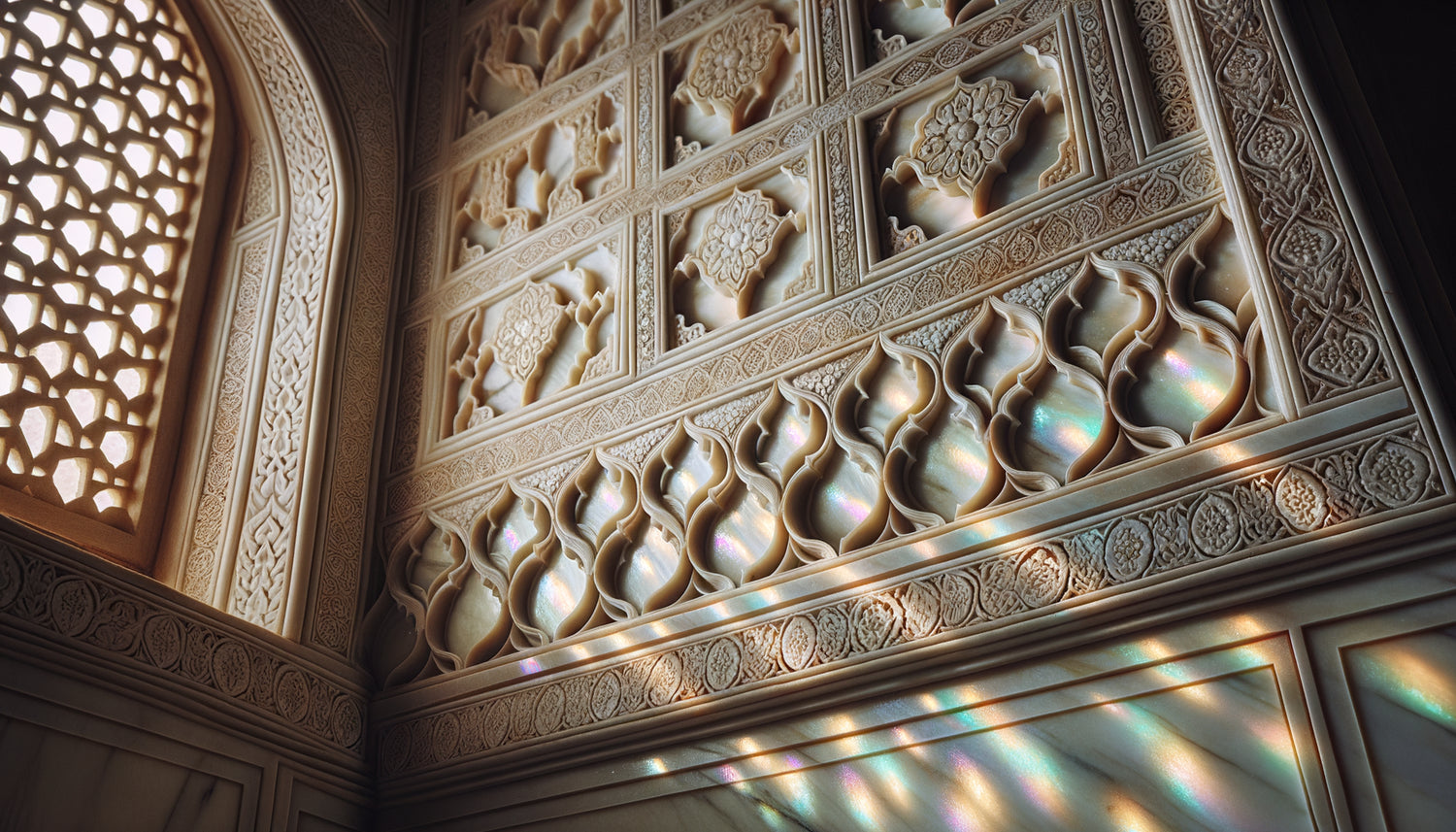
I spent three years restoring the frescoes of a 17th-century Rajasthani haveli when I discovered something extraordinary under my brushes: the walls seemed to literally breathe light. Even in the flickering glow of my lamp, these centuries-old walls captured every photon to send it back transformed, sublimated. Analysis revealed the secret: millions of crushed mother-of-pearl particles, trapped in the plaster for four centuries, continued their luminous dance.
Here's what mother-of-pearl brought to the wall preparations of Mughal palaces: a living luminosity that followed the course of the sun, natural thermal regulation in these stone fortresses overheated, and a material prestige that transformed architecture into a political manifesto. This precious powder was not just a pigment – it was a sophisticated technology at the service of an imperial art of living.
Today, our interiors desperately seek this quality of light. We multiply LED sources, mirrors, and shiny surfaces without ever finding this organic depth that characterized Mughal spaces. We have forgotten that light is not measured in lumens, but in emotions.
Yet, understanding these ancestral techniques can radically transform our approach to color and material in our contemporary spaces. The secrets of the Mughal master craftsmen still resonate with our current aspirations: to create interiors that dialogue with natural light rather than fight it.
Mother-of-pearl, a treasure from the depths at the service of the empire
In the imperial workshops of Agra and Delhi, the chitrakar – these painter-artisans who embodied Mughal excellence – never worked with ordinary materials. The mother-of-pearl came from specific shells, mainly pearl oysters and trochus collected along the coasts of the Persian Gulf and the Sea of Oman.
The preparation process was almost alchemical. The shells were first meticulously cleaned, freed from all organic matter, then calcined at a controlled temperature. This crucial step transformed the nacreous structure without destroying its optical properties. Next came grinding – an endless work of patience on porphyry stones, sometimes for weeks, until a powder as fine as talc was obtained.
This powder contained aragonite crystals arranged in microscopic lamellar structures. It is precisely this natural architecture that created the phenomenon of iridescence: light did not simply bounce off the surface, it penetrated between the crystalline layers, divided, reflected at different levels, creating a three-dimensional luminosity.
An ingredient worth its weight in gold
In the accounting records of Emperor Shah Jahan, preserved in the National Archives of Delhi, we discover that mother-of-pearl was listed among precious materials, alongside lapis lazuli and gold leaf. Its cost was explained by the scarcity of high-quality shells and the weeks of work needed to produce a few kilos of usable powder.
The art of wall preparation: an age-old science
The walls of Mughal palaces were never treated lightly. Wall preparation followed a rigorous protocol that could take several months. The stone or brick surface first received several successive layers of plaster, each finer than the previous, creating a gradual transition between the raw support and the precious finish.
The base layer, called araish, mixed lime, marble powder and sometimes vegetable fibers to ensure cohesion and adhesion. Intermediate layers then followed with progressively decreasing grain size. It was in the two or three last layers that mother-of-pearl was incorporated, mixed with slaked lime, egg or sometimes vegetable gums as a binder.
The secret lay in the precise ratio between pearl and binder. Too much pearl made the plaster fragile and powdery; not enough diluted the desired optical effect. Master craftsmen adjusted their proportions according to the wall's orientation, the expected light intensity, and even according to the seasons – because these wall preparations were applied only during dry periods, never during the monsoon.
Polishing: revealing the soul of the wall
Once the plaster was applied, the crucial step of polishing began. Using agate stones mounted on wooden handles, artisans rubbed the still slightly damp surface in circular motions for hours. This friction compacted the pearl crystals, partially oriented them, and created a surface of almost silky softness to the touch. The final result resembled more precious stucco than a simple plaster.

When light becomes architecture
In the Red Fort of Delhi or the Taj Mahal of Agra, walls treated with mother-of-pearl accomplished a feat that our modern coatings never manage to equal: they transformed mineral hardness into luminous softness. Where an ordinary white wall brutally reflects light, creating glare and visual fatigue, pearl diffused an enveloping clarity.
This quality truly came into its own in Mughal architecture, where water features, gardens, and cleverly calculated openings created a permanent dance of light. The reflections of the basins danced on the pearly walls, the moucharabiehs projected their lace shadows that seemed to float over these milky surfaces. Emperor Jahangir wrote in his memoirs that his private apartments, with walls enriched with mother-of-pearl, provided him with a feeling of coolness even during the hottest hours.
For mother-of-pearl also possessed remarkable thermal virtues. Its crystalline structure reflected not only visible light but also a significant portion of infrared radiation. These palaces, despite their exposure to the relentless sun of northern India, retained an surprisingly moderate interior temperature – a bioclimatic comfort that we are rediscovering today with our modern reflective insulation.
Beyond Technique: Symbolism and Power
The use of mother-of-pearl white in Mughal palaces transcended the simple aesthetic question. It embodied a vision of power where material refinement reflected spiritual legitimacy. In Persian and Islamic culture that permeated the Mughal court, light was not just a physical phenomenon – it symbolized divine presence, wisdom, justice.
A sovereign who transformed his palace into a luminous setting demonstrated his ability to transform raw matter into transcendent beauty. Chroniclers of the time described audience halls with pearly walls as spaces where the emperor literally appeared bathed in light, reinforcing his image as an intermediary between the earthly and the celestial.
This symbolic dimension explains why mother-of-pearl was reserved for the most prestigious spaces: throne rooms, imperial apartments, dynastic mausoleums. Mughal palaces contained entire areas where these wall preparations created a spatial hierarchy immediately perceptible – the closer one got to the heart of power, the more luminous and precious the walls became.
A Signature of Excellence Recognized Worldwide
Foreign ambassadors who visited the Mughal courts reported back to their capitals amazed descriptions of these interiors with walls of light. These testimonies fueled the legendary reputation of the Mughal Empire as a civilization of supreme refinement, permanently influencing the image of the Orient in the European imagination.

What the Mughal Palaces Teach Us About Contemporary Interiors
Restoring these ancestral surfaces, I realized that the Mughal artisans had solved problems we still face today in our design projects. Their approach to mother-of-pearl offers valuable lessons for those seeking to create contemporary spaces with character.
First, they understood that color does not exist independently of texture and light. Mother-of-pearl white is never static – it evolves with the hour, the season, the orientation. This temporal dimension transforms space into a living experience rather than a frozen decor. In your projects, seek materials that dialogue with natural light: lime plasters, Venetian stuccos, quality microcement possess this ability to reveal depth rather than simply reflect.
Next, Mughal wall preparations remind us of the importance of layering. Beauty never arises from a single coat applied hastily. It emerges from patient construction, the accumulation of mastered technical gestures. This philosophy applies wonderfully to renovation projects where respecting and revealing historical layers can create an incomparable visual richness.
Finally, the use of mother-of-pearl illustrates how a noble material, used sparingly in strategic locations, creates more impact than a profusion of decorative elements. This economy of means resonates particularly with contemporary minimalist aspirations – elegance is born of quality, not quantity.
Create Your Own Dialogue with Light
Discover our exclusive collection of black and white artworks that play with contrasts and depth to bring this timeless dimension inspired by the great masters of luminous architecture.
Reinventing the Mughal Lesson in Your Daily Life
You probably won't transform your walls into pearlescent surfaces – and it’s not necessary. The spirit of these ancestral wall preparations can inspire more accessible but equally impactful choices.
Prioritize paints and plasters that retain a visible materiality: slightly textured matte finishes capture grazing light and create the sought-after depth. Avoid overly pure and cold whites; opt for slightly creamy, ivory, or with a touch of warm gray – these shades naturally evoke the softness of mother-of-pearl without its technical complexity.
In key spaces – an entrance, a living room, a bedroom – dare to use a more elaborate surface treatment on a single wall. A lime plaster applied in multiple layers, polished with a Venetian trowel, can transform an ordinary room into a sanctuary of light. These artisanal techniques are experiencing a deserved revival among contemporary artisans who master their subtleties.
Also consider lighting in relation to your surfaces. Mughal artisans worked with indirect natural light: emulate this approach by multiplying soft light sources rather than a brutal central lighting. Wall sconces that graze the surfaces reveal textures as the sun caressed the walls of palaces.
Imagine your space in six months, in a year. The Mughal palaces have crossed the centuries while preserving their magic precisely because they were based on timeless principles: quality of materials, respect for techniques, dialogue with natural light. By adopting this long-term vision, you create not a fashionable decor, but a durable environment that will nourish you aesthetically for years.
The next time you contemplate a bland wall in your interior, ask yourself the question that the master craftsmen of the Mughal empire asked themselves: how could this surface become complicit with light rather than a simple neutral background? This simple questioning can radically transform your perception of space and open up unsuspected possibilities.
Frequently Asked Questions about Mother of Pearl and Mughal Techniques
Can we still find real mother of pearl for decoration projects?
Yes, mother of pearl still exists, mainly as a pigment for artists or an additive for high-end plasters. Some Italian and French manufacturers offer stuccos enriched with crushed nacre, although the cost remains high – count 80 to 150 euros per kilogram depending on quality. For a residential project, these products are used in finishing on small strategic surfaces rather than entire walls. More accessible alternatives include pearlescent effect paints that, without containing real mother of pearl, partially reproduce iridescence thanks to modern interference pigments. If you are looking for maximum authenticity, contact specialized restoration artisans who still master the traditional techniques of preparation and application – their know-how makes all the difference between a simple decorative effect and a true luminous depth.
Are Mughal wall preparation techniques suitable for European climates?
Absolutely, and it's even one of their lesser-known assets. Preparations based on lime and mother-of-pearl, initially developed for the semi-arid climate of northern India, prove remarkably effective in Europe. Lime is naturally hygroscopic: it absorbs excess moisture and releases it when the air dries, creating a natural hygrometric regulation particularly appreciated in our heated interiors. Lime plasters enriched with mother-of-pearl work especially well in old buildings with stone walls that require breathable coatings. However, on modern supports such as plasterboard or cinder blocks, specific preparation of the primer is essential. The main challenge in the European climate concerns application: these plasters require a minimum temperature of 10-12°C and controlled humidity, which limits work to the transitional seasons. But once properly applied, they last for decades with remarkable stability.
How to maintain surfaces treated with techniques inspired by Mughal palaces?
The maintenance of these precious surfaces is surprisingly simple, which partly explains their centuries-long longevity in historic palaces. Lime and mother-of-pearl plasters, once properly polished and hardened, develop a remarkable natural resistance. For routine cleaning, simply dusting dry with a microfiber cloth or soft brush is sufficient. If necessary, a light wipe with a cloth barely dampened with clear water is suitable for superficial stains – absolutely avoid chemical detergents that would alter the patina. These surfaces literally improve with time: the repeated passage of hands, light, air gradually enrich their appearance by creating a micro-patina. Every five to ten years depending on exposure, a slight polishing with agate or smooth pebble can restore the pearlescent sheen. For modern Venetian stuccos enriched with mother-of-pearl, manufacturers generally offer natural protective waxes to be applied every two years, which nourish the surface and intensify the depth. The main advantage of these traditional techniques: they age gracefully rather than degrade, each year adding character rather than defects.