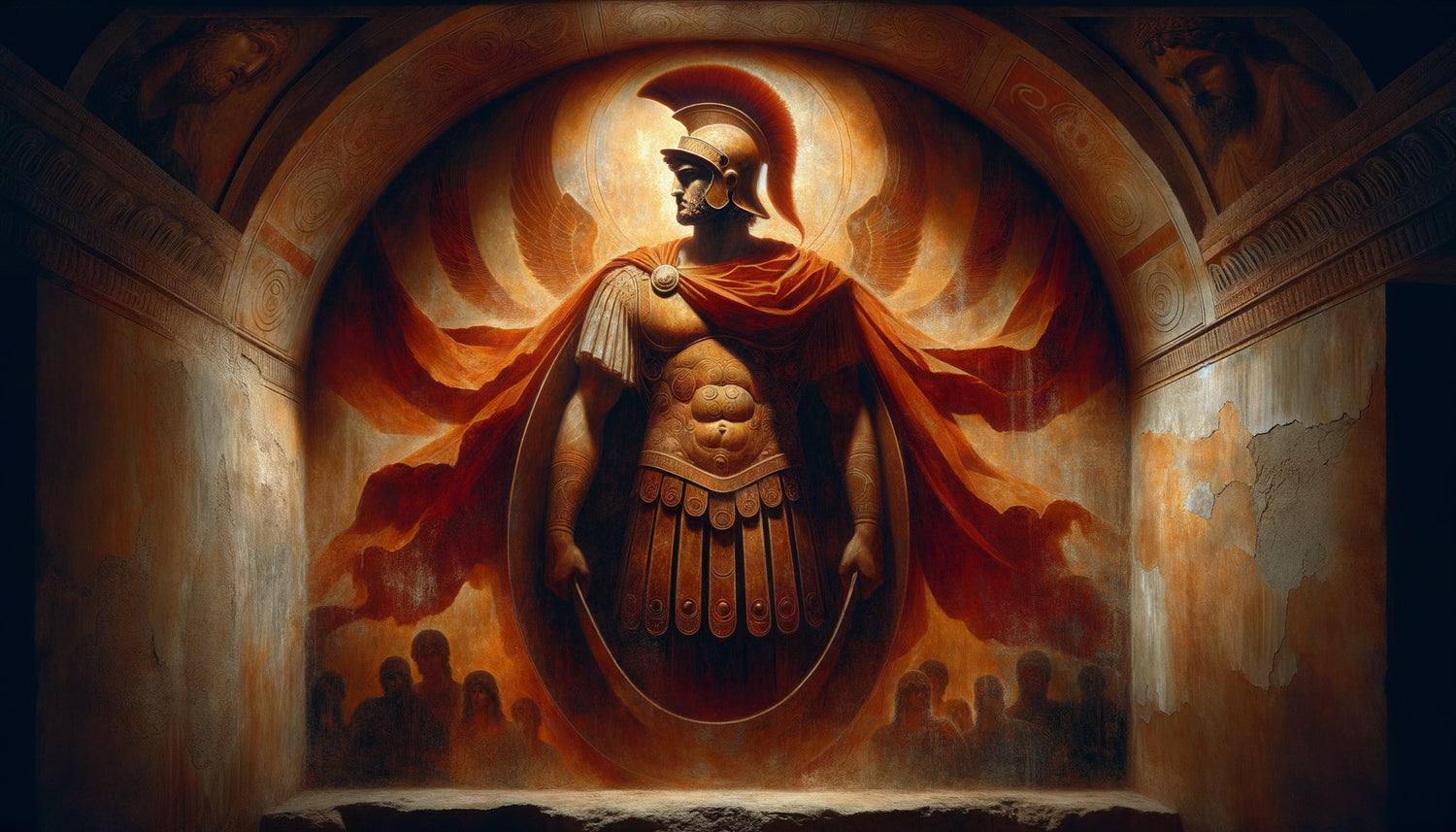
When I first crossed the threshold of the tomb of Vergina, in Greek Macedonia, my eyes took several seconds to adjust to the dimness. Then, suddenly, the frescoes emerged from the darkness like apparitions: faces sculpted by light, bodies that seemed to breathe, a striking depth on walls 2300 years old. That moment overwhelmed me. How could ancient artists, without electricity or spotlights, have created such luminous magic?
Here's what the Macedonian tomb paintings reveal: an early mastery of dramatic chiaroscuro that transformed burial chambers into theaters of eternity, a technique that brought the deceased to life through the subtle interplay of shadows and lights, and an artistic vision that anticipated the great masters of the Renaissance by nearly two millennia.
For years, we believed that chiaroscuro was born with Caravaggio in the 17th century. Yet, in these Macedonian tombs from the 4th century BC, lies one of the first systematic explorations of this revolutionary technique. Many think that ancient art was frozen, static, incapable of capturing movement and depth. The Macedonian funerary frescoes shatter this preconceived notion.
Today I invite you into these sacred chambers where light and shadow dialogued to create the illusion of eternal life. You will discover how these anonymous artists revolutionized mural painting and why their legacy still resonates in our contemporary interiors.
When the tomb becomes a cathedral of light
The Macedonian tombs were not simple burials. Carved into rock or built with monumental blocks, they reproduced the architecture of royal palaces: facades with columns, vaulted chambers, majestic antechambers. But their true splendor lay in their wall paintings, veritable artistic manifestos that celebrated the life of the deceased.
In Vergina, where Philip II of Macedonia, father of Alexander the Great, probably rests, the hunting fresco occupies the entire upper facade. 5.60 meters long, it unfolds a scene of astonishing complexity: ten hunters, seven dogs, three deer, a wild boar, a lion. But what immediately strikes you is the light. It does not bathe the scene uniformly. It sculpts. It digs. It reveals.
The chiaroscuro operates there like an invisible conductor. The illuminated areas – the bare torso of a hunter, the croup of a white horse, the spear brandished – instantly capture the gaze. The shadow areas – the dense undergrowth, the hollows of the muscles, the folds of the clothing – create a dizzying depth. For the first time in the history of painting, shadow is not simply the absence of light: it becomes a narrative tool.
The technical revolution of the Macedonian painters
How did these artists achieve such a dramatic effect? Their secret lay in a triple technical innovation. First, they worked on fresh plaster, using the true fresco technique, which allowed for perfect fusion of pigments with the support. Next, they used a restricted but sophisticated palette: ochres, umber, lime white, carbon black. This chromatic limitation paradoxically reinforced the intensity of the light contrast.
But their true genius lay in tonal modulation. Rather than brutally juxtaposing light and shadow, they created progressive transitions, subtle gradations that gave forms their volume. On the face of a hunter from the Vergina tomb, I counted no fewer than seven different shades of skin tone, from the pure white of the highlights on the forehead to the deep shadow under the jaw.
The anatomy of shadow: deciphering the vocabulary of light
In the Agios Athanasios tomb, discovered in 1994 near Thessaloniki, a scene of a funeral banquet reveals the sophisticated grammar of Macedonian chiaroscuro. The deceased, lying on a klinè (banquet bed), is depicted in a relaxed pose, holding a kylix (drinking cup). But it's the lighting of the scene that truly tells the story.
The light source seems to come from the left, as if an invisible window were projecting its rays. This directional light creates a visual hierarchy: the face of the deceased, fully illuminated, becomes the absolute focal point. His right arm, extended towards the cup, receives a grazing light that emphasizes every muscle, every tendon. Conversely, his left flank plunges into a soft shadow suggesting the depth of the body.
What is fascinating is the spatial awareness of these artists. They didn't just illuminate: they built a three-dimensional space on a flat surface. Cast shadows – that of the cup on the hand, that of the arm on the torso – anchor objects in a coherent space. Self-shadows – those that sculpt volumes – give bodies their palpable presence.
Drapery as a manifesto of chiaroscuro
Nothing better reveals the mastery of chiaroscuro than the treatment of draperies in these Macedonian frescoes. In the Lefkadia tomb, nicknamed 'Tomb of Judgement', the clothes of the mythological figures undulate with striking fluidity. Each fold becomes a miniature theater of shadows and lights.
The crests of the folds capture the light, creating bright lines that guide the eye. The hollows plunge into darkness, suggesting the depth of the fabric. Between these two extremes, an infinity of half-tones creates the illusion of movement. The fabric seems to actually fall, stretch, hug the body. This technique, which Renaissance artists will call 'chiaroscuro', already exists here fully formed, almost two thousand years before Leonardo da Vinci.

From Tombs to Living Rooms: The Contemporary Legacy of Macedonian Drama
You might wonder what these antique funerary paintings have to do with our modern interiors. Yet, their influence is everywhere. Every time an interior architect plays with directional lighting to sculpt a space, every time a photographer uses sidelight to create relief, every time a designer chooses a bold contrast to dramatize a wall, they unconsciously reactivate the Macedonian heritage.
Dramatic chiaroscuro is not just a pictorial technique: it's a philosophy of space. The Macedonian artists understood this. By painting their wall frescoes in private rooms with no natural light, they created their own lighting conditions. They didn’t depict the light they saw; they invented the light they imagined.
This approach resonates powerfully today. In our contemporary interiors, we seek to create moods, atmospheres, emotions through light. A black and white painting hung in a living room works exactly according to the same principles: it creates its own luminous universe, independent of ambient lighting. It sculpts space through contrast.
Three Decorative Lessons from Macedonian Tombs
First lesson: contrast creates depth. In a room with uniform tones, a strongly contrasting element – a dark wall, a graphic work, a sculptural lighting fixture – instantly brings dimension. The Macedonian painters knew this: their most important figures always received the most marked contrast.
Second lesson: directional light tells a story. Rather than uniform lighting that flattens space, prioritize multiple light sources that create zones of shadow and light. As in the Macedonian tombs, these variations create a visual path, a spatial narrative.
Third lesson: chromatic restriction amplifies impact. The limited palette of antique frescoes – essentially earth tones, ochres and whites – created a powerful visual unity. In decoration, reducing your palette around a bold contrast like black and white produces a similar effect: timeless elegance and dramatic intensity.
The Spiritual Dimension of Funerary Chiaroscuro
It would be reductive to consider these wall paintings solely from a technical perspective. Their use of chiaroscuro carried a profound, almost metaphysical meaning. In ancient Greek thought, death was a transition from light to darkness, from the world of the living to the underworld Hades.
By depicting their deceased bathed in light despite the surrounding darkness, Macedonian artists were operating a form of symbolic resistance. Painted light became eternal light. The dramatic contrast between the illuminated figures and the dark background was not only aesthetic: it expressed the victory of memory over oblivion, of presence over absence.
This spiritual dimension of chiaroscuro may explain why this technique has always been favored for serious, solemn, transcendent subjects. From Caravaggio painting his tormented saints to contemporary photographers capturing human intimacy, strong luminous contrast continues to signify depth and gravity.
Emotion through Contrast
In the tomb of the Queen in Vergina, a fresco depicts the abduction of Persephone by Hades. The violence of the scene – the god of the underworld seizing the terrified young goddess – is amplified by an extreme lighting treatment. Persephone's face, white with terror, contrasts violently with the shadow that already invades her body, as if the infernal darkness were already swallowing her.
This emotional intensity stems directly from the dramatic chiaroscuro. By exaggerating contrasts, Macedonian artists amplified the pathos. The technique served the feeling. It is this same logic that we find in our decorative choices: a completely white interior expresses serenity, but an interior playing with strong contrasts expresses passion, character, intensity.
Bring the timeless power of contrast into your interior
Discover our exclusive collection of black and white paintings that capture the dramatic essence and sculptural elegance of chiaroscuro, transforming your walls into veritable theaters of light.

From Vergina to your living room: reinventing ancient drama
The ultimate lesson of the Macedonian tombs may be this: boldness. These artists dared to break with the conventions of archaic Greek painting, flat and linear. They dared to explore shadow when tradition favored clarity. They dared to create depth on flat surfaces.
This boldness remains inspiring. In our aseptic interiors, uniformly lit by ceiling lights that abolish all shadows, daring to use dramatic contrast becomes an act of character. A wall painted in deep black, sculptural lighting that creates shadow zones, a black and white artwork that refuses the ease of color: all gestures that reactivate the Macedonian spirit.
The funerary frescoes of Macedonia remind us that art of contrasts is not a passing fad but an anthropological constant. We have always been fascinated by the emergence of light from darkness, by the progressive revelation of forms, by the narrative power of shadow. It is inscribed in our primordial experience of the world: dawn chasing night, fire repelling obscurity, the beloved face emerging from the penumbra.
By incorporating elements with high contrast into our living spaces, we are not simply making an aesthetic choice. We are weaving a link with a millennial tradition that goes from the anonymous painters of Vergina to contemporary photography masters, passing through Caravaggio, Rembrandt and Georges de La Tour. We affirm that our interior is not just a functional space, but a place of emotion, contemplation, intensified presence.
Imagine your living room transformed by this awareness of contrast. Soft light grazing an armchair, creating games of light and shadow on the fabric. A monochrome painting hung on a colored wall, creating an intense visual resting point. Indirect lighting sculpting the architecture of your room, revealing volumes you had never noticed. That is the living heritage of the Macedonian tombs: not to copy their motifs, but to take ownership of their vision, their boldness, their profound understanding of light as an emotional tool.
The artists of Vergina created for eternity. They painted for the dead who would never see their works, in chambers sealed forever. Yet, their message crosses the centuries: dramatic chiaroscuro is not just a technique, it is a way of seeing, feeling, being present in the world. And this presence, you can make it your own today.
Your questions about the legacy of ancient chiaroscuro
Was chiaroscuro really mastered in antiquity or is it an invention of the Renaissance?
This is one of the great revelations of modern archaeology: chiaroscuro actually existed in antiquity, particularly in Macedonian wall paintings from the 4th century BC. Before the discoveries at Vergina in the 1970s, we thought this technique was born during the Renaissance. But the frescoes in the royal tombs overturned that chronology. Macedonian artists already used sophisticated tonal transitions, consistent shadows and directional light to create volume. The difference with the Renaissance? Italian masters theorized and systematized what Macedonians practiced intuitively. They created a technical vocabulary, rules of perspective, a science of light. But the fundamental intuition – using contrast to create depth and emotion – was already fully present in these ancient tombs. It is a fascinating reminder that artistic genius does not progress linearly: innovations can appear, disappear, then reappear centuries later.
How can I practically apply the principles of Macedonian chiaroscuro in my interior?
Excellent question! The spirit of Macedonian chiaroscuro is less about specific decorative elements than a philosophy of arrangement. First step: rethink your lighting. Abandon the idea of uniform illumination of your rooms. Instead, create zones of light and shadow by multiplying sources: floor lamps, wall lights, indirect lighting. Leave some corners in relative dimness: this will create spatial depth. Second step: introduce visually high-contrast elements. A dark accent wall in a bright room, black and white artworks on colored walls, or vice versa. Third step: observe how natural light evolves in your space throughout the day. Position your furniture and precious objects where the light highlights them, naturally creating chiaroscuro effects. Finally, don't be afraid of black and dark tones: when used judiciously, they do not shrink the space but give it depth and character. The Macedonians understood this: shadow is not the enemy of light, it is its indispensable accomplice.
Why does black and white still retain such emotional power in our era of omnipresent color?
The answer lies precisely in the heritage of antique chiaroscuro! Black and white possesses a unique power of abstraction: by eliminating color, it brings us back to the essentials – form, light, composition. That's exactly what Macedonian painters did with their restricted palette of earths, ochres, and whites. This chromatic restriction concentrates attention on light contrast, on the modeling of volumes, on pure emotion stripped of the easy seduction of color. In our era saturated with colorful visual stimuli – screens, advertisements, social networks – black and white acts as a visual respite, a space for contemplation. It also unconsciously evokes seriousness, depth, timelessness. Think of historical photographs, expressionist cinema, art prints: black and white always signals something important, lasting, meaningful. In an interior, a monochrome artwork functions as an emotional anchor point, an intense moment of pause that allows the eye to rest and the mind to focus. It's the same effect produced by Macedonian frescoes: despite their age, despite the darkness of the tombs, their message transcends time because it speaks the universal language of light and shadow.