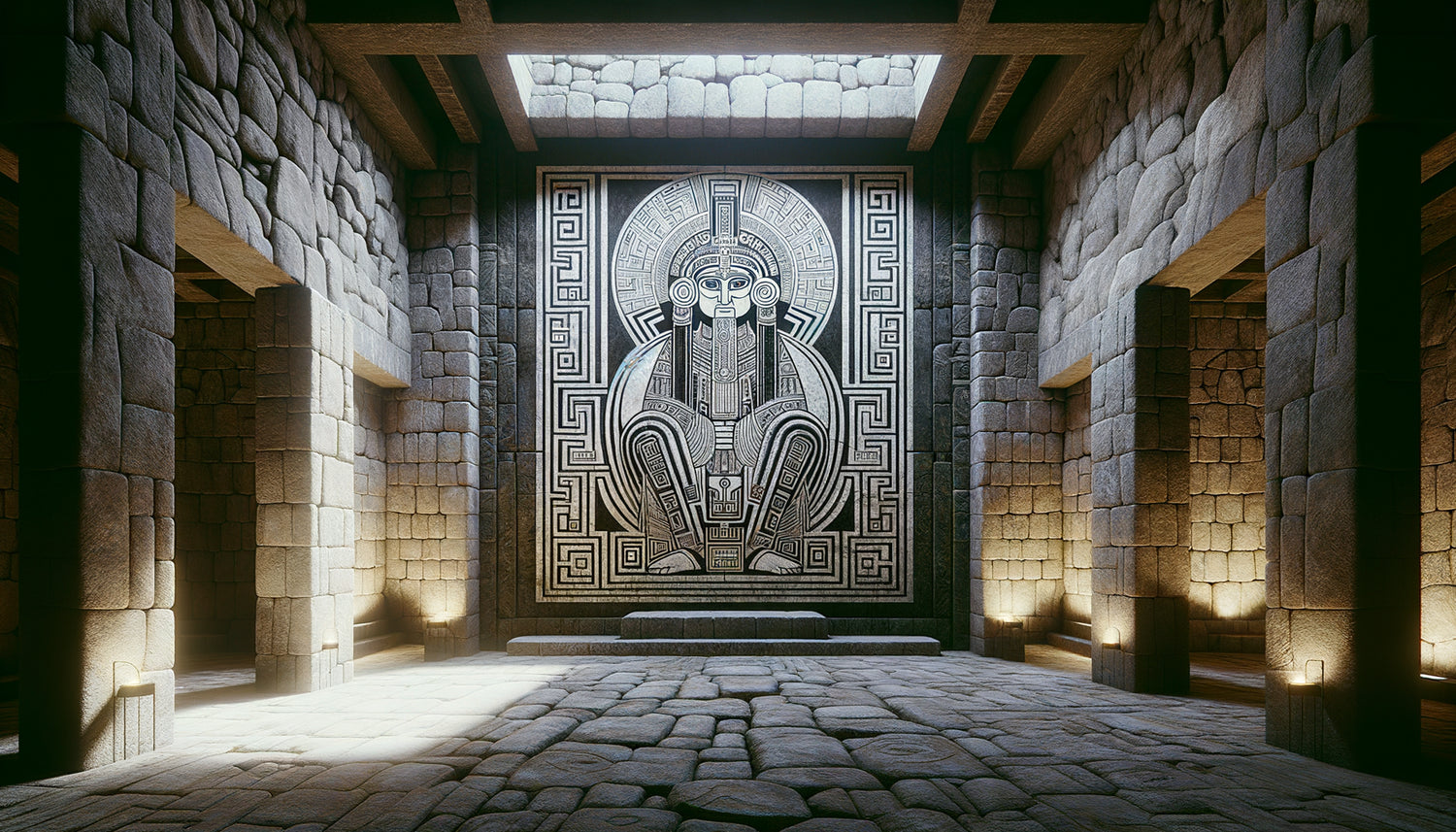
Imagine yourself facing a stone wall, in Cusco, in the twilight of a temple. Your eyes gradually adjust to the darkness, and suddenly, enigmatic silhouettes emerge: divinities traced in intense black outlines, without filling, without color. Just the essentials. This unsettling visual economy is not by chance, but a deeply considered spiritual and aesthetic intention.
Here's what these Inca murals in black outline reveal: a philosophy of the invisible that strangely echoes our contemporary quest for minimalism, a ritual technique that transformed each stroke into prayer, and a symbolic dimension where the absence of color became sacred presence.
You may be fascinated by pre-Columbian art without really understanding why some Inca divine representations seem unfinished. This sobriety is disconcerting: why would an empire so rich in natural pigments choose chromatic restriction to honor its gods? This question deserves attention, as it reveals a radically different conception of the sacred.
Rest assured: this apparent simplicity hides a symbolic sophistication that we will decode together. By exploring the spiritual, technical and cosmological motivations of Inca artists, you will discover how emptiness becomes power, and how this millennial principle can nourish our modern approach to design and decoration.
I invite you on a journey to the heart of this outline aesthetic, where each black line tells a story of faith, power and cosmic balance.
The invisible made visible: The Inca philosophy of sacred outline
In Andean cosmology, divinities do not fully belong to the visible world. They oscillate between the three planes of existence: Hanan Pacha (celestial world), Kay Pacha (terrestrial world) and Ukhu Pacha (underworld). Representing a divinity in black outlines rather than in colored blocks was respecting this transitional nature.
The Inca murals in black outline act as graphic portals. The black line defines a boundary between our reality and that of the gods, without claiming to capture them completely. The empty interior of the outline symbolizes the invisible, the unspeakable, what cannot be fully grasped by the human eye. This approach contrasts sharply with polychrome representations reserved for profane scenes or historical narratives.
This visual economy also created a space for spiritual projection. Facing these divinities in outlines, the faithful had to mentally complete the image, engage in active meditation. The void was not absence, but an invitation to inner contemplation.
The absolute black: A ritual pigmentation charged with meaning
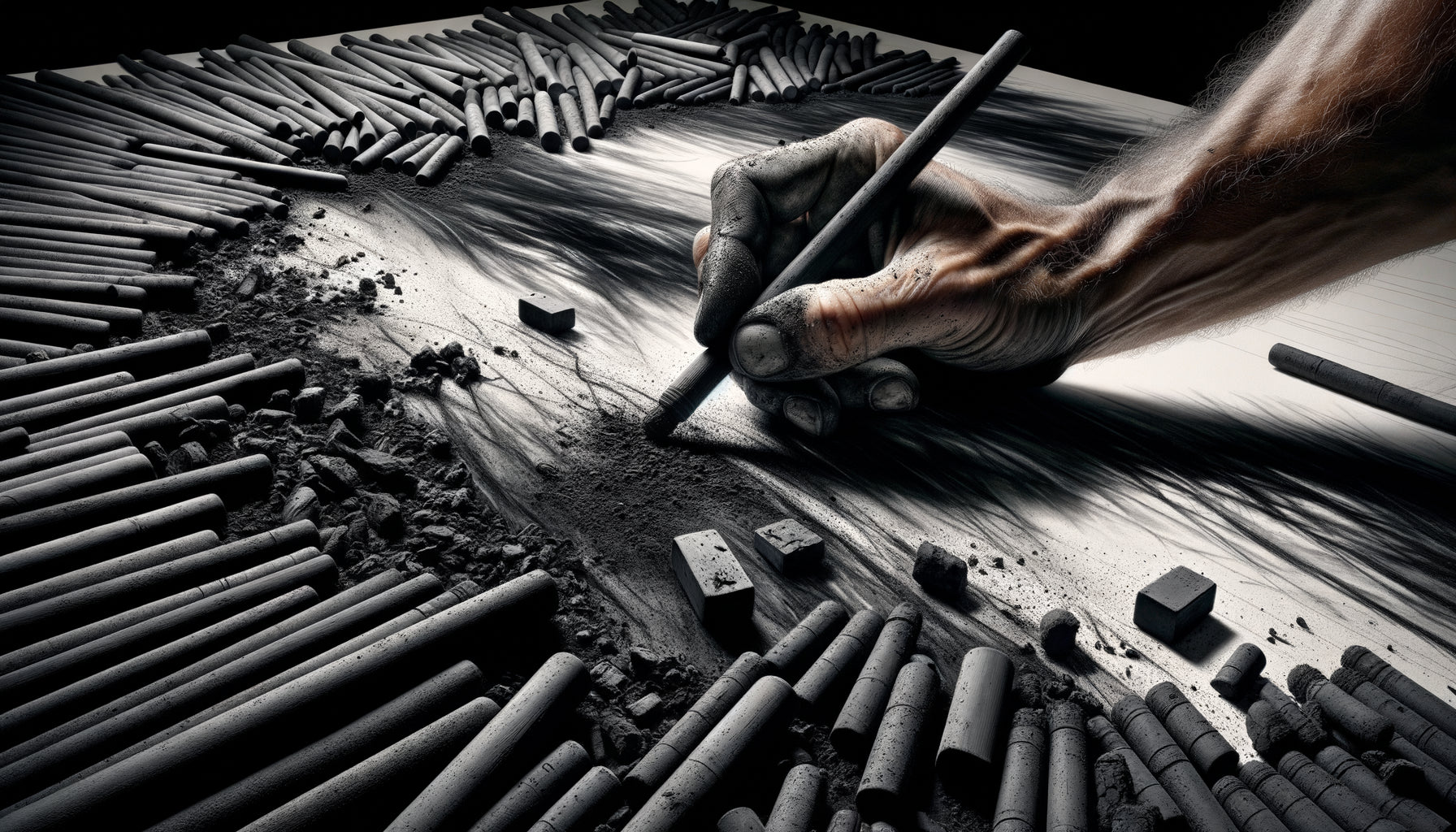
The black pigment used in these murals was not just ordinary charcoal. Inca artists prepared their black ink from vegetable soot mixed with sacred resins, sometimes supplemented with ashes from rituals. Each stroke became a gesture laden with symbolic meaning.
Black possessed a particular cosmological dimension in Andean thought. It represented Mama Quilla during lunar eclipses, when the moon transformed into a black jaguar. It also evoked the depths of Pachamama, mother earth, and the sacred caves from which ancestral founders emerged. Using this pigment exclusively to trace divinities, was to anchor them in that primordial telluric power.
The application technique itself was ritualistic. Painters observed periods of fasting and purification before executing these sacred outlines. The tracing had to be continuous, without repentance or hesitation, reflecting divine perfection. This technical requirement explains why only certain specially trained and initiated artists could create these representations.

When Inca minimalism dialogues with our modernity
It is unsettling to see how these Inca murals in black outlines resonate with our contemporary aesthetic aspirations. Our era celebrates minimalism, clean lines, elegant austerity. Unknowingly, we join a millennial wisdom.
In our modern interiors, the art of black outline is experiencing a fascinating revival. Linear representations evoke that same quiet strength that Inca artists sought to capture. A simple line can suggest an entire presence, create a powerful visual balance without saturating the space. This ancestral lesson nourishes today's designers and decorators in search of authenticity.
The collection of black and white paintings fits precisely into this unexpected lineage. The radical contrast, the chromatic economy, the power of the line: as many principles that the Incas had masterfully explored five centuries before our minimalist revolution. Integrating these graphic codes into your decoration is to bring into your home a philosophy of less-is-more deeply rooted.
The temples of Cusco and Machu Picchu: where to admire these sacred outlines
If the Inca murals are best preserved at Coricancha in Cusco, other sites also reveal this particular aesthetic. In some ritual chambers of Machu Picchu, notably those dedicated to astronomical observations, fragments of these black outlines representing stellar deities survive.
Archaeologists have identified several types of representations: Inti the sun god traced in a simple circle with linear rays, Mama Quilla the moon goddess in a slender crescent, and Illapa the god of thunder in angular broken lines. Each deity possessed its specific graphic vocabulary, a visual signature immediately recognizable by initiates.
What is particularly fascinating is the coexistence within the same architectural spaces of these outline paintings and other complex polychrome frescoes. This dichotomy was not contradictory for the Incas: it simply reflected the sacred hierarchy. The more powerful and abstract an entity was, the more its representation stripped away, tending towards the pure essence of the black line.

Emptiness as fullness: a lesson in spiritual design
The deepest teaching of these Inca wall paintings lies in their treatment of emptiness. For us, heirs to a Western artistic tradition that privileges filling, the horror of emptiness, this approach may seem counterintuitive. Yet, it holds remarkable sophistication.
In Andean thought, emptiness (ch'usaq in Quechua) is not nothingness but potentiality. It is the space where spiritual forces circulate freely, where energies can manifest without hindrance. The black outlines act as channels, permeable boundaries between the visible and the invisible, without ever imprisoning the deity within a fixed form.
This philosophy finds a powerful echo in our contemporary relationship with interior space. A wall does not need to be saturated with colors and objects to create a strong presence. An outline work, playing on the contrast between line and emptiness, can visually structure a space while preserving its breath. It is this dynamic tension between presence and absence that the Incas mastered perfectly.
How to integrate this ancestral aesthetics in your home
Transposing the spirit of these Inca wall paintings into your decor does not mean literally reproducing pre-Columbian motifs. Rather, it is a matter of appropriating their fundamental principles: the strength of contrast, the elegance of line, the power of inhabited emptiness.
Start by identifying in your interior a wall or space that could benefit from this minimalist approach. A large white or light expanse constitutes the ideal canvas to welcome an outline work. Contrary to what one might think, these linear compositions are not only suitable for large volumes: in a small space, they create a welcome visual breath.
Lighting plays a crucial role, just as in Inca temples where the grazing sunlight gradually revealed the sacred contours. Indirect or lateral lighting will accentuate the graphic dimension of your composition, creating subtle shadow games that enrich perception without overloading.
Also consider the materials: black on white contrast gains depth when it dialogues with natural textures. Light stone, bleached wood, ecru linen: these materials recall the original supports of Inca paintings and create a harmonious continuity between the artwork and its environment.
Transform your space with the power of ancestral contrast
Discover our exclusive collection of black and white artworks that capture this timeless elegance where the line becomes presence and emptiness, fullness.
The modernity of a millennial gesture
Faced with these Inca wall paintings in black contours, we realize how much our contemporary aesthetic quest joins ancient spiritual concerns. This convergence is nothing accidental: it reveals constants in our relationship to the sacred, the beautiful, the essential.
By choosing to honor their deities through the sobriety of the line rather than chromatic exuberance, the Incas developed a visual language of striking modernity. They intuitively understood what our designers are rediscovering today: the expressive power of simplicity, the eloquence of visual silence, the magnetic presence of pure contrast.
Integrating this aesthetic into your daily life is more than just a decorative choice. It's welcoming a philosophy of balance into your home, where each element finds its rightful place without excess or lack. It’s creating spaces that breathe, that invite contemplative viewing rather than sensory saturation.
Start simply: observe a wall in your interior with new eyes. Imagine a simple, refined black contour dialoguing with the surrounding emptiness. Feel how this graphic presence can structure space while preserving its lightness. This experience will connect you directly to the genius intuition of Inca artists who, five centuries ago, had already understood everything about the power of less.
Frequently asked questions about Inca wall paintings in black contours
Why didn't the Incas use colors for all their depictions of deities?
The Incas perfectly mastered the extraction and use of colored pigments derived from minerals and plants. While they sometimes chose to represent certain deities only in black outlines, it was by deliberate spiritual choice, not due to technical limitations. This chromatic sobriety marked the transcendent nature of some divine entities, too powerful or abstract to be contained within a complete colored form. Polychrome representations were reserved for narrative scenes, historical events, or deities linked to the terrestrial world. Pure black signaled belonging to the realm of absolute sacredness, the ineffable, which cannot be fully represented but only suggested by the outline.
Can we still see these Inca murals today?
Yes, several sites in Peru preserve fragments of these black outline murals, although their state of preservation varies considerably. The Coricancha in Cusco, the former Temple of the Sun, presents the best documented examples in its partially restored ritual chambers. Some sections of Machu Picchu, particularly in areas reserved for astronomical ceremonies, also reveal these traces. The National Museum of Archaeology in Lima exhibits faithful reproductions and original fragments moved for conservation. It should be known that the Spanish conquest and evangelization unfortunately destroyed the majority of these works considered pagan. The survivors are precious and often protected by restricted access conditions to ensure their preservation.
How can we incorporate the spirit of these Inca paintings into a contemporary decor?
The essence of these Inca murals lies in three principles that can be transposed: radical black contrast on light backgrounds, the expressive power of the clean line, and respect for emptiness as an active element of composition. Specifically, favor minimalist black and white graphic works on walls with neutral tones. Avoid clutter: a single striking piece in black outlines is enough to visually structure a space. Pay as much attention to the void around the work as to the work itself, as the Incas did with the inside of their divine outlines. Combine these graphic elements with raw natural materials (stone, light wood, linen) that recall the original Andean supports. This approach will create a subtle dialogue between the ancestral and the contemporary, bringing depth and serenity to your interior without falling into decorative pastiche.