I discovered Robert Longo during an exhibition in New York in 2015. Faced with his monumental charcoal drawings, I felt a visceral shock. These works, several meters in size, seemed alive, breathing. How can an artist create such feats using only black charcoal on white paper? This question obsessed me for months, pushing me to study his technique in minute detail for my own conservation projects.
Here's what Robert Longo’s method reveals: a mastery of charcoal allowing the creation of monumental photographic effects, a meticulous approach where every millimeter counts, and above all, proof that an ancestral medium can rival modern technology in terms of visual power.
Many think hyperrealism requires color or oil paint. Faced with these hyperrealistic black charcoal murals, visitors often look for a projected screen or printed photograph. This confusion is a testament to Longo’s genius: transcending the perceived limits of a simple stick of charcoal.
Yet, his technique has nothing magical about it. It relies on rigorous discipline, precise tools, and an architectural vision of drawing. I will reveal the manufacturing secrets that transform black charcoal into an instrument of monumental hyperrealism.
By the end of this article, you will not only understand how Robert Longo builds his titanic works, but also why this approach fascinates so many collectors and museums around the world.
The starting point: photography as a visual matrix
Contrary to what many imagine, Robert Longo does not draw from life. His hyperrealistic murals always begin with a meticulously orchestrated photo shoot. The artist directs these sessions like a film director, controlling the lighting, poses, every detail of the composition.
These reference photographs are then projected at monumental scale onto sheets of paper mounted on wood. Some works reach three meters in height. This projection allows him to sketch the main outlines, establishing the fundamental structure of the black charcoal drawing.
This hybrid process between photography and drawing is crucial. It guarantees anatomical precision and perspective consistency impossible to achieve otherwise at this scale. But be careful: the projection is only the skeleton. Longo’s genius lies in what comes after.
The technical arsenal: more than just charcoal
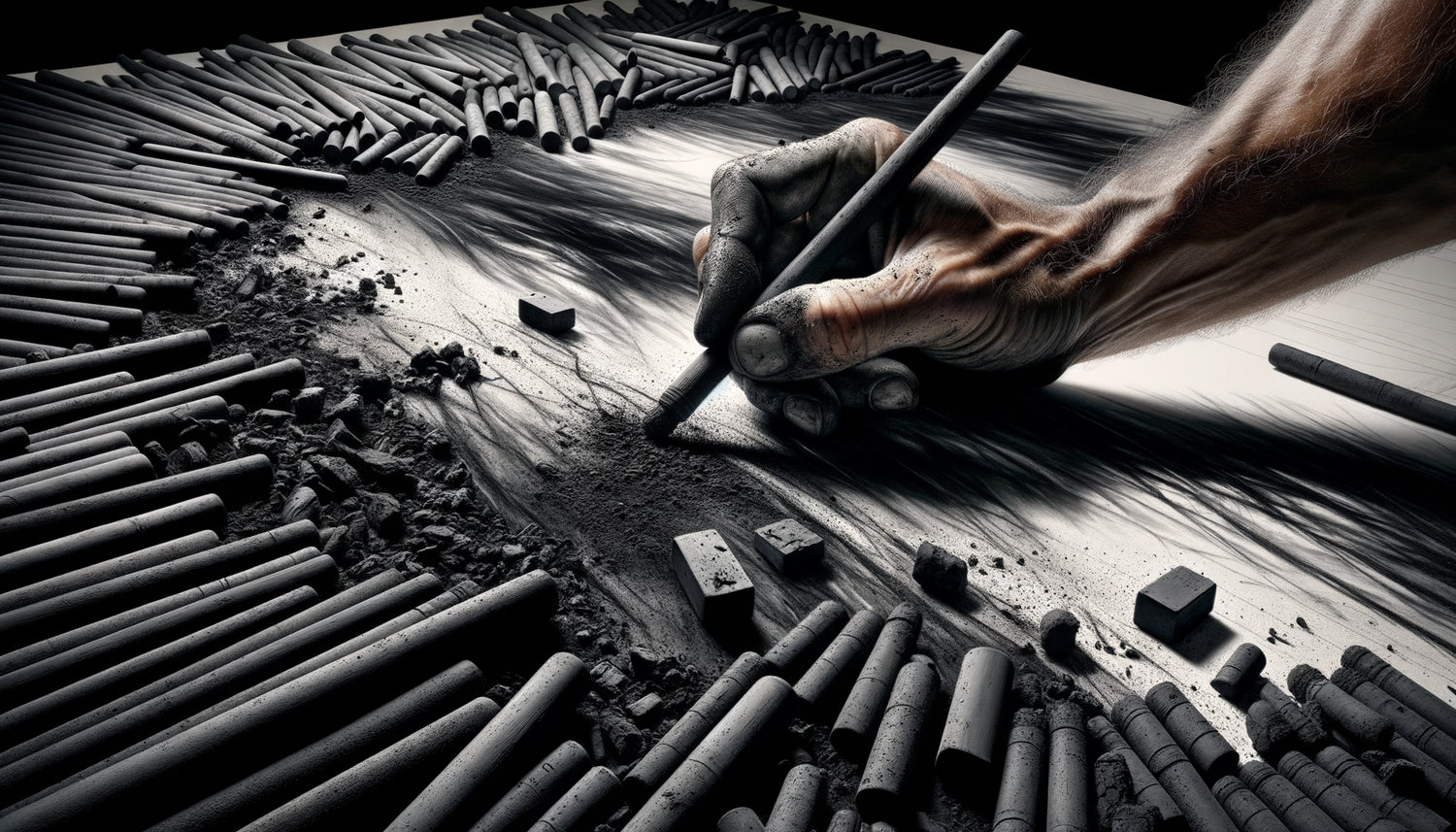
In my restoration laboratory, I analyzed several works by Longo. His black charcoal is not unique: he uses a complete range of charcoal tools. From soft charcoal for deep dark masses to hard charcoal for minute details, each type has its specific function.
Blending stumps play a central role in his hyperrealistic murals. These compressed paper sticks allow the charcoal to be blended into subtle gradations. Longo owns dozens of different sizes, some as thin as a toothpick for delicate areas like eyelashes or wrinkles.
Erasers are just as varied. Breadcrumb eraser for gently lightening, hard eraser for creating bright lights, electric eraser for precise highlights. In black charcoal hyperrealism, the eraser does not erase: it draws the lights.
The paper: a monumental and demanding support
Robert Longo works on thick paper mounted on rigid panels. This solid base is essential to withstand hundreds of hours of black charcoal friction. The grain of the paper directly influences the rendering: too smooth, it's impossible to catch the nuances; too rough, fine details become inaccessible.
Each sheet is meticulously prepared. The slightest defect, the smallest impurity will be visible on these several-meter-square hyperrealistic murals. This preparation can take several days before even the first charcoal stroke.

Construction in layers: patience and methodology
This is where true mastery operates. Longo's hyperrealistic murals are built up by layering dozens of layers of black charcoal. Each pass adds depth and density to the shadows, refines the gradations, and sharpens the textures.
The first phase establishes the general tonal values. Longo blocks large masses of shadow and light with soft charcoal, creating a topographic map of light. At this stage, the work resembles an abstract sketch more than a hyperrealistic drawing.
Progressively, layer by layer, the image emerges. The shapes become clearer. Textures appear: skin grain, crumpled fabrics, metallic reflections. This slow construction requires monastic discipline. An impatient gesture, too much pressure, and weeks of work can be compromised.
Working on specific textures
Each material requires a different approach to black charcoal. To render the velvet of an ocean wave, Longo uses gentle circular movements, gradually building opacity. For the bright chrome of a firearm, he alternates between precise applications and areas of pure white paper.
Faces are the ultimate challenge in his hyperrealistic murals. On a monumental scale, each pore becomes visible. Longo sometimes spends one hundred hours on a single face, carefully blending the charcoal to create those imperceptible transitions between light and shadow that give the illusion of flesh.
Absolute black: creating depth through contrast
A fundamental secret of Robert Longo's hyperrealistic murals lies in his handling of deep blacks. He doesn't simply apply black charcoal uniformly. He builds layered blacks, compressed by multiple passes, achieving a density that few artists master.
These absolute blacks create a dramatic contrast with the pure white areas of the paper. It is this maximum tonal range – from dazzling white to inky black – that gives his works their photographic presence. The human eye naturally interprets this high contrast as an indicator of sharpness and realism.
I measured the luminous reflectance of his blacks during an appraisal: less than 3% of light reflected. For comparison, a standard charcoal black reflects about 12-15%. This technical difference explains why his hyperrealistic murals possess this almost three-dimensional depth.

Monumental scale: a physical and mental challenge
Creating hyperrealistic charcoal murals three meters high transforms the act of drawing into a physical performance. Robert Longo works standing up, constantly moving in front of his work. He climbs ladders to reach the upper areas, squats for the lower details.
This scale poses a unique perceptual problem. A few centimeters from the paper to draw a detail, it is impossible to judge the overall balance. Longo must constantly step back several meters to evaluate his work. This dance between proximity and distance rhythms months of creation.
The black charcoal also generates ubiquitous dust. By the end of the day, the entire workshop is covered with a film of carbon. Longo often wears a mask to avoid inhaling these particles. His hands, his clothes, everything becomes black. Hyperrealism in charcoal is a dirty art.
Duration: months for a single work
A hyperrealistic mural by Robert Longo generally requires four to six months of intensive work. Some complex pieces have taken more than a year. This temporality is completely outside our age of digital instantaneity.
This slowness is not inefficiency: it is the very condition of hyperrealism in black charcoal. Every square centimeter receives meticulous attention. There are no shortcuts, no techniques to speed up the process without compromising the result.
The choice of monochrome: why only black?
Why does Robert Longo impose this constraint of exclusive black charcoal? In a world saturated with digital colors, his hyperrealistic monochrome murals produce a stunning effect. The brain, deprived of color, focuses solely on form, light, and composition.
Black and white also possesses a timeless dimension. His works evoke classic silver photography, German expressionist films, and ancient engraving. This historical lineage confers a gravity, an authority that color could dilute.
Technically, black charcoal allows for a greater tonal range than most colored mediums. Between the pure white of the paper and these stratified blacks I spoke of, Longo potentially has hundreds of distinct tonal values. This richness of grays paradoxically creates more nuances than a limited color palette.
Be inspired by the power of monochrome contrast
Discover our exclusive collection of black and white artworks that capture this dramatic intensity and timeless elegance in your interior.
The contemporary legacy: when charcoal rivals the digital
In my conservation work, I regularly encounter collectors fascinated by Robert Longo's hyperrealistic murals precisely because they embody a paradox. In the age of Photoshop and artificial intelligence, these black charcoal drawings affirm the irreducible relevance of the manual gesture.
Each drawing bears the physical imprint of hundreds of hours of human labor. You can literally see the stratified layers of charcoal, feel the texture of the paper. This artisanal materiality creates an emotional connection impossible with a digital image.
Yet, Longo does not reject technology. He intelligently integrates it into his process – the initial photography, the projection – while maintaining the artisanal essence. This synthesis between contemporary tools and ancestral techniques may define the art of the 21st century.
Conclusion: slowness as an act of creative resistance
Robert Longo's hyperrealistic black charcoal murals remind us that excellence and patience are inseparable. In a world obsessed with speed and efficiency, spending six months on a single image becomes almost a radical act.
His method demonstrates that constraints stimulate creativity. By limiting himself to black charcoal, Longo has developed an unparalleled technical mastery, a visual signature recognizable among thousands. Monochrome, far from being a limitation, has become his distinctive strength.
The next time you look at a black and white drawing, think about the hundreds of possible hours behind each gradient, each texture. Behind the apparent simplicity of charcoal lies a universe of technical complexity. And perhaps, try it yourself: take a piece of charcoal, some paper, and discover this slow meditation that is monochrome drawing. The transformation begins with a first stroke.
FAQ : Your questions about Robert Longo’s technique
Can you create hyperrealistic drawings with charcoal without extensive artistic training?
The technique of hyperrealistic mural drawings does indeed require advanced mastery, but it all starts with the fundamentals. You can absolutely begin with modest formats and simple subjects. The key is patience and regular practice with charcoal. Start by mastering gradients on small surfaces, learn to control pressure, use blending stumps. Thousands of self-taught artists are now creating impressive hyperrealistic works after a few years of diligent practice. Robert Longo himself developed his technique over decades. What's important isn't the starting point, but consistency in learning. Set progressive goals: a fruit, then a face, then a more ambitious composition. Online resources now offer detailed tutorials for each technical step of charcoal hyperrealism.
What materials do you need to get started with hyperrealistic black charcoal drawings?
Good news: unlike oil or acrylic paint, black charcoal remains a financially accessible medium. To get started seriously, invest in an assortment of charcoals of different hardnesses (soft, medium, hard), a few blending stumps of varying sizes, a kneaded eraser and a classic white eraser. Paper is crucial: choose paper with a medium grain, at least 160gsm, specifically designed for charcoal. Avoid ordinary machine paper which will not retain the charcoal properly. A spray fixative is also essential to protect your hyperrealistic mural drawings from crumbling. For around €50-€80, you can acquire a complete professional quality kit sufficient for months of practice. Robert Longo obviously uses high-end materials, but the difference in results between average and excellent materials only becomes significant with an already advanced technical level.
How long does it take to master hyperrealism with charcoal?
This question comes up constantly in the workshops I host. The honest answer: it depends entirely on your practice and your goals. To create your first recognizable and satisfying charcoal drawing, count a few weeks of regular practice. To reach a semi-professional level where your works impress those around you, plan for two to three years of constant work. To rival the hyperrealistic wall drawings of Robert Longo... a decade or more of total dedication. But don't let these numbers discourage you! Pleasure and satisfaction appear from the first successful achievements. Each drawing teaches you something. Hyperrealism in charcoal is as much a journey as it is a destination. Many artists find fulfillment and recognition long before reaching the absolute level of the masters. Set progressive goals, celebrate each progress, and above all: draw regularly. Fifteen minutes daily are better than three hours sporadically weekly.