Wandering through the ruins of Pompeii on a summer morning, I placed my hand on a wall that seemed covered in plates of precious marble. The expected coolness under my fingers gave way to a rough texture: simple painted plaster. This masterful illusion, two thousand years old, still worked perfectly. The Campanians had mastered an art now almost forgotten: transforming ordinary walls into sumptuous palaces thanks to monochrome.
Here's what this millennial technique brings us: timeless visual sophistication, accessible elegance without expensive materials, and a striking proof that refinement never depends on budget but always on craftsmanship. You might think recreating the opulence of marble requires considerable means, that imitations always sound false, that chromatic simplicity lacks interest. Think again: Roman artisans perfected over centuries an approach that transformed the humble into the majestic, the common into the extraordinary. I invite you to discover their secrets and how they still resonate in our contemporary interiors.
Architectural illusion: when painting becomes sculpture
In the villas of Campania – these patrician residences that bordered the Gulf of Naples – owners competed for ingenuity to display their status. But here's the thing: real marble cost a fortune. It had to be extracted from the quarries of Carrara, transported by boat, and precisely carved. A brilliant solution emerged then: monochrome trompe-l'oeil painting.
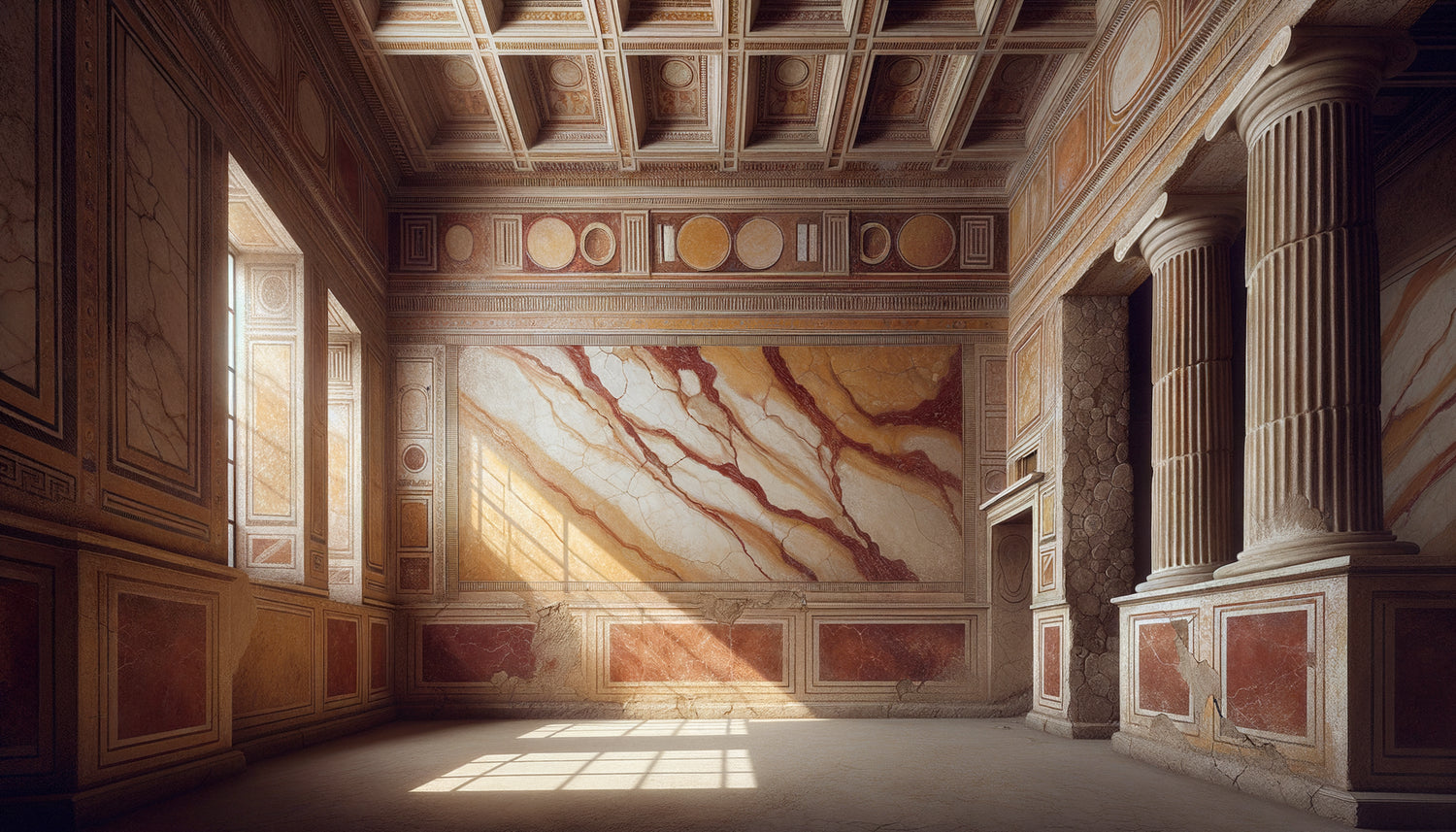
Roman fresco painters developed what is called the structural style, particularly visible in the homes of Pompeii and Herculaneum. On fresh plaster, they applied mineral pigments in camaïeux – yellow ochres, iron reds, carbon blacks – to imitate the characteristic veins of marble. Monochrome was not a limitation but a strategic choice: it allowed focusing attention on subtle tonal variations, those gradations that give natural marble its hypnotic depth.
I have long studied the walls of the Villa of the Mysteries, where this technique reaches its peak. The artisans first created a uniform background, then superimposed translucent layers to simulate the translucency of marble. They then added the veins with fine brushes, following the random but recognizable patterns of precious marbles: the golden giallo antico from North Africa, the purple pavonazzetto from Phrygia, or the sober Luna marble white-gray.
The chromatic vocabulary of opulence
Roman monochrome was based on a restricted but skillfully orchestrated palette. Contrary to what one might think, monochrome does not mean monotonous. Fresco painters worked in expanded monochromatic ranges: a yellow could be declined in fifteen shades, from pale cream to deep amber.
This chromatic restriction paradoxically created an extraordinary visual richness. The human eye, freed from the distraction of multiple colors, perceived with a doubled acuity variations in brightness, suggested reliefs, simulated textures. The Romans intuitively understood what neuroscience confirms today: chromatic simplicity amplifies the perception of volume and matter.
In the triclinia – these dining rooms where guests lay down – monochrome walls resembling marble created an atmosphere that was both sober and luxurious. Pompeian red, this iconic shade obtained from cinnabar or red ochre, served as a background for monochrome panels imitating white marble. The contrast between the vibrant red and the gray-veined white rectangles generated a sophisticated visual tension, a balance between warmth and coolness, passion and restraint.
The pigments of illusion
Roman artisans drew on a precise mineral pharmacopoeia. For the light monochromes imitating noble marbles, they used ground chalk, kaolin, or marble powder itself mixed with lime. These white bases then received tiny touches of charcoal black or earth tones to create the characteristic veins.
For dark monochromes evoking Egyptian or Greek marbles, they employed brown ochres, natural or calcined earth pigments, sometimes enriched with vine black. The key was the relative transparency of each layer: the Romans mastered the art of glazing, these diluted pigmented veils that, when superimposed, create a luminous depth impossible to obtain in a single opaque application.

The faux marble technique: a choreography of gesture
Recreating the appearance of marble required technical virtuosity that only years of training could impart. The process began with careful preparation of the wall: several layers of lime plaster and marble powder, sanded until a perfectly smooth surface was obtained. This step was crucial because true marble has a reflective surface that only a flawless support could imitate.
Next came the application of the background color, always as a fresco – on wet plaster – to ensure perfect adhesion and a particular luminosity. The pigments penetrated slightly into the plaster, creating that characteristic milky quality of real Pompeian frescoes.
The marble veins were added according to a codified method. The artisan dipped a natural sponge into diluted pigment and dabbed the wall in irregular movements, creating clouds of texture. Then, with an ostrich feather or a very fine brush, he traced the main veins following the natural directions of the marbles: diagonals for the brocatelle, horizontal for the cipolin, concentric for some alabasters. These veins were never perfectly straight but slightly trembling, like in authentic stone.
One detail fascinates me particularly: the Romans often added tiny sparkling inclusions – mica powder or crushed shell fragments – into the last layer. These particles captured the light from oil lamps and torches, creating a subtle shimmer. In the flickering light of the evening, the illusion became total.
When constraint becomes an aesthetic signature
Monochromatism was not only an economical solution but an aesthetic statement. By choosing to limit their palette, the Romans asserted a form of intellectual sophistication: that which finds complexity in simplicity, abundance in restraint.
This approach created interiors of remarkable visual coherence. Imagine an atrium where all walls display faux marble panels in shades of gray and white: the space seems larger, brighter, more airy. The architecture itself becomes a protagonist rather than competing with overloaded polychrome decorations.
In some villas like that of Poppaea in Oplontis, entire rooms are treated in yellow monochrome imitating the prestigious giallo antico. These spaces bathe in perpetual golden light, independent of the time of day. Monochromatism creates an immersive atmosphere, almost meditative, which transforms the spatial experience.
The dialogue between reality and artifice
What touches me deeply about these frescoes is their paradoxical honesty. The Romans were not trying to completely deceive: up close, the painting remains visible. But they created what I call a consented illusion – a tacit pact between the artisan and the observer. The pleasure does not lie in confusion with real marble but in appreciating the know-how necessary to approach this truth.
This philosophy strangely resonates with our contemporary interiors. We accept and even celebrate successful imitations – textured effect wallpapers, decorative paints, ceramics imitating wood – not as ersatz but as legitimate expressions of creativity. The Romans were already teaching us: authentic elegance does not depend on materials but on intention and execution.

Ancient Lessons for Modern Interiors
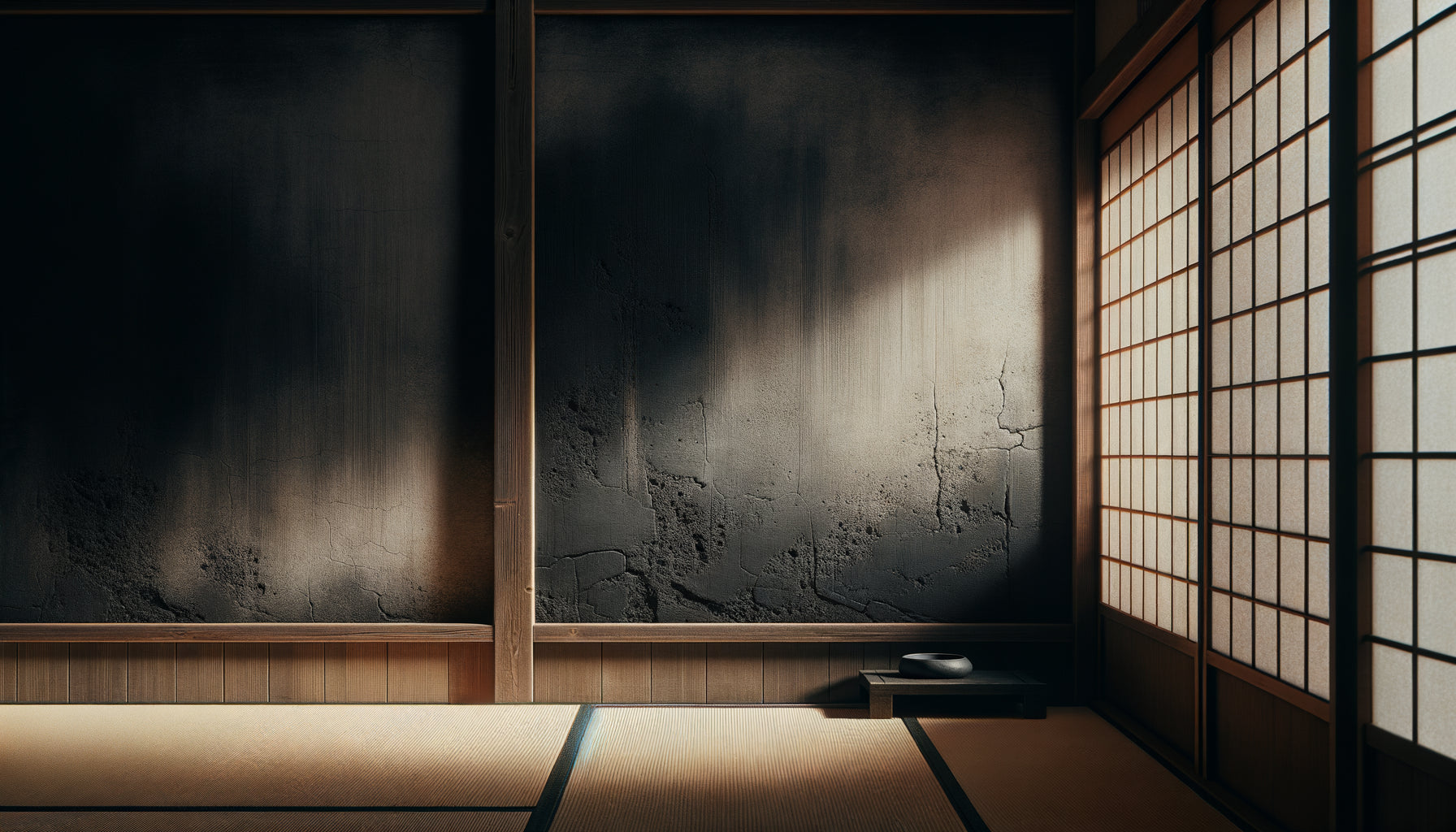
What can we learn from walls that are two millennia old? First, that monochrome possesses an enduring power. In our spaces often saturated with visual stimuli, a wall treated in subtle grayscale – whether it imitates marble or not – instantly creates a sense of refined calm.
Next, that intelligent imitation is not dishonorable. Wanting the look of marble without its cost or environmental impact is not a compromise but a thoughtful choice. Modern pictorial techniques – lime paints, decorative plasters, glazes – allow you to recreate these effects with an ease that the Romans would envy.
Finally, that chromatic restriction liberates creativity. By imposing a monochrome palette on yourself, you refine your sensitivity to nuances, textures, and plays of light. Your choices become more intentional, more precise, more personal.
I often encourage my clients to experiment with monochrome panels in their reception areas: an accent wall treated in faux gray marble creates a sophisticated focal point without the ostentation of a real stone cladding. That's exactly what wealthy Romans did: assert their taste rather than flaunt their wealth.
Transform Your Walls into Timeless Works of Art
Discover our exclusive collection of black and white artworks that capture this monochrome elegance of ancient frescoes and bring sophistication and depth to your contemporary interiors.
The Living Legacy of a Millennial Aesthetic
Every time you admire an all-white interior with subtle variations in texture, every time a charcoal gray wall seems mysteriously deep, every time a decorative paint imitating stone moves you, you reconnect with this Campanian tradition. The monochrome of Roman frescoes is not an archaeological curiosity but a living aesthetic language.
These anonymous artisans of Pompeii bequeathed us far more than a technique: a philosophy of decoration founded on expressive restraint, the intelligence of materials, and the conviction that beauty is born from mastery rather than accumulation. Their walls continue to speak to us across the centuries, murmuring that true elegance lies in what is suggested rather than what is exhibited.
Perhaps it is time to look at your own walls differently. Not as simple surfaces to cover, but as possibilities of transformation, canvases awaiting an inspired hand to deploy the silent magic of monochrome. The Romans did it with lime, ochres and natural sponges. You can do it with the tools of your time, perpetuating this discreet but powerful heritage: that of creating splendor with simplicity.