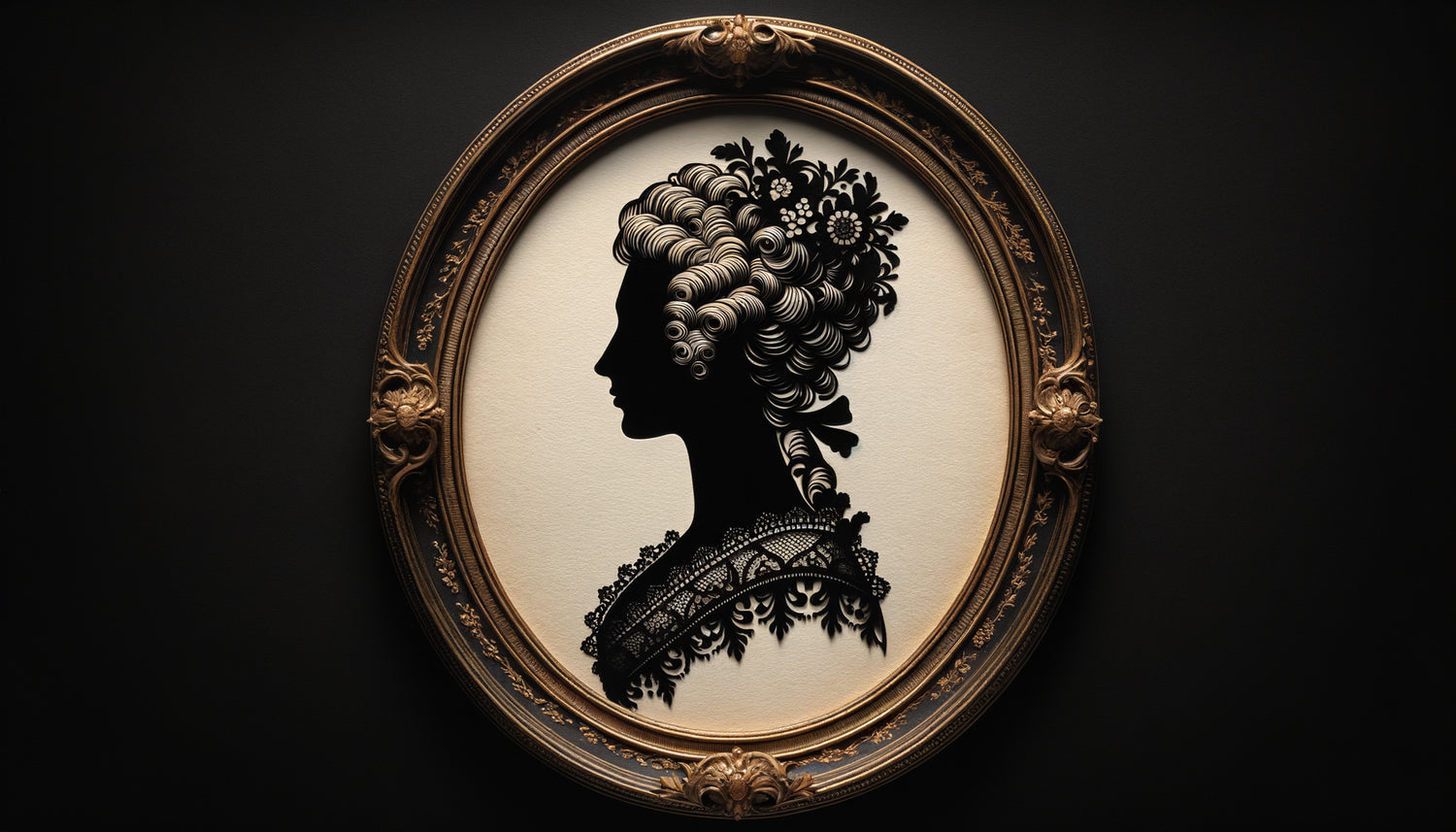
Imagine a portrait that captures the essence of a person in a single, continuous line, cut from black paper with surgical precision. No colors, no superfluous details – just the pure profile of a face telling a story in millimeters. This is the magic of 18th-century silhouettes, this almost forgotten art that revolutionized portraiture before the invention of photography. In Parisian salons and European courts, these black paper cutouts were more than a trend: they represented democratic elegance, accessible to all, from noble to bourgeois.
Here's what the art of silhouettes brings to your contemporary interior: timeless elegance that transcends centuries without aging, a touch of poetic mystery that intrigues and fascinates, and graphic sophistication that integrates perfectly with the codes of modern design. Pure black on white background has this visual power that never fades.
You may be looking to create a decoration that tells a story, that has depth without falling into decorative overload. Today's interiors are overflowing with digital images, standardized prints, soulless reproductions. How to bring that touch of authenticity, that dialogue with history that transforms a simple wall into conversation?
The art of silhouettes offers exactly this answer. And contrary to popular belief, this 18th-century art never veers into dusty pastiche. Its graphic modernity surprises, its minimalist strength seduces, its elegance speaks to our contemporary interiors with a disturbing accuracy. Let me tell you the fascinating story of these black and white cut portraits, and how they can transform your view of wall decoration.
When scissors rivaled brushes
In the mid-18th century, an artistic phenomenon swept across Europe: the silhouette portrait. Its name comes from Étienne de Silhouette, controller general of finances for Louis XV, known for his thrift – hence the expression “à la silhouette” meaning “done economically.” But this technique of cut portrait existed long before him, practiced since antiquity in various forms.
What makes 18th-century silhouettes so particular is their technical perfection. Silhouettists – true virtuosos of the scissors – could capture a profile in just minutes. The subject would sit in profile facing a light source, their shadow was projected onto white paper, and the artist would then cut this shadow from black paper with astonishing precision. Some masters worked freehand, without even tracing a preliminary outline.
This speed of execution partly explains the phenomenal enthusiasm for this art. Where a painted portrait required weeks of posing and a fortune, a cut silhouette could be obtained in moments for a fraction of the price. The democratization of portraiture was underway: bourgeois, artisans, servants – all could now immortalize their image.
The power of pure black: when less is moreThere is something fascinating about this radical reduction: a whole human being condensed into a simple black cutout. No shades of gray, no subtle shadows, just the absolute contrast between black and white. This economy of means paradoxically creates a remarkable visual intensity.
Silhouette portraits capture the essence: the line of the forehead, the curve of the nose, the angle of the chin, the characteristic hairstyle of the era. Every detail counts. A simple bump on the nasal ridge, a slightly off-center bun, a particular nape posture – these micro-details are enough to identify a person. Silhouettists developed a keen sense of physiognomic observation.
This aesthetic of pure black strangely resonates with our time. Contemporary minimalism, Scandinavian simplicity, modern graphic design – all these trends share the same fascination for formal reduction. An 18th-century silhouette framed on a white wall integrates as naturally into a contemporary loft as it does into a Haussmann apartment.
The elegance of constraint
The greatest silhouettists transformed this technical limitation into an expressive strength. Augustin Edouart, a French master established in England, created entire scenes with multiple characters, cutting narrative compositions of astonishing complexity. His black paper cutouts depicted entire families in interiors, with furniture, hangings and accessories – all without a single pencil stroke, only with scissors.
This technical mastery elevated the art of silhouette to the rank of virtuosity. Some artists added minute details: the buttons on a coat, the folds of a dress, the curls of a wig. Others played with negative spaces, creating voids as expressive as the solids.

A gallery of forgotten faces that still whisper
Each antique silhouette is a fragment of existence frozen in paper. These anonymous profiles – as many no longer bear a name – continue to question us. Who was this lady with the imposing bun? This gentleman with the aquiline nose? These children captured in their games?
Museum collections are full of these cutout portraits that once constituted entire family albums. They were given as tokens of friendship, exchanged like visiting cards, sent to loved ones far away. Before the photographic era, these small black cutouts were the only accessible portraits for most people.
Some 18th-century silhouettes have retained their original frame: oval medallions, gilded bronze frames, precious boxes. Others were simply glued into leather-bound albums. This variety of presentations is a testament to the adaptability of this art form to all budgets and contexts.
The Stars of Silhouette Cutting
Johann Caspar Lavater, a Swiss physiognomist, used cut silhouettes for his theories on human character. He believed he could deduce a person's personality by analyzing their profile. His treatises, richly illustrated with silhouettes, were a resounding success throughout Europe. Although his science was questionable, his collections of profiles remain fascinating.
In France, the Hubert Gravelot family excelled in this art. Their pure black portraits adorned the most renowned Parisian salons. Each silhouette artist developed their own style: some favored pure and simple lines, others added white highlights to suggest volume, a few even incorporated details painted with gouache.
Reinventing Silhouette in Our Modern Interiors
How to integrate this historical aesthetic without creating a dusty cabinet of curiosities? The key lies in the audacity of contrast. An 18th-century silhouette or one inspired by this art finds its place in the most contemporary settings precisely because it refuses compromise.
On an immaculate white wall, a series of framed silhouettes creates a gallery of mysterious portraits. Unlike conventional family photos, these anonymous profiles intrigue without imposing themselves. They bring a human presence without the narcissism of selfies, a story without the chatty anecdote.
The art of silhouette remarkably complements minimalist furniture. In a clean Scandinavian interior, these black cutouts provide the organic touch that warms without overwhelming. In an industrial loft, they soften the brutality of concrete and metal. In a classic apartment, they recall the elegance of bygone eras without veering into historical reconstruction.
Composing Your Own Collection
You don't need antique silhouettes to create this effect. Quality reproductions, contemporary creations inspired by this technique, or even modern graphic interpretations of the concept work perfectly. The essential thing is to respect the founding principle: pure black on white background, absolute contrast, clean line.
Play with scales. A large dramatic silhouette as a centerpiece, surrounded by smaller profiles, creates a dynamic composition. Or opt for uniformity: six identical silhouettes in size but different in subject, aligned precisely, produce a very contemporary gallery effect.
Framing matters enormously. A simple, thin black frame respects the minimalist spirit of the artwork. A baroque gilded frame creates a dialogue between eras. A generous matting gives air, breathing room to the cut.

The Return of the Profile in the Age of Selfies
Ironically, as we live in an era of omnipresent imagery, the art of silhouette is making a comeback. Perhaps precisely because it offers the opposite of our digital overexposure: mystery rather than revelation, suggestion rather than exhibition, essence rather than appearance.
Contemporary artists are revisiting this technique. Some create giant laser-cut silhouettes, others project them onto urban walls, some transform them into three-dimensional sculptures. The ancestral technique inspires new expressions, but the fundamental principle remains: to capture humanity by its outline.
In our interiors saturated with screens and ephemeral digital images, a black paper silhouette has this reassuring permanence. It doesn't change, it doesn't update, it doesn't frantically seek our attention. It is simply there, silent, patient, carrying a story that everyone can interpret in their own way.
Let the absolute contrast transform your walls
Discover our exclusive collection of black and white artworks that capture this timeless elegance of pure contrast, where each work dialogues with the graphic heritage of silhouette masters.
The Shadow That Reveals More Than Light
What fascinates about silhouette portraits is their ability to reveal through absence. No gaze – and yet one guesses the personality. No skin color – and yet humanity is present. No precise clothing details – and yet the era transpires in the hairstyle, posture, bearing.
This radical economy reminds us that the essential sometimes lies in a few things. In a visually overloaded world, 18th-century silhouette art teaches us the power of restraint. A single black profile on a white wall can create more impact than an accumulation of colorful images.
Cut silhouettes also possess a rare quality: they age well. A photograph yellows, a digital print fades, a painting cracks. But a black paper cut-out, properly preserved, traverses centuries practically intact. It is an art of permanence, transmission, tangible memory.
Imagine your interior transformed by this discreet but powerful presence. A wall that tells silent stories. Mysterious profiles that intrigue your guests. Graphic elegance that never goes out of style because it has already crossed three centuries without a wrinkle. The art of silhouette is not a nostalgia for the past – it is a rediscovery of what minimalism has most powerfully: the ability to say the essential with almost nothing.
Start simply. A single well-chosen silhouette, well placed. Observe how it transforms the space, how your gaze returns to it, how it creates mystery and depth. Then let your collection build organically, over time, as you make discoveries, as you fall in love. Each cut profile will add its note to the visual symphony of your interior, this silent conversation between centuries that makes all the magic of authentic decoration.
Frequently Asked Questions about 18th Century Silhouettes
How to recognize an authentic antique silhouette?
An 18th century silhouette has several distinctive characteristics. First, the paper itself: generally thick, slightly textured, sometimes slightly yellowed by time but never uniformly. The cut shows minimal irregularities, witnesses of work with hand scissors – unlike modern laser cuts perfectly regular. Then observe the clothing details: powdered hairstyles, ruffs, men's wigs, elaborate chignons correspond to the fashions of the era. The original mounting – often on period cardboard, sometimes with handwritten notes on the back – is a valuable clue. Finally, the style of the cut itself: 18th century silhouette artists had characteristic ways of treating certain details such as hair curls or collar shapes. That said, for contemporary decorative use, historical authenticity is less important than the aesthetic quality and visual impact of the piece in your interior.
Do silhouettes work in all interior styles?
Absolutely, and that's precisely their strength. The pure black aesthetic possesses this universality that transcends decorative styles. In a minimalist contemporary interior, the cut silhouettes reinforce the purity and graphic design. In an industrial space, they bring the organic and human touch that softens metal and concrete. In a classic or Haussmannian apartment, they create a direct link with historical heritage while remaining understated. Even in a bohemian or eclectic interior, they function as a visual anchor, a zone of graphic calm amidst decorative profusion. The key lies in framing and presentation: a simple, modern frame for contemporary interiors, a more elaborate frame for classic spaces. Also consider grouping: a rigorous geometric composition for a modern style, a freer arrangement for a bohemian spirit. Silhouette portraits adapt to your universe rather than imposing it.
Can we create our own silhouettes today?
Certainly, and it's even a fascinating creative activity. The traditional technique remains accessible: place your subject in profile in front of a strong light source, project their shadow onto a white sheet fixed to the wall, trace the outline of the shadow with a pencil, then cut out this shape from black paper. For a more refined result, use precision scissors or a craft knife on a cutting board. Professional silhouette artists used to cut directly without preliminary tracing, but that mastery takes a lot of practice. Today, you can also use digital methods: photograph a well-lit profile, convert the image into a pure silhouette with an editing software, then print it or have it laser cut from quality paper. Some contemporary artists even offer custom silhouettes created using the traditional method. Creating your family's silhouettes using this ancestral technique adds a unique personal dimension to your decor – a visual legacy that you will pass on to future generations, just as families did in the 18th century.