The first time I discovered a William Hogarth engraving at a London auction, I was struck by its narrative power. It wasn't simply decorative artwork – it was an eighteenth-century graphic novel, a merciless mirror held up to English society, engraved in a black and white of surgical clarity. Every detail mattered, every character told a story, every shadow carried a moral judgment.
Here’s what Hogarth’s caricatures bring to your contemporary interior: a narrative depth that transforms your walls into a gallery of captivating stories, a timeless black and white aesthetic that enhances any space, and an intellectual dimension that sparks conversation and wonder among your guests.
Many believe that eighteenth-century satirical art has no place in our modern interiors, that it is too dark, too moralistic, too dated. Yet, it is precisely this emotional and narrative charge that gives Hogarth’s works their extraordinary modernity. In a world saturated with superficial images, his engravings offer a rare visual and conceptual richness. I will show you how these masterpieces of English morality can transform your perception of wall decor and bring a unique sophistication to your space.
The golden age of London satire: when black and white becomes a social weapon
William Hogarth (1697-1764) was not simply an engraver – he was a social chronicler armed with a burin. In the bustling London of the eighteenth century, where the industrial revolution was beginning to disrupt social structures, Hogarth created what he called 'modern moral dramas'. His narrative series like A Harlot's Progress, A Rake's Progress or Marriage A-la-Mode told the progressive decline of characters grappling with the vices of their time.
What makes these Hogarth caricatures absolutely fascinating for our contemporary interiors is their extraordinary visual density. Each engraving contains literally dozens of significant details: a crookedly hung painting symbolizing moral chaos, a scrawny dog representing domestic neglect, scattered medicines evoking venereal disease. One can spend hours deciphering a single image, discovering new layers of meaning with each glance.
The very technique of black and white engraving was not an arbitrary aesthetic choice – it was an economic necessity that became an artistic strength. Hogarth wanted to disseminate his works widely, reaching all social classes. This democratic accessibility came with a graphic clarity that made his moral messages instantly readable, while rewarding careful observation with endless discoveries.
The power of contrast: why black and white amplifies the message
In my years of expertise in antique prints, I have observed that Hogarth's black and white caricatures possess a dramatic intensity that color would have diluted. Deep shadow areas create oppressive atmospheres in scenes of vice, while bright whites illuminate moments of moral revelation. This binary contrast perfectly reflects the moral vision of the time: good versus evil, virtue versus vice, ascent versus decline.
For a contemporary interior, this monochrome palette offers remarkable decorative flexibility. Hogarth's engravings fit equally well in a Scandinavian minimalist apartment as in an industrial loft or a traditional library. Black and white acts as a neutralizer that allows the work to dialogue with any surrounding color palette.
Narrative series: transform your wall gallery into an 18th-century graphic novel
Hogarth's ingenious innovation was to create narrative sequences functioning as the chapters of a visual novel. A Rake's Progress, for example, comprises eight engravings telling the story of a young heir: from the euphoria of inherited wealth to madness and confinement in Bedlam asylum. Each image is both autonomous and an integral part of a complete narrative arc.
This sequential structure opens up exciting decorative possibilities. Imagine a hallway transformed into a narrative gallery, where your guests literally follow the story of a character image by image. Or a large room where several engravings from the same series create visual coherence while offering enough variety to maintain interest. This is exactly what discerning collectors are looking for today: not just decoration, but an immersive experience.
The series Marriage A-la-Mode remains my favorite for sophisticated living spaces. Six scenes describe an arranged marriage between impoverished aristocracy and a wealthy bourgeoisie, inevitably leading to disaster. The sumptuous yet cluttered interiors, the subtle facial expressions, the symbolic objects – all contribute to creating a biting social satire of disturbing topicality. The critique of vanity, materialism, and social appearances resonates strangely with our age of social networks.
Composition and gaze: the art of directing the viewer's eye
What distinguishes Hogarth's caricatures from simple humorous drawings is his exceptional mastery of visual composition. Trained as a coat of arms engraver and then apprenticed to a silversmith, Hogarth possessed an innate understanding of balance and detail. His scenes teeming with life are never chaotic – each element is strategically placed to guide the eye along a precise path.
He used what he called the 'line of beauty' – a serpentine curve that he considered the most pleasing shape to the eye. This line often traverses his compositions, connecting the main characters and creating a natural visual flow. For a contemporary interior designer, this compositional sophistication ensures that the artwork never fatigues the gaze, remaining dynamic even after years of daily exposure.

Decoding the symbols: when every detail becomes a message
One of the endless joys offered by Hogarth's caricatures lies in their elaborate symbolic language. The 18th-century audience, accustomed to reading religious and heraldic emblems, instantly deciphered these visual codes. Today, this encrypted dimension adds a fascinating layer of mystery that transforms each artwork into a visual enigma.
Domestic animals, omnipresent in his engravings, are never there by chance. A hungry dog signals the master's negligence; a cat stealing meat evokes moral disorder; a monkey dressed up ridicules aristocratic pretensions. Paintings hung on walls in his interior scenes ironically comment on the main action – a Last Judgement above a scene of debauchery, for example.
Even the most commonplace objects carry meaning. Medicines on a table suggest syphilis; scattered unpaid bills announce ruin; a broken mirror portends misfortune. This semantic density makes Hogarth's caricatures works that never run dry. It is an intellectual investment as much as an aesthetic one – each contemplation reveals new details, new connections, new ironies.
The architecture of vices: urban and moral settings
Hogarth was also an implacable chronicler of Georgian London. His backgrounds are not mere backdrops but documentary testimonies of the taverns, brothels, gambling houses, and asylums that comprised the moral geography of the capital. Every street, every building is identifiable, anchoring his moral parables in a tangible urban reality.
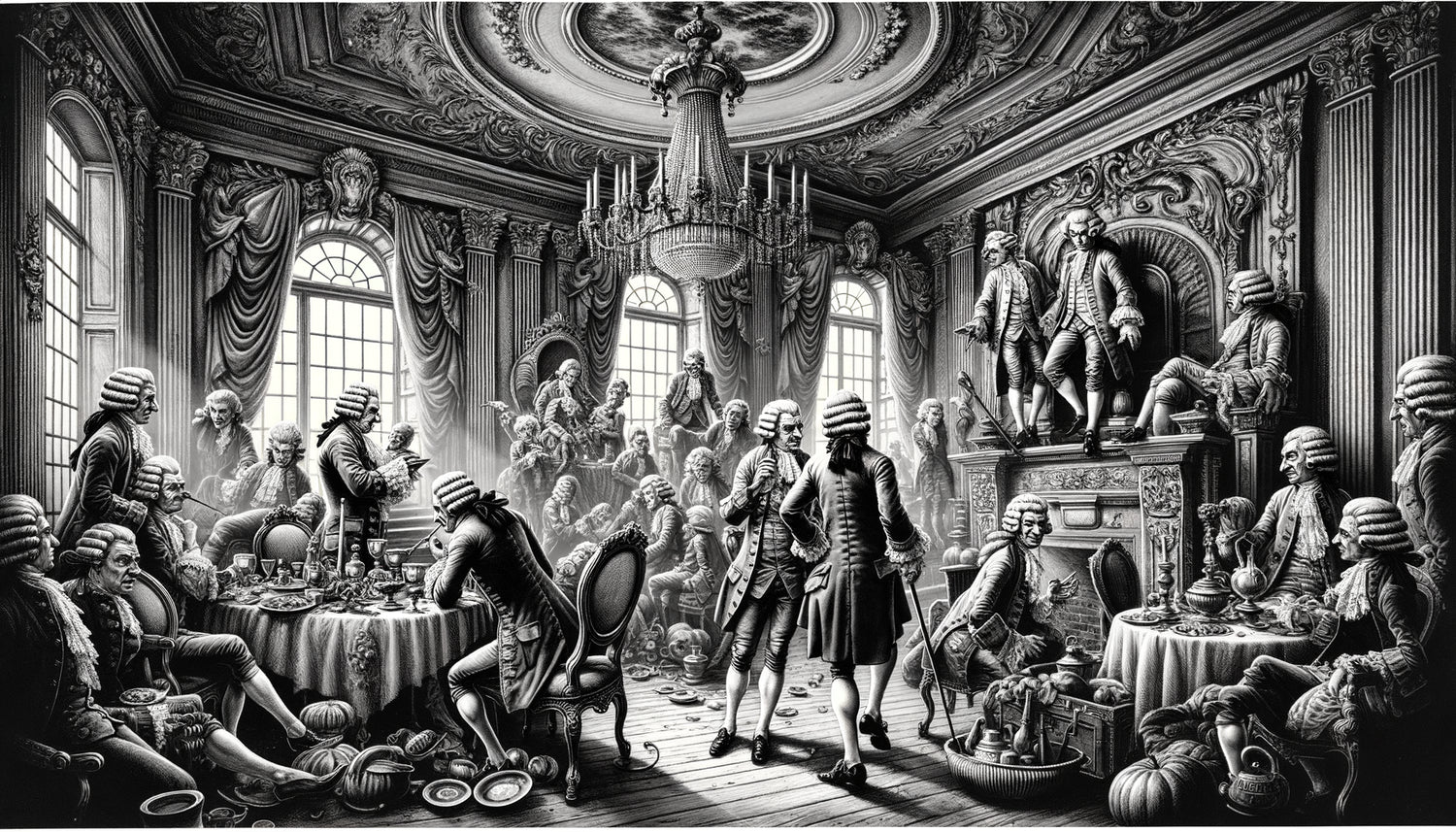
For lovers of history and interior architecture, this documentary dimension adds extraordinary value. One observes the costumes, furniture, lighting, and layout of rooms from the 18th century with almost photographic precision. Hogarth's caricatures then become windows in time, offering a journey through time from your contemporary living room.
Timeless Modernity: Why Hogarth Still Speaks to Our Time
What strikes me most after years immersed in the world of Hogarth is the troubling relevance of his themes. The critique of ostentatious consumption in *Marriage A-la-Mode* could apply to the age of Instagram. The denunciation of exploitation in *A Harlot's Progress* resonates with current debates. The analysis of the addiction-decline cycle in *Gin Lane* retains its power in the face of contemporary public health crises.
This temporal universality explains why Hogarth’s caricatures are experiencing a revival in high-end interiors. They are not perceived as dusty antiques but as social commentaries that remain active. They offer what purely decorative works cannot: intellectual depth, a starting point for reflection and conversation.
Even Hogarth's graphic style – these precise lines, these sharp contrasts, this narrative clarity – naturally dialogues with the contemporary aesthetic of graphic design. His influence can be found in modern comics, editorial illustration, even in some street art movements. Hanging a Hogarth engraving is establishing a cultural bridge between the 18th century and our digital present.

Integrating Hogarth into Your Interior: Expert Advice
The most common mistake I see is treating Hogarth’s caricatures as mere historical curiosities, relegated to a dark corner. These works deserve careful presentation that respects their dramatic intensity while integrating them harmoniously into the contemporary space.
For bright and minimalist spaces, a large framed reproduction of *Gin Lane* or *Beer Street* creates a powerful focal point. The contrast between the modern simplicity of the environment and the baroque complexity of the work generates a fascinating visual tension. Choose a simple frame – light natural wood or matte black – that does not compete with the richness within the image.
In a library or office, a complete series of *A Rake's Progress* transforms the space into an intellectual cabinet of curiosities. Arrange the engravings in a narrative frieze, at eye level, with indirect lighting that avoids reflections on the glass while creating dramatic shadows. The effect is that of a private gallery that invites prolonged contemplation.
For reception areas – living room, dining room –, interior scenes from Marriage A-la-Mode work wonderfully. They depict sumptuous rooms from the 18th century, creating a temporal dialogue with your own living space. Guests are invariably captivated by these windows onto a bygone world, sparking rich conversations about history, art and society.
Transform your walls into a captivating narrative gallery
Discover our exclusive collection of black and white paintings that bring the same narrative depth and timeless sophistication as the masters of English engraving.
The living heritage: from Hogarth to contemporary creators
Hogarth's influence crosses centuries and mediums. Modern political cartoons owe their narrative structure and symbolic charge to him. Graphic novel creators like Art Spiegelman or Alan Moore explicitly acknowledge his lineage. Even television series such as The Wire or Succession, with their merciless portraits of corrupt societies, bear his mark.
This creative genealogy adds an extra dimension to acquiring works inspired by Hogarth. You are not simply hanging an antique – you are enrolling in a living tradition of social critique through image. It is a cultural positioning that says a lot about your intellectual and aesthetic sensibility.
Contemporary artists continue to reinterpret Hogarth. Grayson Perry, with his satirical narrative tapestries, directly takes up his method. Paula Rego, in her dark pastels, shares his taste for visual moral parables. David Hockney has created series of etchings inspired directly by A Rake's Progress. Owning a Hogarth engraving is therefore dialoguing simultaneously with the past and present of narrative art.
Authenticity and reproductions: making the right choices
One question constantly comes up: should you invest in antique engravings or opt for quality reproductions? Original 18th century engravings, printed during Hogarth's lifetime, fetch considerable prices at auction – sometimes tens of thousands of euros for the rarest states. They constitute serious patrimonial investments but inaccessible to most enthusiasts.
Fortunately, excellent reproductions exist, using modern printing techniques that faithfully restore the tonal richness of the originals. A museum-quality giclée print on art paper, properly framed, offers a remarkably close visual experience to the original for a fraction of the cost. The key is to avoid low-end digital prints that flatten subtle nuances of gray and destroy the fine details that make Hogarth's magic.
Look for reproductions using high-resolution scans of engravings held in institutions such as the British Museum or the Tate Gallery. Prioritize textured papers that mimic the verge paper of the era. And never skimp on the framing – museum-quality anti-reflective glass makes all the difference to detail readability.
After years of contemplating, studying and living with Hogarth's caricatures, I remain convinced that they represent one of the best possible acquisitions for a cultured interior. They do more than decorate – they enrich, question, tell stories. Every morning, as you pass in front of one of these engravings in your hallway, you are invited to a moment of reflection, a connection with the timeless humanity that Hogarth knew how to capture.
Perhaps start with a single work – The Laughing Audience, a theatrical scene brimming with life, or The Sleeping Congregation, a hilarious satire of a drowsy sermon. Let yourself be seduced by Hogarth's universe, learn to read his symbolic language, discover the joy of decoding his visual enigmas. Then, inevitably, you will want to deepen, complete, create your own narrative gallery. This is the beginning of a passion that never fades, because unlike so many decorative works that become tiresome, Hogarth's caricatures are renewed with each glance, always revealing a new layer of meaning, a new tasty detail, a new resonance with our contemporary world.