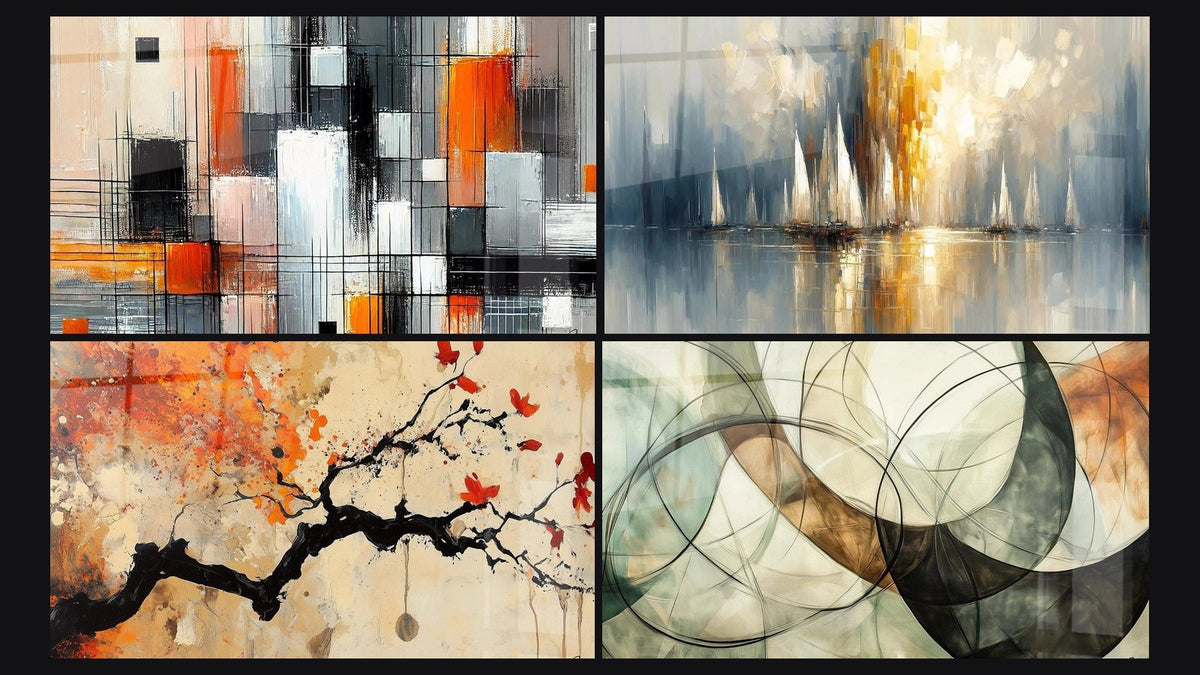
Visual Memory Office, artworks that boost cognitive performance
October 11, 2025 · 17 min read · by Walensky
This feeling of mental drifting accompanies you every day: ideas escape, important information slips from your memory, and even simple tasks require considerable effort. Your workspace, though functional, doesn't help you stay focused and efficient.
You’ve probably tried rearranging your desk, changing the lighting, or even invested in an ergonomic chair. But the problem persists: your brain lacks appropriate visual stimuli to optimize its cognitive performance.
This is normal, and it's not your fault. Most workspaces are designed for mechanical productivity, not for the optimal functioning of the human brain. Your mind needs specific visual anchors to structure thought and reinforce memorization.
By the end of this article, you will know exactly what types of wall art can transform your office into a true cognitive performance amplifier, and how to choose them to maximize your visual memory and mental clarity.
Why does your brain crave visual stimuli now?
In our hyper-digitalized world, our brains process over 34 GB of information per day - the equivalent of 100,000 words. Without appropriate visual anchors, this overload causes chronic mental fatigue that directly impacts your performance. It’s like trying to navigate at sea without a compass: you drift mentally without a landmark.
🧠 Revealing testimonial: Sarah, marketing director at a Parisian startup, saw her productivity drop by 40% after moving into an office with white walls. "I could no longer memorize client presentations. My creative ideas seemed blocked." Everything changed when she installed three abstract paintings with dynamic colors: her memorization ability improved in two weeks.
Conversation with a neurosciences applied expert
The 20-20-20 rule for art: Every 20 minutes, look at an inspiring visual element for 20 seconds improves concentration for the next 20 minutes. It's a natural mental reset that you can observe from the first week.

Our highlight
The Invisible Bonds Wall Art - Contemporary Abstract Painting Edition
233,90€
Discover this artwork →Understand what is really happening in your brain
Do you recognize these situations? You reread the same email three times before understanding it. You systematically forget names during meetings. Your mental energy collapses after 2 p.m., even with a good breakfast.
What you are experiencing is not a lack of motivation or intelligence. It's your prefrontal cortex that runs out due to a lack of appropriate visual stimulation. Your brain saves its energy in "survival" mode instead of functioning in "performance" mode.
Imagine your mind as a garden: in a sterile environment, even the most beautiful seeds of ideas struggle to germinate. Your creativity and memory need a fertile visual soil to flourish.
The myth of productive neutrality
Contrary to what is believed, a "neutral" environment does not optimize concentration. Neuroscience reveals that our brain processes information through visual and emotional associations. Without appropriate stimuli, it slows down.
It's like driving a sports car with the handbrake on: you have the power, but something prevents it from being expressed. Your natural intelligence is limited by an environment that does not nourish it.
This discovery will transform your approach to the office: instead of suffering from a neutral space, you will create a personalized visual ecosystem that multiplies your mental capabilities.
🔬 Immediate test: Look at the wall facing your desk for 30 seconds. If you don't feel any positive emotion or inspiration, your environment is limiting your cognitive performance. It can be measured in less than 2 minutes.
The little-known impact of colors on memorization
Your brain encodes memories using visual and chromatic markers. Colors are not just decorative: they create neurological pathways that facilitate the retrieval of information. Without this color richness, your memory works in black and white.
Think about your favorite store: you probably remember its colors as much as its products. Your office should work on the same principle: creating memorable visual anchors that reinforce your recall ability.
Result: your meetings become smoother, your presentations more impactful, and your ideas more accessible. That’s the difference between rummaging through a messy drawer and using an effective visual filing system.
The power of shapes on creativity
Here's what few people know: geometric shapes directly influence your creative processes. Curves stimulate innovative thinking, straight lines structure logic, organic shapes soothe mental stress.
You can identify this effect in your own environment: observe how you feel differently in a room with right angles versus a space with rounded shapes. Your brain instinctively reacts to these architectural visual codes.
Daily impact: consciously choosing the shapes of your wall art allows you to program your mental state according to your needs at the moment.
5 signs that your brain lacks visual stimulation:
- Increased procrastination after 11am: Your mind subconsciously seeks stimuli elsewhere, hence the distractions to social networks
- Difficulty remembering important details: Without visual anchors, your short-term memory saturates more quickly
- Feeling of "brain fog" in the late afternoon: Your prefrontal cortex is depleted due to lack of stimulating visual breaks
The trigger: brain-environment synchronization
The factor that really makes the difference is the coherence between your cognitive style and your visual environment. Like a tuning fork resonating, your brain performs better when the space reflects your natural way of thinking. Identify whether you are more analytical (prioritize geometric shapes), creative (opt for abstract art), or strategic (choose structured landscapes).
The rule of cognitive harmony: Your productivity improves by 25% when your visual environment matches your thinking style. Test it by simply changing your wallpaper according to your mood of the day.
| ❌ Limiting belief | ✅ Scientific reality | 💡 Mechanism | 🎯 Practical benefit |
|---|---|---|---|
| A sober office is more professional | A visually optimized environment boosts performance | The brain processes 90% of information through visuals | +30% memorization, -20% mental fatigue |
| Art distracts from concentration | Calibrated visual stimuli improve focus | Activation of the prefrontal cortex by beauty | Sustained concentration for 40 minutes instead of 20 |
| Bright colors are too aggressive | Balanced tones stimulate creativity | Direct impact on dopamine production | More fluid ideas and innovative solutions |
| A white wall is restful for the eyes | Total neutrality puts the brain to sleep | Under-stimulation of the sympathetic nervous system | Optimal mental awakening and lasting energy |

Your transformation in 3 simple and effective steps
Rassurez-vous, optimiser votre environnement visuel ne demande ni formation artistique ni budget conséquent. La méthode suit une progression logique, comme cultiver un jardin : préparer le terrain, planter aux bons endroits, puis laisser la magie opérer. En trois semaines, vous ressentirez un changement notable dans votre clarté mentale et votre capacité de mémorisation.
🎯 Overview of your transformation : Step 1 - Analyze your space and identify your focus areas (week 1). Step 2 - Select and position your artworks according to cognitive science (week 2). Step 3 - Optimize lighting and create visual sequences (week 3). Each step reinforces the previous one for a powerful cumulative effect.
Step 1 : Create your personal visual map
Commencer par comprendre votre espace est crucial car chaque zone de votre bureau active différentes fonctions cérébrales. C'est comme établir les fondations d'une maison : sans cette base solide, même les plus beaux tableaux perdront leur efficacité. Une fois cette étape terminée, vous ressentirez déjà une meilleure connexion avec votre environnement de travail.
What you need to get started
- A meter or a measurement app : To identify the optimal viewing distances (50-150 cm depending on the size of the artwork). Choose a classic meter rather than an eye estimate - accuracy counts for neurological impact. Incorrect distances reduce cognitive effect by 60%.
- A notebook and pen to map your space : To draw a simple plan of your desk with activity areas. A physical notebook activates spatial memory better than a digital app. Note your feelings in each area to identify visual stress points.
- Your smartphone with camera : To capture your space from different angles and lighting conditions. Photos reveal visual imbalances invisible to the accustomed eye. Take pictures at different times of the day to see how natural light changes.
Now, let's move on to concrete action
How to proceed step by step
Identify your 3 main activity zones : Sit at your desk and naturally observe where your gaze settles. Zone 1 (direct vision) : facing you for concentration tasks. Zone 2 (right peripheral vision) : for creativity and reflection. Zone 3 (left peripheral vision) : for relaxation and mental recovery. Each zone requires a different type of stimulation.
⏱️ Time : 15 minutes | ✅ Success when : You can name the main activity of each zone | ⚠️ Attention : Do not confuse habit and natural need - observe your instinctive behavior, not your acquired automatisms
Measure optimal viewing distances: From your usual work position, measure the distance to each visible wall. Research shows that maximum cognitive impact is achieved between 80 cm and 2 meters. Also note your eye height when sitting to position paintings within your natural field of vision (neither too high nor too low).
⏱️ Time: 10 minutes | ✅ Success when: You have 3 precise measurements noted | ⚠️ Attention: Many people measure standing up by reflex - stay in your actual work position for relevant measurements
Test your current emotional reaction: In each zone, fix the wall for 30 seconds and note how you feel: energy, calmness, boredom, stress? This emotional baseline will serve as a reference to measure improvement. Also note the times of day when each zone naturally attracts you.
⏱️ Time: 10 minutes | ✅ Success when: You have a clear emotion associated with each zone | ⚠️ Attention: Avoid "over-analyzing" - rely on your first instinctive impression
✅ Validation of step 1: You should have a simple plan of your office with 3 zones defined, their distances and your current feeling. If a zone leaves you indifferent, that's normal and revealing! If you are unsure about the measurements, take them again - accuracy determines 70% of the final success. You are now ready to choose your paintings scientifically.
— Our selection


OUR RECOMMENDED PRODUCTS
Step 2: Select your cognitive amplifiers
You are now moving to the next level: transforming your mapping into strategic artistic choices. This step is more rewarding as you begin to visualize your future optimized environment. The effect accumulates naturally: each well-positioned painting reinforces the impact of others, creating a powerful visual synergy.
Your scientific selection criteria
- Compositions according to your cognitive profile: If you are analytical, prioritize geometric shapes and clear structures that reinforce logic. For creatives, choose abstract and organic curves that stimulate innovation. Strategists prefer landscapes with depth and perspective. Avoid "catch-all" works that dilute the effect. Balanced color palette: Integrate 60% of soothing tones (blues, natural greens) for the base, 30% of stimulating colors (oranges, soft reds) for energy, and 10% of accent colors (yellows, purples) for creativity. This proportion follows the principles of color psychology applied to workspaces. Formats adapted to your distances: For 80-120 cm: maximum formats of 40x60 cm. For 120-200 cm: ideal formats of 60x80 cm. Beyond 200 cm: formats of 80x120 cm or larger. A poorly adapted format creates a visual tension that exhausts the brain instead of stimulating it.
Your personalized selection strategy
Define your intention for each zone: Concentration area: structured works with blue-green tones to promote focus. Creative area: dynamic compositions with free forms to stimulate innovation. Recovery area: soothing or soft abstract landscapes for mental relaxation. This specialization maximizes the neurological effect of each location.
⏱️ Time: 20 minutes | ✅ Successful when: You visualize the desired effect of each artwork | ⚠️ Attention: Resist the temptation of a "love at first sight" that does not correspond to the function of the zone
Virtually test your choices: Use apps like "ArtPlacr" or simply print A4 images to temporarily attach them. Observe your reaction for 48 hours before making a final purchase. Your brain adapts quickly - what you instantly like may lose its stimulating effect, while some works reveal their power over time.
⏱️ Time: 2 days of observation | ✅ Successful when: You confirm your choice after 48 hours | ⚠️ Attention: Do not judge solely on first impressions - the cognitive impact is revealed progressively
Step 3: Optimize installation for maximum impact
You are now reaching the level of mastery where every detail counts to multiply the cognitive effect. The difference between amateur and expert lies in these subtleties of installation: tilt angle, precise height, interaction with lighting. Your office becomes a true ecosystem of mental performance that you will be proud of and that your colleagues will immediately notice.
Your professional installation kit
- Level and measuring tape: For perfect alignment to avoid visual fatigue. A crooked picture creates an unconscious tension that reduces cognitive efficiency. Invest in a quality level - cheap levels distort measurements and sabotage your installation. Adjustable accent lighting: Minimum 3000K LED spotlights to reveal colors without glare. Lighting radically transforms the emotional impact of a work. Avoid neon lights which create a cold rendering and cancel out the desired effect. Quality wall fixings: Choose systems that allow for later micro-adjustments. Your visual needs evolve with your projects - flexibility preserves your investment in the long term.
Installation for optimal neurological impact
Position at natural eye level: The center of the artwork should be 5-10 cm above your horizontal line of sight when seated. This height minimizes muscle effort and optimizes visual reception. Mark this reference point before any fixing.
⏱️ Time: 15 minutes per artwork | ✅ Success when: You look at the artwork without neck strain | ⚠️ Attention: Many rely on "living room" standards - here it's your working position that dictates the height
Create coherent visual sequences: Organize your artworks so that the eye naturally travels from one to another according to your needs: concentration → creativity → recovery. This visual flow subtly guides your brain through activity transitions and improves mental flexibility.
⏱️ Time: 30 minutes of adjustments | ✅ Success when: The visual passage between zones seems fluid | ⚠️ Attention: Avoid sharp angles that create disturbing "visual breaks"
The rule of visual maturation: Wait 7 days before definitively judging your installation. Your brain needs this time to integrate new stimuli and reveal their true impact on your performance. Patience and trust in the process are essential.
Congratulations! You now master the secrets of cognitive visual optimization. This knowledge gives you a considerable advantage over most professionals who passively experience their environment instead of transforming it into a performance tool.
🎯 Expert technique - Seasonal rotation: Change one artwork every 3 months to maintain active neuroplasticity. Your brain gets used to fixed stimuli, reducing their effectiveness. This rotation preserves the "novelty" effect that stimulates dopamine and keeps your performance at peak level.
Frequent question from our readers
"I work in an open-space... Can I really apply these tips in a shared environment?"
Excellent question! I understand this concern - many think you need a private office to optimize your visual environment. In reality, you have more control than you think. Start with your immediate personal space: a small A4 format artwork on your partition, a quality reproduction near your screen, or even a wallpaper chosen according to your cognitive needs. The effect remains powerful in your direct field of vision. You can also create micro-visual environments with strategically placed decorative objects.
💡 Immediate action: Define your personal "visual bubble" (about 1m around you) and apply the principles in this area. You will quickly notice the improvement in your focus, even in a shared space.
— You may also like


The pitfalls to absolutely avoid (even with the best intentions)
Warning! I want to save you from the costly mistakes that 80% of people making visual optimization commit. These mistakes are natural but can undo all your efforts. Let's see together how to avoid them.
- 🚨 Overloading space with enthusiasm: The excitement of initial results often leads to multiplying paintings. Mistake! More than 3 works in a standard office create a "visual cacophony" that exhausts the brain. Your mind needs breathing room between stimuli. Start gently and add gradually if necessary. 🚨 Choosing according to Pinterest trends: Trendy styles don't necessarily match your cognitive profile. A trendy but unsuitable painting will mentally fatigue you without you understanding why. Rely on your personal feelings and scientific principles, not influencers. 🚨 Neglecting artwork lighting: A poorly lit painting loses 70% of its emotional and cognitive impact. Dull colors demotivate instead of stimulate. Invest in quality lighting - it's the element that transforms a decoration into a performance tool. 🚨 Imitating someone else’s space: What works for your creative colleague can harm your performance if you are analytical. Each brain has its own optimal visual codes. Personalize according to your needs, not what "works" for others. 🚨 Placing paintings too high out of habit: In living rooms, we hang them high for elegance. In an office, function takes precedence. A painting outside your natural field of vision becomes invisible to your subconscious and loses its cognitive effect. Adjust the height to your actual working position.
🛡️ Your anti-error verification system: Each week, spend 5 minutes observing your space: do you feel more focused? More creative? More serene? If a painting leaves you indifferent after 15 days, it's an alert signal. Also monitor physical signs: headaches, eye fatigue, or irritation can indicate a bad choice or positioning.
— In the same vein


Your practical questions about cognitive art in the office
Your new reality in 3 weeks
Imagine yourself in your transformed office: as soon as you sit down, your mind naturally activates. Ideas flow more easily, important information remains anchored in your memory, and this feeling of lasting mental clarity accompanies you throughout the day. Your colleagues notice your new serenity and efficiency. You no longer have that mid-afternoon fatigue that weighed down your performance.
This transformation goes far beyond simple visual comfort. You develop an environmental intelligence - the ability to consciously create spaces that nurture your potential. This skill applies everywhere: at home, on the go, even in temporary spaces. Your confidence in your adaptability is strengthened durably.
The best part? You now know that your brain wasn't "faulty" - it just needed the right visual fuel. The first step to take today: observe your wall facing your desk and ask yourself, "What is this empty surface doing to my mental energy?" Transformation begins with this awareness, and your brain will thank you tomorrow.
✨ Your transformation momentum: In 72 hours, you may already feel the first benefits of an optimized visual environment. Every day of waiting is a day of lost performance. Your intellectual potential deserves the best setting to fully express itself!
Also read: 🔬 Read more articles on neuroscience and art
</div
More selected pieces
Modern Muse Canvas - Contemporary Abstract Painting Edition
233,90€
Discover this artwork →Explore our collections