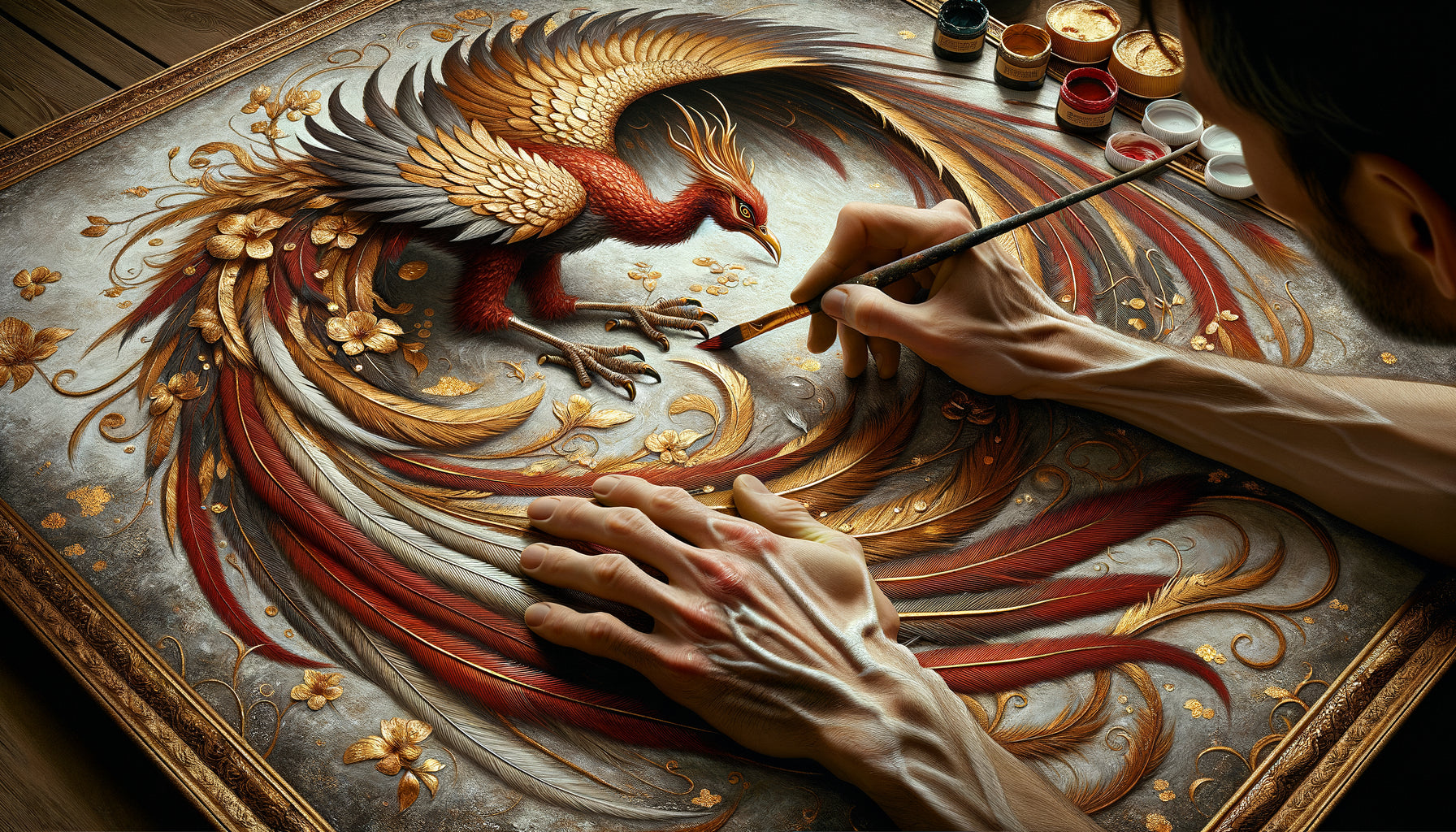
When I restored my first fresco depicting Anubis in a Parisian townhouse, I discovered beneath the surface layers a blue so intense that it seemed to radiate. It wasn't an ordinary pigment: it was authentic lapis lazuli, ground according to millennia-old techniques. At that moment, I understood why some wall art depicting Egyptian deities achieve prices that leave people perplexed.
Here's what a wall artwork using authentic pigments brings: an impossible chromatic depth to be reproduced synthetically, exceptional resistance to time which transforms the investment into patrimonial heritage, and a tangible connection with ancestral know-how that transcends simple decoration.
Many collectors face this frustration: why can two representations of Isis or Râ display price differences of several thousand euros? The confusion often comes from the inability to distinguish a printed reproduction from a creation using noble pigments applied according to the rules of art.
Rest assured: understanding the real value of pigments does not require a degree in art history. It is enough to know a few secrets that I share after fifteen years spent restoring and appraising wall artworks with Egyptian themes.
In the lines below, I reveal exactly which pigments justify a significant investment, how they transform simple decoration into true heritage, and why their initial cost translates into an incomparable added value.
The gold of the pharaohs: when precious metal sublimates the deities
On a wall artwork depicting Egyptian deities, gold is never just a decorative detail. In ancient Egypt, this metal embodied the very flesh of the gods, their immortal and incorruptible nature. Even today, when an artist applies genuine gold leaf to Hathor's ornaments or Nut's headdresses, they perpetuate more than just an aesthetic tradition.
The difference between gold leafing and synthetic gilded paint is immediately measured by the light. True gold captures and reflects rays at multiple angles, creating that luminous vibration that the Egyptians called nebu. In a contemporary interior, this quality radically transforms the perception of space: the artwork becomes a living source of light rather than a simple decorative element.
The cost of authentic gold pigments is explained by the technique of their application. A 23 or 24 carat gold leaf, beaten to reach just a few microns in thickness, requires specific know-how. The artisan must prepare the support with layers of gesso – this preparation based on clay and glue – then apply the leaf under precise conditions of humidity and temperature.
I calculated that a wall artwork of average size (120 x 80 cm) generously using gold leaf requires between 20 and 40 leaves, representing a material cost of 150 to 400 euros, excluding the meticulous hours of work. This difference naturally affects the final price.
Egyptian blue: the first synthetic pigment of humanity
Among all pigments in Egyptian artworks, Egyptian blue holds a special place. Invented almost 5,000 years ago, this copper and calcium silicate represents the very first color ever created by humankind. Its manufacture required furnaces reaching 850 to 1000°C, a considerable technical feat for the time.
What justifies its high price in contemporary mural creations depicting deities is threefold: its rarity (few artists still master its traditional manufacturing), its exceptional stability against UV rays, and above all its astonishing luminescent properties. Under infrared light, Egyptian blue emits visible fluorescence, creating mysterious effects particularly sought after in sophisticated interiors.
When Khéphri, the scarab god of the rising sun, is represented with this authentic blue, the shade obtained differs radically from modern cobalt or ultramarine blues. It possesses that characteristic milky transparency, slightly greenish, which immediately evokes the waters of the Nile or the Egyptian sky at dawn.
The artisanal manufacture of Egyptian blue for a mural work takes several days: calcination of raw materials, ultra-fine grinding of the obtained product, stabilization of the pigment. The production cost easily exceeds 200 euros for 100 grams of pure pigment, whereas a synthetic industrial blue costs less than 5 euros.

Lapis-lazuli and natural ultramarine: the prestige of ground precious stones
During my years of training in Italy, I learned to grind Afghan lapis-lazuli to extract natural ultramarine. This semi-precious stone, imported from Afghanistan via ancient trade routes, contained literally more value than gold by weight during certain historical periods.
On a mural work representing Nout, the goddess of the night sky, the use of natural ultramarine changes everything. This pigment possesses a depth that chemists have never managed to perfectly reproduce: each microscopic grain of lazurite refracts light differently, creating that sensation of three-dimensional starry sky that the Egyptians sought to represent the celestial vault.
The extraction process alone justifies the prohibitive cost of pigment. First, the stones richest in lazurite (the blue mineral) must be selected, finely ground, and then a complex levigation is performed: the powder is mixed with wax, resin, and oil, and all are kneaded in alkaline water. Only the particles of pure lazurite detach themselves and fall to the bottom, creating this extraordinary blue.
To obtain 30 grams of top-quality natural ultramarine – enough to work on the celestial areas of a wall artwork of medium size – expect between €150 and €300 in raw materials, compared to less than €10 for the synthetic equivalent. But the visual difference justifies this investment for informed collectors.
Rare ochres and umber earths: the palette of the sacred desert
Egyptian deities are inseparable from the desert landscapes that gave them birth. This is why the ochres, sienna earths, and umber earths used in authentic works ideally come from specific deposits, some of which are depleted or protected.
The red ocher of Roussillon, natural sienna earth from Italy, or certain Cypriot umbers possess unique mineral compositions that directly influence their behavior in light. In a wall representation of Sekhmet, the lioness goddess, the use of ochres rich in natural hematite creates this orange-blood vibration impossible to obtain with synthetic iron oxides.
I have visited ocher quarries in Provence where artisans still manually extract the purest veins. These natural pigments contain mineral impurities – clays, quartz, micas – which paradoxically enrich their final rendering. Each grain subtly refracts light, creating this vibrant texture that ancient painters mastered perfectly.
The cost of rare ochres and earths is explained by their selective extraction and preparation: washing, decanting, drying, calibrated grinding. For an Egyptian wall artwork highlighting the warm tones of the desert, investing in these noble pigments generally adds €100 to €200 to the material cost, but guarantees chromatic stability for generations.

Vermilion of cinnabar: the sacred red of divine crowns
The red used for the crowns of Egyptian deities is never arbitrary. Historically, vermilion – natural mercury sulfide extracted from cinnabar ore – represented divine blood, vital force, the solar power of Ra. Its vibrant orange-red hue, slightly fluorescent, resembles no other red pigment.
On a museum-quality contemporary wall art, the artist will choose either natural cinnabar (now rare and regulated) or superior synthetic vermilion manufactured using traditional Chinese methods. The difference with modern cadmium reds? A higher chromatic density and exceptional lightfastness.
I restored a fresco where the vermillion applied in 1880 had retained 95% of its original intensity, while retouching with cadmium red from the 1960s had already turned brown. This permanence justifies an additional cost: quality vermilion costs between €80 and €150 per 100 grams, or 5 to 10 times more than common synthetic reds.
In the depiction of deities such as Amun-Ra or the Lower Egyptian deshret crowns, the use of authentic vermilion literally transforms the presence of the work. The pigment seems to emit its own light, creating that solar radiance that Egyptian priests associated with divine power.
Ground malachite: the eternal green of rebirths
Green occupies a major symbolic place in Egyptian iconography: color of rebirth, fertility, perpetual renewal embodied by Osiris. The traditional green pigment came from grinding malachite, this copper carbonate with shimmering veins.
On a wall art depicting Osiris in his resurrected form, the use of ground malachite produces a green with varying nuances – from deep blue-green to bright apple green – depending on the fineness of the grind and the pictorial layer. This variability, far from being a defect, enriches the perception of the work: it creates a chromatic vibration that uniform chrome or phthalocyanine greens cannot match.
The cost of ground malachite is explained by the increasingly scarce quality ore. Historic Sinai deposits, exploited since the Old Empire, are exhausted. Today, artists turn to Congolese or Russian sources, with prices ranging from €60 to €120 per 100 grams for the purest qualities.
I compared two wall representations of Osiris side by side: one used natural malachite, the other a modern phthalocyanine green. Under raking light, the first revealed depth and texture, while the second remained flat. This difference justifies the investment for a collector seeking authenticity.
Transform your interior into a sanctuary of chromatic excellence
Discover our exclusive collection of Myths and Legends paintings that perpetuates the legacy of master pigmenters and enhances your spaces with exceptional wall creations.
The investment in permanence: why noble pigments last through the centuries
When analyzing the price of a wall art piece depicting Egyptian deities, it is necessary to reason in terms of permanence. Authentic pigments are not only more beautiful: they are chemically stable against the three enemies of any work of art – light, humidity and atmospheric pollution.
I have assessed frescoes in Egyptian tombs in the Valley of the Kings, dating back 3,200 years. The mineral pigments – ochres, Egyptian blue, ground malachite – had retained 70 to 80% of their original intensity. This millennial resistance comes from their inorganic nature: unlike organic dyes which degrade under UV light, mineral pigments are essentially crushed rocks, therefore practically unchanged.
For a contemporary wall art piece intended for a residential space, this permanence translates concretely: after 50 years of exposure to indirect light, a creation using noble pigments will retain 90% of its brilliance, while a digital print or standard acrylic paint will have lost 30 to 50% of its chromatic intensity.
The initial extra cost – generally between 40 and 60% for a work exclusively using authentic pigments – therefore dissolves over the long term. Reduced to a perspective of heritage transmission, the investment becomes rational: you are not buying a temporary decoration, but a stable legacy.
Recognizing a work using noble pigments: the distinctive signs
How can a non-expert collector identify a wall art piece depicting Egyptian deities that truly uses quality pigments? Several clues do not deceive, which I have learned to spot during my years of expertise.
First sign: the variable chromatic depth. Natural pigments contain micro-variations in composition that create subtle nuances even in an apparently uniform area. Observe the sky behind a representation of Nout: if it presents a subtle gradation, subtle variations in tone, there is a good chance that the artist used natural ultramarine or Egyptian blue. A synthetic blue remains desperately uniform.
Second indicator: behavior under grazing light. Ask to see the wall art illuminated laterally by a strong light source. Authentic pigments, applied in layers according to traditional techniques, reveal a texture, a subtle relief. True gold shimmers with multiple reflections, crushed malachite shows a delicate granularity.
Third criterion: documentation provided by the artist. A creator genuinely using noble pigments will explicitly mention it, often with the precise origin (Afghan lapis lazuli, Roussillon ochre, etc.). This transparency is generally accompanied by a detailed certificate of authenticity detailing the pigment composition.
Finally, the price itself is a reliable indicator. A Egyptian wall art of average size (100 x 80 cm) generously using gold, lapis lazuli, malachite and vermilion simply cannot physically be sold below a certain threshold without the artist working at a loss. If the price seems too attractive, question the actual composition.
Beyond the Price: The Sensory Experience of Authentic Pigments
After fifteen years spent alongside Egyptian wall art of all qualities, I can affirm that the difference between noble pigments and synthetic substitutes transcends the simple monetary question. It is a radically different sensory experience.
A representation of Isis made with genuine natural pigments is not just seen: it is felt. The luminous vibration of gold, the hypnotic depth of lapis lazuli, the earthy warmth of rare ochres create a physical presence in space. Visitors to your interior will be unconsciously drawn to the artwork, even without rationally understanding why.
This presence comes from the optical complexity of authentic pigments. Each microscopic grain refracts light at a slightly different angle, creating what physicists call Mie scattering. The human brain, extremely sensitive to chromatic nuances, perceives this richness as a form of “life” of the artwork.
I have observed this phenomenon repeatedly: place a printed reproduction and an original wall art using noble pigments in the same room, and looks will systematically go towards the second. This ability to capture and retain attention justifies, for many collectors, the extra cost of noble materials.
Imagine Your Space Transformed
Visualize your living room at dusk. The declining light touches a wall representation of Anubis, and suddenly, the gold of its ornaments comes to life, capturing the last rays as did the frescoes of Karnak temple three millennia ago. The deep blue of the night sky behind the deity seems to deepen as the room darkens, creating that mysterious presence that only authentic pigments can produce.
This isn't just a decoration you've acquired, but a fragment of ancestral craftsmanship, a tangible connection with the master artisans who painted the tombs of pharaohs. Each visit to this room reminds you that you chose excellence over ease, authenticity over approximation.
The noble pigments of an Egyptian mural work don't just justify their price: they transcend it by offering an irreplaceable aesthetic experience and a permanence that transcends generations. Your investment today becomes tomorrow's heritage, carrying this unalterable beauty that only true materials can guarantee.
Frequently Asked Questions
How to verify that a mural actually uses authentic pigments?
Verification begins with the documentation provided by the artist or gallery. A work using noble pigments will systematically be accompanied by a detailed certificate detailing the exact composition: provenance of lapis lazuli, type of gold used (23 or 24 carat leaf), origin of ochres. Also ask to see the work under different lighting conditions: authentic pigments reveal subtle variations and depth that synthetic substitutes cannot imitate. Under raking light, true gold shows multidirectional reflections, lapis lazuli reveals tiny golden flecks (natural pyrite), and ochres present a delicate graininess. If the seller hesitates or is vague about the composition, consider this as a warning sign. Artists who truly use authentic pigments in their Egyptian works are proud of it and communicate it clearly, as it represents a major competitive advantage and justifies their pricing.
Does a mural with noble pigments require special maintenance?
Paradoxically, wall art using authentic pigments requires less maintenance than its synthetic equivalents, precisely because these materials have been selected over millennia for their exceptional stability. Mineral pigments – ochres, Egyptian blue, malachite – are chemically inert and naturally resist light, normal relative humidity, and domestic air pollution. Maintenance is limited to gentle dusting once or twice a year with a soft natural bristle brush, avoiding any chemical or wet product. For gilded areas, a simple breath followed by a gentle wipe with a microfiber cloth is sufficient. Avoid direct sunlight (as with any work of art) and maintain relative humidity between 40 and 60%. Unlike inkjet prints that yellow or acrylics that crack, your Egyptian artwork using noble pigments will last through the decades without visible degradation, retaining 90% of its chromatic intensity after 50 years. This natural resilience is part of the intrinsic value of the investment.
Does the price of a work with authentic pigments represent a good long-term investment?
Analyzed from a heritage perspective, investing in an Egyptian wall artwork using noble pigments has several measurable financial advantages. Firstly, permanence: where an inkjet print loses 30 to 50% of its brilliance in 20 years (requiring costly replacement or restoration), authentic pigments retain their intensity for generations, eliminating replacement costs. Secondly, increasing scarcity: with the depletion of historical deposits of lapis lazuli, malachite and cinnabar, artworks using these materials are mechanically becoming rarer, creating a dynamic of appreciation. I have observed works acquired in the 1990s generously using Afghan lapis lazuli (then at €80/100g, now at €300/100g) whose value has tripled, regardless of the artist's rating. Thirdly, transmission: a work with authentic pigments becomes a family heritage that can be passed down, unlike reproductions without residual value. Finally, liquidity: on the secondary art market, documented artworks using noble materials find buyers more quickly and at a better price. Consider the initial price difference (40-60% premium) not as an expense but as insurance against depreciation, doubled by a potential appreciation linked to the scarcity of raw materials.