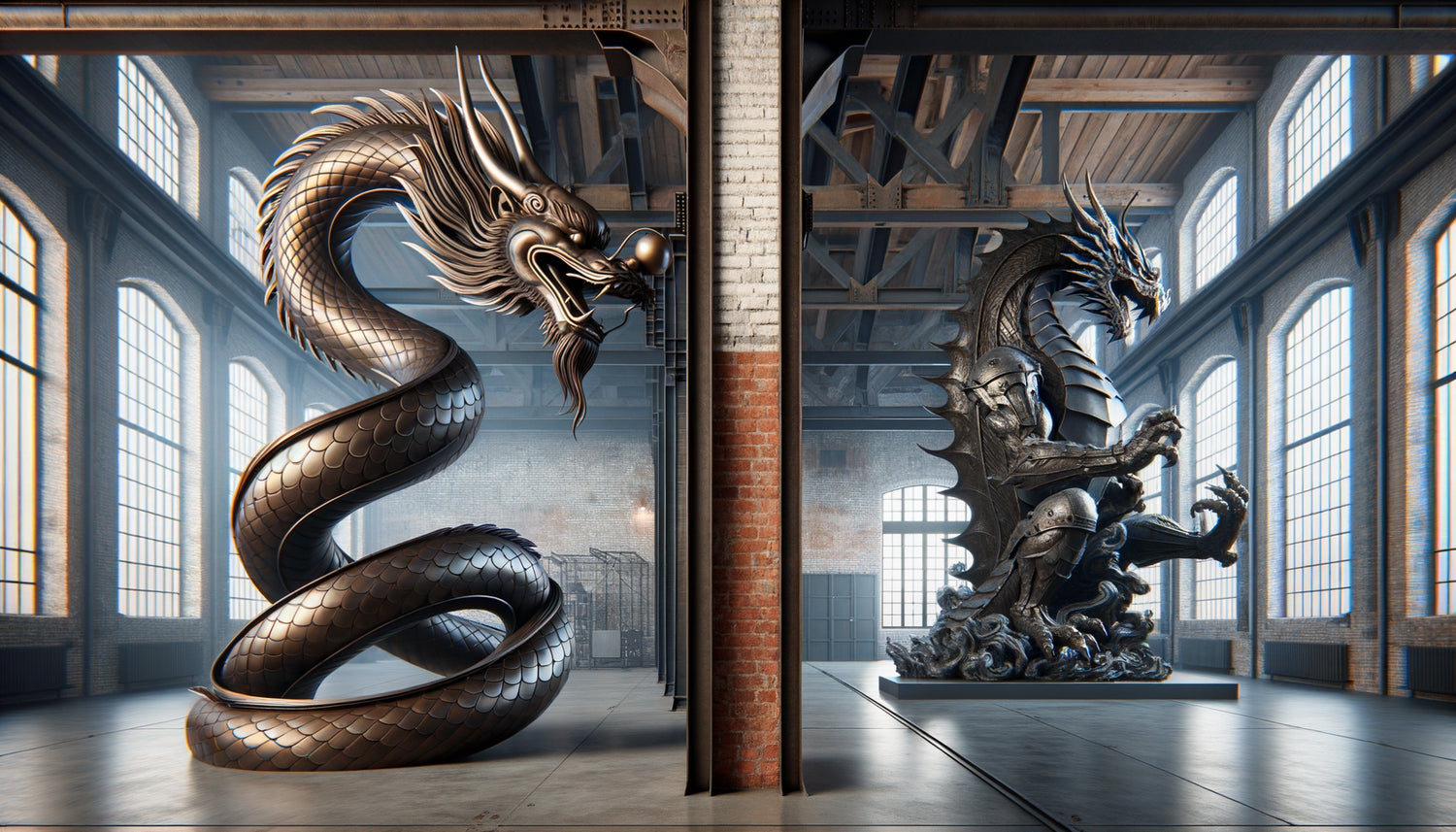
I grew up surrounded by metal frameworks, in my father's conversion workshop that transformed old factories into living spaces. One day, an architect client walked in with two dragon reproductions under his arm: a sinuous Chinese dragon in red lacquer and a fire-breathing medieval dragon. His question? "Which one should I put in my loft?" I have relived this scene dozens of times since taking over the family business.
Here's what dragon representation brings to an industrial loft: it transforms raw coldness into inhabited mythological territory, it dialogues with metal structures like an ancestral narrative facing modernity, it creates a focal point that attracts the eye and gives soul to the space.
The problem? Most loft owners hesitate between these two draconian universes without understanding that they tell radically opposed stories. They buy on impulse, install their piece... and vaguely feel that something is wrong with the spatial balance. The oriental dragon seems too delicate, or the western dragon too aggressive.
Rest assured: this discomfort has nothing to do with the quality of your piece. It simply reveals that you haven't yet understood the architectural language spoken by your loft. Once this code is deciphered, the choice becomes obvious.
In this article, I will show you how each dragon representation dialogues with your industrial volumes, what balances it creates or destroys, and above all how to choose the one that will make your loft a unique place.
The oriental dragon: when fluidity meets brutality
The Asian dragon meanders. This is its fundamental aesthetic signature. Observe any traditional representation: the body undulates in continuous curves, wraps around itself, creates perpetual movement. In Chinese or Japanese symbolism, this dragon embodies wisdom, benevolent power, the balance of natural forces.
Transposed into an industrial loft, this oriental dragon produces a striking contrast effect. Faced with IPN beams, geometric brick walls, and exposed ducts that cut up the space in vertical and horizontal lines, its sinuosity becomes hypnotic. Last year, I installed a gilded Chinese dragon mural sculpture in a former 180 m² textile workshop. The body of the dragon followed the curve of a metal pillar, creating a visual conversation between industrial rigidity and organic fluidity.
Oriental representations excel in double-height lofts. Their natural verticality - the dragon rising to the heavens - beautifully complements these generous volumes. A large kakemono depicting a dragon among the clouds, suspended along a six-meter wall, instantly transforms the perception of space: it is no longer just an architectural volume, but a fragment of universe where earth and sky dialogue.
The color palette that makes the difference
Traditional oriental dragons display precise color ranges: imperial red, celestial gold, deep jade, ink black. These shades possess an intensity that fears no dominant industrial neutrality. In a loft with gray-concrete-steel tones, a lacquered red dragon becomes what I call a "chromatic detonator": it awakens the space without attacking it, because its presence remains rooted in a millennial tradition that legitimizes its boldness.
I've noticed that black and gold representations work particularly well in lofts with minimalist Scandinavian furniture. The dragon brings the sophistication and historical depth that can be lacking in these interiors, which are sometimes too refined.
The Western Dragon: Mirror of Industrial Architecture
The medieval European dragon has a compact musculature, membranous wings spread, a fighting posture. It is a creature of territory, an aggressive guardian of treasures, the embodiment of danger that a hero must face. Aesthetically, it favors angularity, mass, frontal presence.
In an industrial loft, this representation produces an effect of architectural resonance. Exposed metal structures, riveted beams, wrought iron staircases find their symbolic equivalent in the metallic scales, sharp claws, and architected wings of the Western dragon. It is a dialogue of raw materials and primal forces.
A collector client once confided to me: "My medieval dragon made from recycled metal does not decorate my loft, it is part of it." That was perfectly summarized. Western representations, especially when using steel, patinated bronze or wrought iron, do not add to the industrial space: they extend it, comment on it, reveal its latent mythological dimension.
The Sculptural Impact in Open Spaces
The Western dragon requires space. Its spread wings, muscular tail, and open mouth create a three-dimensional volume that powerfully occupies the territory. In a loft whose main asset is precisely available space, this volumetric presence becomes an advantage.
I installed a life-size medieval dragon sculpture in a former converted hangar. Positioned in the center of the open space, it naturally created a functional separation between the living area and the dining area, without visually partitioning. The dragon acted as a sculptural furniture piece, a mobile architectural element that structured the space.
The Western wall representations - bas-reliefs, dragon heads mounted like trophies, dramatic paintings - work admirably on brick walls. The rough texture of the historic material dialogues with the symbolic roughness of the creature.

Key Considerations: Let Your Architecture Speak
After fifteen years of observing these installations, I have identified three questions that immediately reveal which draconian representation will enhance your industrial loft.
First question: what is the geometric dominant of your space? If your loft multiplies straight lines, sharp angles, orthogonal structures, an oriental dragon will bring the missing curve, organic breath. Conversely, if you have retained rounded elements - arches, silos, tanks -, an occidental dragon with angularity will create a structuring counterpoint.
Second question: what narrative do you want to inhabit? The oriental dragon evokes wisdom, cosmic harmony, positive transformation. It is suitable for lofts designed as refuges, spaces of renewal. The occidental dragon speaks of conquest, protection of territory, assumed power. It thrives in statement lofts, these spaces that affirm a strong personality.
Third question: what is your existing palette? An loft with warm tones - red bricks, reclaimed wood, brass - will naturally welcome the imperial hues of an Asian dragon. A space with cool tones - gray concrete, brushed steel, glass - will enhance the metallic patinas of a medieval dragon.
Scale: The Fatal Error to Avoid
I have seen too many draconian representations ruined by a scale problem. In a 40 m² loft with high ceilings, a monumental dragon crushes the space. In a volume of 200 m², a small dragon gets lost, becomes anecdotal.
Rule of thumb: in an industrial loft, your draconian representation should visually occupy between 5 and 15% of your main wall. An oriental vertical dragon can reach up to 80% of your ceiling height. A horizontally deployed occidental dragon can cover 60% of the wall width without overload.
Contemporary Hybridizations: The Third Way
In recent years, I am observing the emergence of hybrid draconian representations that borrow from both traditions. Contemporary artists are creating dragons with sinuous oriental bodies but massive occidental heads, or vice versa. These culturally mixed creatures find a particular resonance in lofts themselves hybrids - these spaces that mix industrial authenticity and contemporary design comfort.
A hybrid neon dragon, for example, can fuse the undulating Asian silhouette with the electric materiality of Western industry. Installed in a former car workshop converted into a creative space, it creates a temporal bridge between the history of the place and its contemporary rebirth.
Mixed media representations - digital printing on rusted metal, resin sculpture imitating jade on steel structure - allow for impossible visual dialogues with pure traditional forms. They are particularly suitable for owners who refuse to choose between two cultural heritages.

Installation and lighting: reveal the power
An oriental dragon requires light that sculpts its curves. I often use grazing side lights that create sinuous shadows on the adjacent wall. The dragon multiplies, its movement extends into space.
A Western dragon on the other hand calls for dramatic frontal lighting that accentuates its volume, carves out its reliefs, makes its metallic scales shine. In a loft with large bay windows, position it so that it captures natural light during golden hours: the transformation is spectacular.
For industrial lofts retaining their old overhead crane rails on the ceiling, I like to suspend oriental dragons made of rice paper or fabric. They float in the volume as if in their natural element - the sky - creating an aerial poetry that beautifully contrasts with industrial heaviness.
The dragon as a modular system
An approach I often recommend: rather than a single massive representation, compose a constellation of dragons smaller in size. Three oriental dragons of different sizes ascending along a pillar. Five dragon heads forming an asymmetrical wall composition. This multiplication creates a narrative, a movement, where a unique piece would remain static.
Ready to give a mythological soul to your loft?
Discover our exclusive collection of Myths and Legends paintings that transform your industrial volumes into territories inhabited by legends.
Your loft dictates its dragon
Ultimately, the question is not knowing which representation is objectively superior. The oriental dragon and the western dragon each possess their own genius, their unique ability to transform a space.
Your industrial loft already has a personality: in its proportions, its preserved materials, its natural light, its manufacturing history. The right dragon is one that reveals this latent identity, that makes resonate the hidden harmonics of your architecture.
Imagine yourself in your space tomorrow morning, coffee in hand, discovering your dragon in the slanting dawn light. Which one gives you the feeling that your loft is finally complete? It's that emotion that never deceives. Trust it, then take action. Your mythological territory awaits you.
Frequently asked questions
Can we mix oriental and western dragons in the same loft?
Absolutely, but with a golden rule: create a clear hierarchy. Choose a main representation - a large oriental dragon on the living room wall, for example - and use the other tradition in secondary touches, in functionally distinct spaces such as the bedroom or office. I carried out a project where an immense red Chinese dragon dominated the living room, while small medieval gargoyles punctuated the adjacent library. The two universes coexisted because they occupied clearly delimited territories. The mistake would be to place an oriental and a western dragon face to face on the same wall: they would enter into visual competition. In a loft, open space allows for this zoned coexistence, where each representation reigns over its domain without confusion. Think of your loft as a mythological geographic map, with distinct provinces.
What is the minimum size for a dragon to have an impact in a large loft?
In a loft of over 100 m², aim for a minimum of 120 cm for the main dimension of your draconic representation. Below that, even a beautifully detailed dragon dissolves into the volume. I've found that a vertical oriental dragon should measure at least one-third of your ceiling height to create the desired sense of elevation - approximately 180-200 cm in a typical 3-meter high loft. For a horizontal Western dragon with wings spread, allow for a minimum wingspan of 150 cm. These dimensions may seem imposing in a catalog, but remember that your loft visually absorbs objects. The rule I apply: always choose the size larger than what seems reasonable at first glance. Once installed, this dimension you deem excessive will prove perfectly proportioned. If in doubt, create a paper template with the intended dimensions and temporarily hang it up: your eye will immediately tell you if the scale is right.
Are dragon representations suitable for minimalist lofts?
Not only are they suitable, but they can save a minimalist loft from coldness. Industrial minimalism - polished concrete, streamlined furniture, monochrome palette - sometimes creates technically impeccable but emotionally empty spaces. A well-chosen dragon then becomes what I call the « unique soul »: the only striking piece that radically personalizes the space. In this context, prioritize an exceptional representation over several average pieces. An oriental dragon in black lacquer on a pristine white background, or a Western dragon in patinated bronze standing out against raw concrete. The contrast between the extreme austerity of the surroundings and the symbolic richness of the dragon creates a fascinating visual tension. I furnished an ultra-minimalist loft of 140 m² where the only decorative element was a 2-meter Japanese Raku ceramic dragon. This void inhabited by a unique mythological presence produced a stunning effect of contemporary sanctuary. Minimalism does not reject ornamentation: it demands that it be perfectly justified.