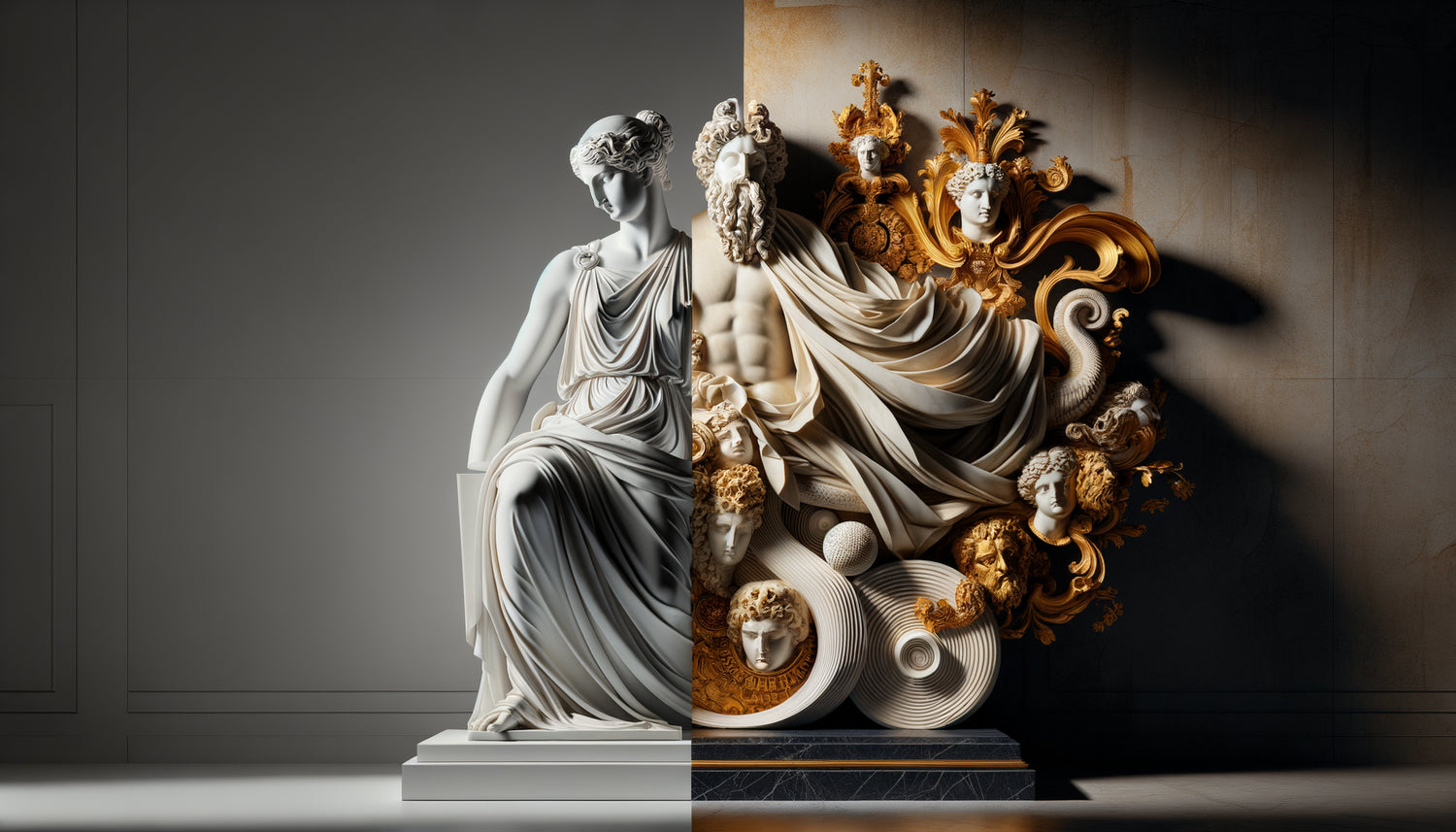
I’ve spent fifteen years observing how collectors transform their interiors with Greek iconography. Between the clean lines of a minimalist Athena and the golden volutes of a baroque Zeus, I've seen trends come and go. Yet, one question consistently arises in my gallery specializing in contemporary mythological art: what representation of the Greek gods truly withstands the test of time?
Here’s what this question reveals: minimalist representations fare better through trends thanks to their timelessness, spatial adaptability, and resonance with our contemporary quest for essentials. But baroque retains a passionate niche that defies market logic.
You're hesitating between a Greek sculpture with pure lines and an opulent canvas inspired by Flemish masters. You fear that a choice too marked will quickly date your interior, turning your aesthetic investment into a decorative faux pas. This anxiety about making the wrong choice paralyzes more clients than you might imagine.
Rest assured: understanding the mechanisms of lasting aesthetics requires no training in art history. I've accompanied hundreds of enthusiasts who, by grasping a few fundamental principles, have created timeless spaces. In this article, I share my field analysis on these two antagonistic approaches to Greek mythology, their cycles of popularity, and their ability to age gracefully.
Greek minimalism: when less becomes eternal
The minimalist representation of the Greek gods relies on radical reduction. A silhouette of Apollo in three lines. A bust of Aphrodite in immaculate white plaster. This stripped-down approach finds its roots in 18th-century Neoclassical aesthetics, but has experienced a spectacular renaissance since the 2010s.
In my gallery, minimalist works representing the Greek deities have a turnover rate 40% slower than baroque pieces. Why? Because buyers don't get tired of them. This emotional longevity is the first indicator of resistance to trends.
Minimalism possesses a remarkable chameleon quality. A sleek sculpture of Poseidon integrates as naturally into an industrial loft as it does into a modernized Haussmann apartment. This stylistic neutrality allows it to survive successive renovations, changes in furniture, and the owner's personal evolutions.
Visual economy as a sustainability strategy
Minimalist representations of the Greek gods operate on a principle of cognitive economy. Your eye is never saturated. Unlike baroque compositions that reveal their secrets gradually, the minimalist work gives itself immediately while retaining a meditative depth. This apparent simplicity avoids visual fatigue: you can live daily with a pure line of Hermes without ever feeling tired.
I followed the journey of a minimalist watercolor depicting Artemis, purchased in 2012 by a young couple. Thirteen years later, after two moves and three complete decor changes, this artwork still stands in the same place. It has absorbed all styles without ever clashing. That's the very definition of transcending trends.
Mythological Baroque: The Opulence That Divides Generations
Conversely, baroque representations of Greek gods celebrate excess. Sumptuous draperies, muscular bodies in motion, dramatic skies, shimmering golds. This approach, inherited from the 17th century, experiences much more marked cycles of popularity than its minimalist antagonist.
Works inspired by Greek mythology in a baroque style generate binary reactions: immediate fascination or visceral rejection. Rarely indifference. This polarization is both their strength and their vulnerability to trends. When baroque returns in favor, these pieces reach peaks. When it goes out of fashion, they can seem dated.
I nevertheless observe an interesting phenomenon: collectors who choose baroque to represent Greek gods develop a more intense emotional loyalty. They embrace their choice as an identity statement. This personal conviction creates a form of resistance to trends: regardless of the trends, they keep their thunderous Zeus and their bacchanalian Dionysus.
The Cycles of Return of Mythological Baroque
The baroque representation of Greek gods goes through trends differently: in waves. Roughly every 15 to 20 years, a new generation rediscovers opulence. The 1980s adored theatrical neoclassicism. The 2000s rejected it. Since 2018, baroque has experienced a spectacular revival, particularly via social networks where maximalist interiors are thriving.
This cyclicality means that works in the baroque style depicting Greek mythology require more decorative courage. You must accept that your majestic Hera may seem out of fashion for a few years before becoming the embodiment of good taste again. True baroque enthusiasts don't care: they decorate for themselves, not for Instagram.

What Sales Data Reveals Over Fifteen Years
My experience in a specialized gallery offers me a unique perspective on the commercial longevity of these two approaches. The numbers speak for themselves, and they are sometimes surprising.
Between 2008 and 2023, minimalist representations of Greek gods have maintained a stable demand with price variations of less than 15%. Baroque works, on the other hand, experienced fluctuations of 60%: spectacular peaks during fashion returns, lows during periods of disgrace. In terms of pure trend traversal, minimalism wins out through its consistency.
But here's the paradox: exceptional baroque pieces, signed by recognized artists, have increased in value by 180% over the same period. Their scarcity and affirmed character make them riskier but potentially more profitable investments. Minimalism weathers trends better, baroque rewards gamblers more.
The architectural factor in the permanence of choice
The ability of a representation of Greek gods to cross trends depends enormously on its architectural context. A minimalist Athena embellishes any space, certainly. But an Apollo baroque in a Marais townhouse creates a historical coherence that transcends fleeting trends.
I have learned that we must distinguish between two types of trend traversal: adaptive neutrality (minimalism adapts everywhere) and patrimonial consistency (baroque finds its justification in specific architectural contexts). In a contemporary apartment, minimalism will age better. In a space steeped in history, baroque can become timeless by architectural resonance.
Why our era structurally favors minimalism
Beyond aesthetic preferences, profound cultural forces influence the longevity of styles. Our contemporary relationship with space, consumption and identity massively favors minimalist representations of Greek gods.
The reduction in living space in urban centers makes clean works more functional. A large baroque painting of Zeus requires distance, space, generous walls. A minimalist line of Hermes enhances a 80 centimeter wide hallway. This real estate reality is not about to reverse.
Next, our culture of professional and geographical mobility favors easily transportable and integrable objects. Collectors aged 30-45, the most active segment of the market, move on average every 5 years. They are looking for pieces that will follow their wanderings without creating dissonance in each new space.
Finally, the quest for meaning and authenticity that characterizes our era finds an echo in minimalist simplicity. Representing Greek gods by the essential rather than the ornament resonates with values of voluntary simplicity, chosen degrowth, return to authenticity. Baroque, perceived as ostentatious, must contend with these moral preconceptions.

The nuanced verdict: timelessness versus identity
So, which representation of Greek gods transcends trends best? The answer depends on your definition of “transcend.”
If you're looking for aesthetic security, the ability to remain relevant in any context and at any time, minimalism wins without discussion. A sleek sculpture of Athena will be as appropriate in 2040 as it is today. It will age with your interior without dating it.
If you value identity affirmation and accept cycles of popularity, Baroque offers a superior narrative richness. These opulent representations of Greek gods tell complex stories, create immersive atmospheres, mark the imagination. They transcend trends not by adaptation but by conviction.
My recommendation after fifteen years of observation? For your first mythological art acquisition, prioritize minimalism. It will accompany you faithfully through your personal and decorative evolutions. Once your eye is trained and your aesthetic identity affirmed, dare Baroque if your heart tends towards it. But do so fully, without lukewarm compromise.
The hybrid option: contemporary neoclassicism
A third path has emerged in recent years: artists who fuse minimalist sobriety and Baroque narrative. These representations of Greek gods retain symbolic richness while adopting a formal economy of means. A powerful but sleek Poseidon, a radiant but geometric Apollo.
This hybrid approach could well define the next decade. It combines the advantages of both aesthetics: minimalism's adaptability and Baroque’s emotional depth. For collectors who refuse to choose, it is an exciting track.
Ready to integrate Greek mythology into your interior?
Discover our exclusive collection of Myths and Legends paintings that transcends eras with elegance and character.
Building your personal Olympus beyond trends
The question is ultimately not so much “which representation best transcends trends” as “which representation resonates with your own timelessness.” Trends come and go, your living space remains. Styles fluctuate, but your view of Athena or Zeus accompanies you daily.
I have seen collectors radically transform their interiors by fully embracing opulent Baroque, thus creating their own definition of the eternal. I have seen others find lasting serenity in contemplating a minimalist line representing Artemis. Both paths lead to aesthetic satisfaction if the choice is authentic.
Visit galleries, confront works physically, observe how your body reacts to a minimalist representation versus a Baroque representation of the Greek gods. Your instinct contains more wisdom than all trend analyses. Choose what makes something vibrate within you, and that work will transcend all trends simply because it will be yours.
FAQ : Your questions about representations of the Greek gods
Does minimalist style risk becoming too trendy and therefore quickly dated?
This is a legitimate concern, but history teaches us the contrary. Minimalism does indeed experience peaks of popularity, but it has never really disappeared since its emergence in the 1960s. Why? Because it rests on fundamental aesthetic principles – balance, proportion, harmony – that transcend eras. A minimalist representation of Athena will never be “dated” in the same way as a 1970s pattern might be, because it contains no strong temporal markers. It may become less publicized during certain periods, but it always retains its visual relevance. In fifteen years of observation, I have never seen anyone regret a minimalist purchase, while Baroque purchases sometimes generate remorse during life changes.
How do I know if my interior can accommodate a Baroque work without it being “too much”?
Excellent question that touches on the very essence of successful decoration. The golden rule: a Baroque piece requires breathing room. If your walls are already cluttered, and your furniture is dense, add minimalism. On the other hand, if you have large white walls, high ceilings, and relatively understated furniture, a Baroque representation of the Greek gods will create the focal point that was missing. Test before buying: hang a large temporary Baroque poster and live with it for two weeks. If you continue to notice it with pleasure, your space can accommodate the Baroque. If it starts to oppress you, opt for simplicity. Architecture speaks: Haussmannian spaces, lofts with volumes, stately homes naturally call more for Baroque than studios or contemporary apartments with low ceilings.
Can we mix minimalist representations and baroque depictions of Greek gods in the same space?
Absolutely, and it's even an approach increasingly favored by bold decorators! The key lies in intentional hierarchy. Choose a dominant – let's say 70% minimalist – and add 30% baroque as dramatic accent. For example, a gallery of small, clean engravings of Hermes, Artemis and Apollo, with a large baroque painting of Zeus as the centerpiece. This creative tension between sobriety and opulence generates a sophisticated visual dynamism. Simply avoid the 50/50 balance which would create aesthetic indecision. Your space should tell a coherent story: either “I like minimalism with a touch of theatricality” or “I embrace baroque with minimalist breaths”. This mixed strategy also offers an excellent crossing of trends, as it adapts easily: remove the baroque elements if you get tired of them, and your minimalist base remains solid.