The first time I contemplated a depiction of Quetzalcoatl in a colonial villa in Mexico City, I understood that this feathered serpent deity did more than simply adorn a wall. It commanded the entire space. Fifteen years spent traversing Mesoamerican archaeological sites and advising collectors taught me a fundamental truth: integrating a Quetzalcoatl wall art into a pre-Columbian art collection requires far more than simple decorative hanging.
Here's what this integration brings: a narrative coherence that unifies your collection, a spiritual focal point that dialogues with your other pre-Columbian pieces, and a symbolic depth that transforms your space into a true cultural sanctuary.
Many collectors accumulate pre-Columbian art pieces without creating a genuine visual conversation between them. An Aztec mask here, a Mayan ceramic there, but no common thread. The result? A juxtaposition rather than a harmonious collection. Others fear that a contemporary Quetzalcoatl wall art might compromise the authenticity of their ancient artifacts.
Rest assured: pre-Columbian art has always been a living tradition, reinventing itself through the centuries. A Quetzalcoatl wall art well chosen does not betray this tradition – it perpetuates it. I will show you how to create this perfect synergy between millennial tradition and contemporary expression, so that your collection finally tells the powerful story it deserves.
The feathered serpent as a spiritual cornerstone
In any pre-Columbian art collection worth its name, Quetzalcoatl occupies a central place. This deity embodied the fundamental duality of Mesoamerican civilizations: the earthly and the celestial, matter and spirit, the crawling serpent and the soaring bird. Integrating a Quetzalcoatl wall art is like installing the philosophical heart of your collection.
I have observed that a Quetzalcoatl artwork works beautifully as a transition piece between different cultural areas. You own Mayan ceramics and Aztec sculptures? The feathered serpent, venerated under different names throughout Mesoamerica (Kukulkan among the Mayans, Quetzalcoatl among the Aztecs), naturally creates this thematic bridge.
Prioritize an imposing format for your Quetzalcoatl wall art – minimum 80x120 cm. This scale respects the grandeur of the deity and allows it to visually structure the entire collection. The most powerful representations capture the undulating movement of the serpent, with iridescent quetzal feathers that evoke ancient codices.
Chromatic dialogues with your ancient artifacts
The palette of your Quetzalcoatl artwork determines all the visual harmony of your pre-Columbian art collection. Mesoamerican civilizations favored specific symbolic colors: sacred turquoise, cinnabar red, obsidian black, solar yellow and jade green.
When advising collectors on how to incorporate a Quetzalcoatl wall art piece, I first analyze the dominant tones of their existing pieces. A collection rich in Teotihuacan ceramics with earthy oranges will call for a Quetzalcoatl artwork with deep greens to create a vibrant contrast. Conversely, if you own turquoise masks or jade ornaments, look for a Quetzalcoatl artwork that picks up these nuances to create a soothing chromatic continuity.
Gold and metallic pigments deserve special attention. The Aztecs associated gold with the divine, with the blood of the sun. A Quetzalcoatl wall art piece with golden accents beautifully dialogues with reproductions of pre-Columbian jewelry or bronze pieces. But be careful not to overload: two or three touches of gold are enough to create this precious echo without falling into excess.
Geometric patterns as a common language
Pre-Columbian art speaks the language of sacred geometries. Your Quetzalcoatl artwork must take up these visual codes: Mesoamerican Greek key designs, cosmic spirals, interlocking lozenges. These motifs instantly create a resonance with your other pieces, whether they are Andean textiles, painted ceramics or bas-reliefs.

Orchestrating the space: placement and staging
The positioning of your Quetzalcoatl wall art piece in your pre-Columbian art collection obeys almost architectural rules. In Mesoamerican temples, representations of the divine always occupied significant cardinal positions - a wisdom that we can transpose into our contemporary interiors.
I have developed what I call the inner temple method for incorporating a Quetzalcoatl artwork: identify the wall that catches the eye as you enter the room. This is your main axis, your east if you will. It's where your Quetzalcoatl wall art piece should reign, like the rising sun.
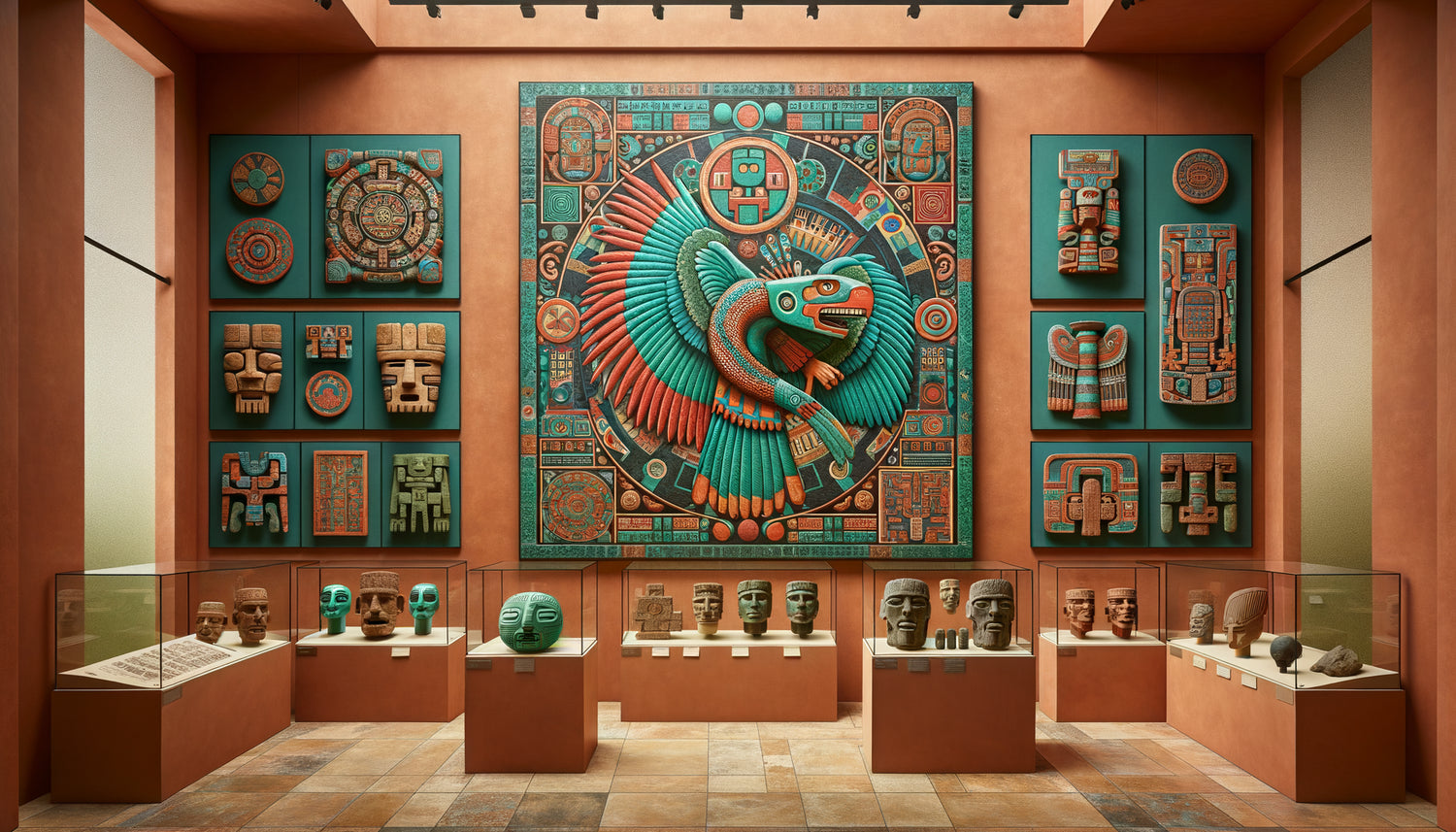
Around this centerpiece, organize your artifacts in concentric circles of decreasing importance. On the same wall, at mid-height, arrange your most valuable pieces: ceremonial masks, reproductions of codices, votive sculptures. On the side walls, integrate ceramics, textiles and Pre-Columbian everyday objects. This spatial hierarchy reproduces the organization of Mesoamerican sacred spaces.
The hanging height deserves particular consideration. Unlike Western conventions that place works at eye level, representations of Quetzalcoatl are best slightly elevated – 20 to 30 centimeters above the standard line of sight. This subtle elevation subconsciously reinforces the divine dimension and naturally draws the gaze upwards, creating an upward dynamic.
When millennial tradition meets contemporary creation
A question invariably arises: can we mix ancient artifacts (or their reproductions) and Quetzalcoatl wall art contemporains without creating a temporal dissonance? My answer is categorical: not only is it possible, it is desirable.
Pre-Columbian art has never been frozen in the past. Each Mesoamerican civilization reinterpreted inherited myths and iconography. The Aztecs redrew Mayan glyphs, the Toltecs transformed the symbols of Teotihuacan. Integrating a contemporary Quetzalcoatl wall mural perpetuates this living tradition of reinterpretation.
Look for artists who master traditional iconographic codes while infusing them with a personal vision. A successful Quetzalcoatl artwork should be immediately identifiable – the feathers, the serpent, the divine attributes – while offering a renewed reading. Some artists integrate textures that evoke the murals of Bonampak, others play with geometric abstraction inspired by pyramids.
In my own collection, I placed a Quetzalcoatl wall mural with clean and contemporary lines just above a reproduction of a Mayan stela. The temporal contrast, far from creating a break, generates a fascinating conversation: the same myth, separated by centuries, unified by a common belief in the power of the feathered serpent.
Materials as temporal bridges
To strengthen the cohesion between ancient and modern, prioritize Quetzalcoatl artworks on supports that evoke ancestral techniques: textured canvas reminiscent ofamate (Pre-Columbian bark paper), wood printing like ancient sculptures, or even integration of natural pigments similar to those used in codices.

Sacred lighting: revealing the power of the feathered serpent
A poorly lit Quetzalcoatl wall art loses 70% of its impact in a pre-Columbian art collection. I've seen magnificent pieces ruined by generic lighting that neither respected solar symbolism nor chromatic subtleties.
Mesoamericans designed their temples so that natural light would illuminate divine representations at specific times in the calendar. We can transpose this approach with strategic lighting. For your Quetzalcoatl painting, install two light sources: a directional lighting that creates dramatic shadows reinforcing the relief of feathers and scales, and a warm ambient light (2700-3000K) that warms the tones and creates this sacred atmosphere.
Avoid cold white LEDs which crush nuances and give a cold museum look. Your pre-Columbian art collection should breathe the warmth of solar civilizations. I often use dimmers to adjust the light intensity according to the time of day: more intense in the late afternoon to capture that golden light that used to bathe the pyramids at sunset.
If your Quetzalcoatl wall painting features metallic or iridescent elements evoking quetzal feathers, install a track-mounted spotlight. You can then adjust the angle to make the reflections dance and create this impression of vital movement that characterized the animated representations of the feathered serpent in rituals.
Creating a narrative: from cosmic chaos to civilized order
A pre-Columbian art collection truly becomes powerful when it tells a story. Integrating a Quetzalcoatl wall painting offers you the opportunity to structure your collection around the Mesoamerican founding myth: Quetzalcoatl as civilizer, who brought corn, the calendar, writing and the arts.
Organize your space into visual chapters. Your Quetzalcoatl painting opens the narrative, establishing divine presence. Around it, arrange your pieces according to a narrative logic: on one side, objects related to agriculture and fertility (grain ceramics, corn sculptures) evoking the gifts of the feathered serpent. On the other, elements related to knowledge and astronomy (reproductions of codices, sculpted calendars) celebrating Quetzalcoatl as inventor of knowledge.
This narrative staging transforms your wall into a true three-dimensional codex. Visitors no longer see an accumulation of objects but read a coherent story that begins with your Quetzalcoatl wall art and unfolds in space. I applied this method for a collector who owned about thirty pieces without any apparent connection: by reorganizing the whole around a central Quetzalcoatl artwork, we created five thematic areas that naturally dialogue.
Bring your pre-Columbian art collection to life
Discover our exclusive collection of Myths and Legends artworks that will transform your space into a cultural sanctuary where past and present dialogue.
The fatal mistakes that break harmony
After fifteen years of observing pre-Columbian art collections, I have identified the recurring errors that sabotage the integration of a Quetzalcoatl wall art. The first, and most devastating: choosing a representation that mixes cultural registers. A Quetzalcoatl with Egyptian, Greek or Asian elements may seem original, but it creates confusion that weakens your entire collection. Pre-Columbian art has enough iconographic richness to stand on its own.
Second trap: symbolic overload. Some Quetzalcoatl artworks accumulate all possible attributes – feathers, serpent, shells, stars, glyphs, calendar – in a stifling composition. Paradoxically, this abundance dilutes the message. The most beautiful pre-Columbian representations work by suggestion and refinement. Favor a Quetzalcoatl wall art that focuses on two or three powerful iconic elements rather than a visual encyclopedia.
Third mistake: neglecting the relative scale between your pieces. I have seen collectors install a monumental Quetzalcoatl artwork surrounded by tiny figurines. The imbalance is brutal. Apply the rule of thirds: your Quetzalcoatl wall art should occupy about one third of the total wall surface dedicated to your collection, the rest being divided between medium-sized pieces (another third) and small objects (last third).
Finally, the most subtle but perhaps most damaging mistake: ignoring Mesoamerican sacred geometry in your layout. Pre-Columbian civilizations organized space according to precise mathematical proportions. When you integrate a Quetzalcoatl artwork, measure distances and look for harmonious ratios – the golden number frequently appears in pre-Columbian architecture. Regular and proportioned spacing subconsciously creates a sense of cosmic order.
Beyond decoration: ritualize your space
A collection of pre-Columbian art with a Quetzalcoatl wall mural seamlessly integrated transcends simple decoration to become a space for contemplation, almost meditative. The Mesoamericans did not separate art from the sacred, aesthetics from spirituality. We can find this dimension in our contemporary interiors.
Create a ritual around your Quetzalcoatl painting. Not necessarily religious, but a moment of conscious attention. Some collectors light a candle at the foot of their painting every evening, others change the lighting according to the seasons to create different atmospheres. These simple gestures transform your pre-Columbian art collection into a living, breathing space that evolves.
I also encourage incorporating olfactory elements. Copal, this resin burned during Mesoamerican ceremonies, releases a balsamic fragrance that instantly activates the sensory dimension of your collection. Place a discreet incense burner near your Quetzalcoatl wall mural – the combination of image and smell creates a memorable immersive experience for your visitors.
Imagine yourself in a few weeks, contemplating your transformed collection. Your Quetzalcoatl wall mural no longer simply occupies space on your wall: it dialogues with each room, unifies the whole, tells a millennial story that still resonates today. Your guests will no longer see an accumulation of exotic objects, but a coherent cultural sanctuary, vibrant, which honors the sophistication of pre-Columbian civilizations.
Start by analyzing your current collection. What are your masterpieces? Which civilizations dominate? Then look for a Quetzalcoatl painting that meets these chromatic and thematic specifics. Install it according to the principles of height and positioning that we have explored. Adjust the lighting. Then, gradually, reorganize your other pieces in a harmonious conversation with the feathered serpent.
Pre-Columbian art still speaks to us across the centuries, about this quest for balance between earth and sky, matter and spirit. Integrating a Quetzalcoatl wall mural into your collection is becoming the contemporary guardian of this ancestral wisdom, and transforming your interior into a bridge between two worlds.
Frequently Asked Questions
Won't a modern Quetzalcoatl painting spoil the authenticity of my pre-Columbian art collection?
This is a legitimate concern, but rest assured: the Meso-American civilizations themselves were constantly reinterpreting their myths and iconography. A contemporary Quetzalcoatl wall art does not betray this tradition, it perpetuates it. The key is to choose a work that respects the fundamental iconographic codes – the serpent, the quetzal feathers, the divine attributes – while offering a personal vision. This coexistence between ancient and modern even creates an additional narrative richness: it shows that Quetzalcoatl, like all great mythological figures, transcends eras and continues to inspire. Simply check that the artist masters the pre-Columbian cultural references rather than creating a haphazard fusion with other traditions.
What size of Quetzalcoatl painting is suitable for a small collection of ten to fifteen pieces?
For a collection of this scale, aim for a Quetzalcoatl wall art between 60x80 cm and 80x120 cm. It's imposing enough to visually structure your ensemble without overwhelming your other pieces. Apply my rule of thirds: measure the total surface area you dedicate to your pre-Columbian art collection, and your Quetzalcoatl painting should represent about one third of that surface. For example, if your wall is 3 meters wide and you use 2 meters for your collection, your painting can occupy approximately 60-70 cm of that width. This proportion creates a clear focal point without creating imbalance. Remember that a vertical (portrait) format is better suited to evoke the celestial ascent of the feathered serpent, while a horizontal (landscape) format works beautifully to represent the undulating movement.
Can I mix different pre-Columbian cultures around my Quetzalcoatl painting?
Absolutely, and it is even desirable! Quetzalcoatl (or its equivalents like Kukulkan among the Mayans) was venerated throughout Meso-America, making it the perfect link between different cultural areas. Your Quetzalcoatl wall art can harmoniously unite Mayan ceramics, Aztec sculptures, Zapotec textiles and Toltec pieces. The feathered serpent acts as a mythological thread that transcends specific cultural boundaries. Conversely, I do not recommend mixing Meso-American art (Mexico, Guatemala, Honduras) with Andean art (Peru, Bolivia), as these two civilizational areas functioned according to very different cosmologies. Focus on Meso-America, and your Quetzalcoatl painting will naturally create this cohesion between your various pre-Columbian pieces.