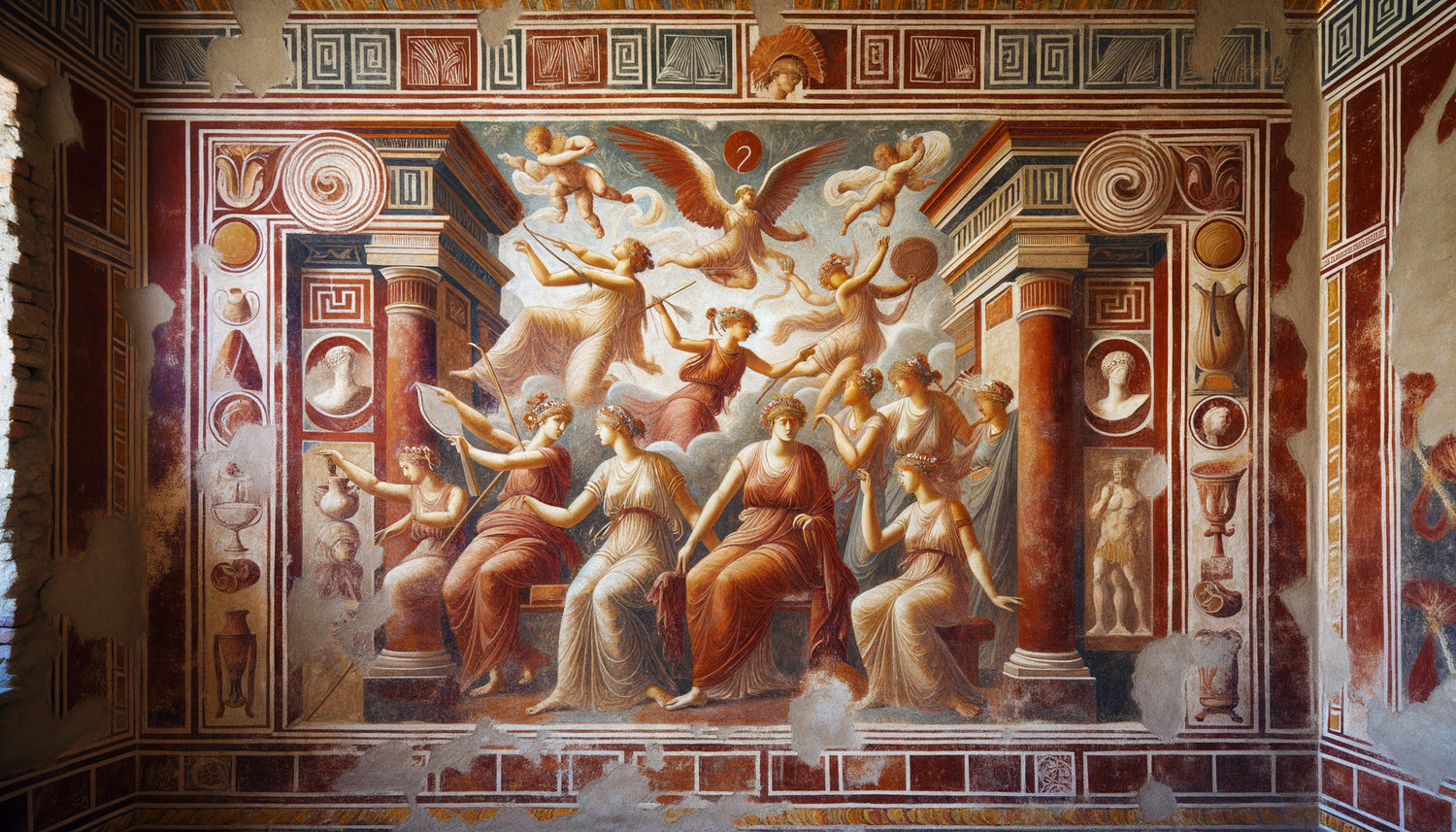
When I first laid eyes on the frescoes of Villa dei Misteri in Pompeii, I felt this strange sensation that the characters painted on these walls were telling me something that no one had really understood for two thousand years. These faces, these ritual gestures, these mythological scenes of disturbing intensity... They carry within them fragments of beliefs that even the greatest classical texts have never mentioned.
Here is what the frescoes of Pompeii reveal to us: unpublished variants of myths we thought we knew, secret domestic cults that escaped official writings, and an intimate vision of Roman spirituality that texts could not capture.
We all know the great Roman myths through Ovid, Virgil or Livy. But these texts represent the official version, that of the literate elites. What stories were told in the intimacy of Pompeian homes? What tales did the artisan-painters whisper who decorated these walls with fascinating creative freedom? The frescoes of Pompeii offer direct access to this living, popular, sometimes heretical mythology.
I will take you on this fascinating journey between archaeology and imagination, where pigments reveal what parchments have silenced.
When walls speak better than manuscripts
Ancient texts have come down to us through successive copies, filtered by centuries of monastic transcription. The frescoes of Pompeii, on the other hand, are raw testimonies, frozen in 79 AD by the ashes of Vesuvius. This immediacy confers an extraordinary authenticity upon them.
In the House of the Tragic Poet, a fresco depicts the sacrifice of Iphigenia with details that do not correspond to any known version of the myth. The posture of the characters, the expression of Agamemnon, the presence of unidentified secondary figures... Everything suggests the existence of a local variant, perhaps Campanian, of this legend.
Even more disturbing: some frescoes in Pompeii show hybrid mythological scenes, mixing different narratives. In the Villa de San Marco, a composition combines elements of the myth of Europe with attributes related to the cult of Dionysos. These syncretisms reveal how ordinary Romans appropriated myths, reinventing them according to their personal spiritual needs.
The Dionysian mysteries: a lost initiation
The famous Villa dei Misteri undoubtedly houses the most enigmatic frescoes in Pompeii. Over 17 meters long, 29 life-size characters recreate what appears to be an initiation ceremony into the Dionysian mysteries. But what kind of ceremony?
No ancient text precisely describes these secret rites. Classical authors mention their existence, but the initiatory secrecy forbade any written revelation. The frescoes of Pompeii then become our only window onto these mysterious practices.
We see a young woman terrified, a winged demon wielding a whip, a bacchante dancing in ecstasy, a matron overseeing the ritual. These images suggest a female initiation journey around sexuality, symbolic death and spiritual rebirth. A lived myth, performed, much more than a simple narrative.
Specialists are still debating: is it a real initiation, a symbolic representation, or a myth entirely invented by the villa's owner? This very uncertainty proves how the frescoes of Pompeii preserve mysteries that two millennia have not elucidated.

Familiar gods with an unexpected face
The frescoes of Pompeii also show us Roman gods under features that literature never evokes. In several homes, Venus appears not as the goddess of ethereal love, but as a local protective deity, sometimes armed, sometimes associated with specific marine symbols in the Bay of Naples.
This Venus Pompeiana clearly possessed cult attributes specific to the city, local origin myths that great Roman poets never deemed it useful to record. The frescoes thus become the visual archives of erased regional beliefs.
In the House of the Vettii, a fresco depicts Priapus in a posture and context that does not correspond to any literary description. The god of fertility appears surrounded by symbols suggesting a foundation myth, perhaps linked to the commercial prosperity of this wealthy merchant family.
Mythological eroticism without censorship
Ancient texts, even the most daring, underwent a form of literary self-censorship. The frescoes of Pompeii, decorated for private spaces, free themselves from these conventions. They reveal a carnal dimension of Roman myths rarely expressed in writing.
Erotic scenes involving deities or mythological heroes abound. Leda and the swan, Mars and Venus, Pan and the nymphs... These explicit representations suggest that Roman myths also served to legitimize, sacralize, or simply evoke sexuality in domestic intimacy.
Some frescoes go even further by showing erotic variations of known myths, with combinations of characters or situations that do not appear anywhere in literature. These creative freedoms testify to a living mythology, constantly reinterpreted according to the desires and fantasies of the commissioners.

Secret domestic cults
Beyond the great public myths, the frescoes of Pompeii reveal the existence of extremely personalized domestic religious practices. Each house possessed its lararium, but the accompanying frescoes often mixed major gods and minor deities according to unique associations.
In some homes, we find frescoes depicting Egyptian deities (Isis, Anubis) integrated into Roman mythological scenes. These religious syncretisms, these personal mythological inventions, remained invisible in the official texts that described a codified state religion.
The frescoes of Pompeii show us instead a pieced-together spirituality, where everyone composed their own protective pantheon, invented their own sacred narratives, adapted Roman myths to their intimate needs. This intimate dimension of ancient religiosity would have been totally lost without these pictorial testimonies.
Unknown heroes in forgotten adventures
Some frescoes from Pompeii depict complete narrative scenes for which we find no trace in the preserved literature. Heroes with names erased by time, adventures whose memory has been lost with the destruction of ancient libraries.
In the House of Meleager, a sequence of frescoes tells a complex mythological story involving a male character, a female deity and a fantastic creature. Specialists struggle to identify the myth represented. Is it a local variant of a known myth? A now lost narrative? A pure invention of the painter?
This uncertainty reveals the extent of our ignorance. How many Roman myths have disappeared with texts not recopied, oral traditions extinguished? The frescoes of Pompeii may be the last traces of stories told for centuries before sinking into oblivion.
Let ancient myths enchant your daily life
Discover our exclusive collection of Myths and Legends paintings that capture the timeless power of ancient tales to transform your interior into a sanctuary of inspiration.
What frescoes teach us about ourselves
Beyond pure archaeology, the frescoes of Pompeii teach us something fundamental about the nature of myths. They prove that mythological narratives were never fixed, that they lived, mutated, adapted to the needs of each community, each family, each individual.
The Roman myths we know from texts are only one version among others, the one that the literate elite deemed worthy of being recorded. The frescoes of Pompeii reveal the underground life of these narratives, their popular, intimate, sometimes subversive dimension.
When contemplating these painted walls dating back two thousand years, we realize that we are doing exactly the same thing today: constantly reinventing the stories that give meaning to our existence. Contemporary superheroes, fanfictions, cinematic reinterpretations of ancient myths... We are direct heirs to these Pompeian artisans who dared to rewrite the gods.
Imagine your living room transformed by a work that carries within it this millennial narrative power. Imagine those conversations that would be sparked by a mythological representation in your living space, that tangible link with those Pompeians who decorated their walls with the same divine dreams. The myths did not die under the ashes of Vesuvius. They are simply waiting for us to bring them back to life, one wall at a time, one story at a time.
Start by choosing the myth that resonates within you. The one that speaks to your personal journey, your aspirations, your intimate questions. That's exactly what Pompeians did, and that’s why their frescoes continue to fascinate us.
Frequently Asked Questions
Why are the frescoes of Pompeii better preserved than other ancient sources?
The eruption of Vesuvius in 79 AD buried Pompeii under several meters of ash and pumice in a few hours. This cover created an airtight environment that protected the frescoes from humidity, oxidation, and human destruction for nearly 1700 years. Unlike texts which had to be copied (with risks of errors or censorship), or paintings exposed to the elements, the frescoes of Pompeii remained in exceptional condition. They offer us a genuine snapshot of Roman art and culture from the 1st century AD, without the filters of time. It's as if someone had pressed pause in the middle of daily Roman life.
How do we know that some myths represented in Pompeii do not exist in the texts?
Researchers systematically compare the scenes depicted in Pompeii's frescoes with the entire corpus of ancient literature that has been preserved: works by Ovid, Virgil, Homer, Greek tragedies, historical writings, etc. When a fresco shows a mythological scene with narrative details, characters or combinations that do not appear in any known text, several hypotheses emerge: either the myth existed in lost texts (it is estimated that 90% of ancient literature has disappeared), or it is about local oral variants never recorded in writing, or artists took creative liberties. In all cases, these frescoes preserve mythological versions that would have been completely lost without the eruption.
Can we integrate the aesthetics of Pompeii's frescoes into contemporary decoration?
Absolutely, and it is even a strong trend in current high-end decoration! The aesthetics of Pompeii's frescoes combine timelessness and elegance that harmonizes remarkably with modern interiors. Their characteristic colors (Pompeian red, ocher, Egyptian blue, deep black) create a rich but sophisticated palette. You can integrate this aesthetic in touches: a painting representing a mythological scene in a clean living room, a triptych in a dining room, or even a large format in a bedroom to create an atmosphere of personal sanctuary. The contrast between contemporary furniture and ancient iconography produces a striking effect that evokes both cultural refinement and a connection with human history. This is exactly what decoration enthusiasts are looking for who want to go beyond ephemeral trends.