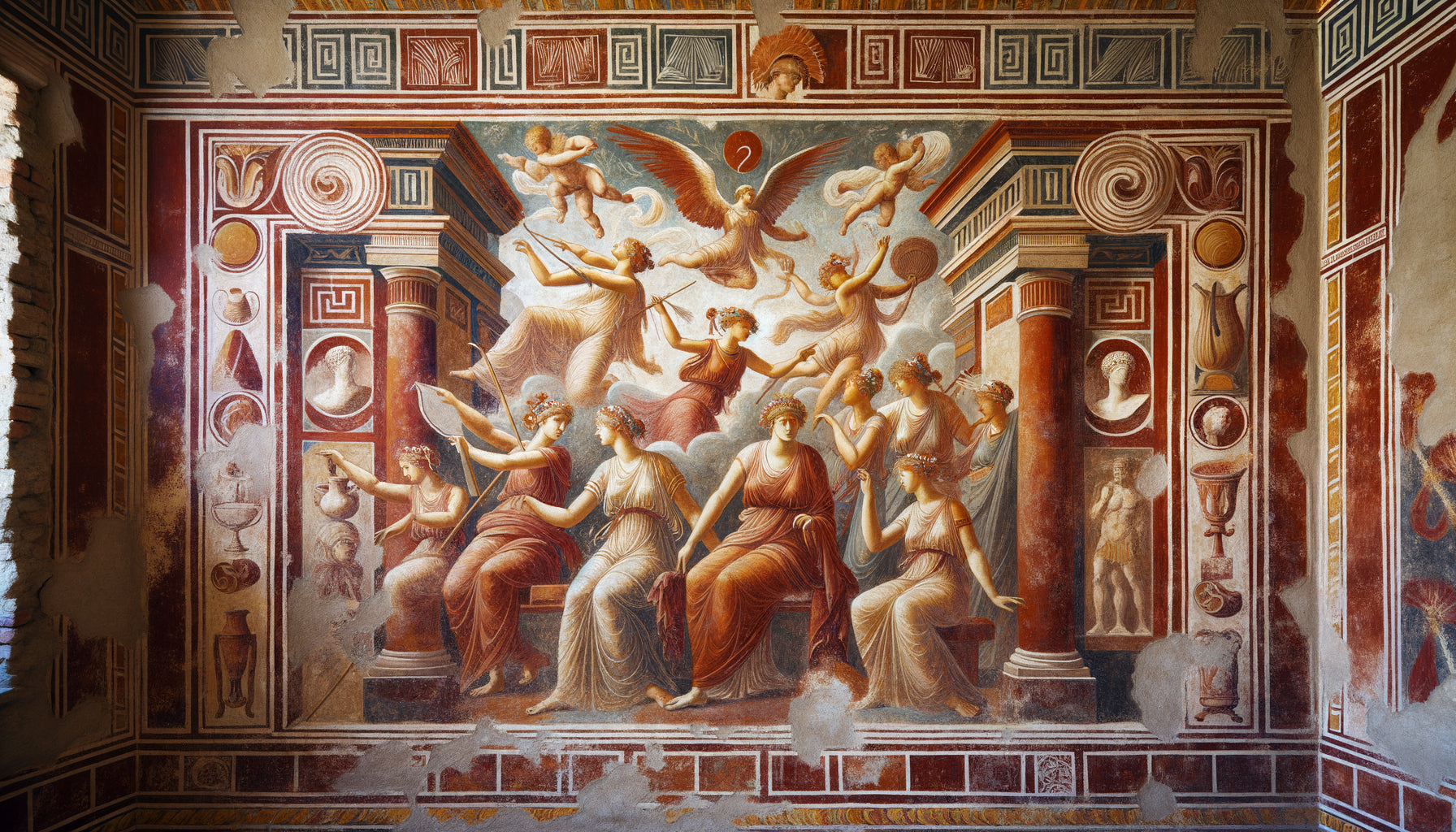
Imagine entering a Florentine gallery from the 16th century. On the walls, monumental frescoes tell of Venus’s loves, Jupiter’s rages, and Mercury’s adventures. But how would you know who was who? Renaissance artists developed a true codified visual language to make each Olympian god instantly recognizable. In your contemporary interiors, these iconographic codes transform a simple reproduction into a sophisticated cultural conversation.
Here's what this identification system brings: an immediate understanding of mythological scenes, the ability to decode the hidden messages in artworks, and the art of choosing pieces that tell your story.
Faced with a mythological painting, you might feel lost. These divine characters all look alike with their idealized bodies and elegant draperies. It’s impossible to distinguish Mars from Neptune without a tour guide at hand. This confusion deprives you of the narrative richness of these exceptional works.
Rest assured: Renaissance painters thought of everything. They created a system of visual attributes – objects, animals, colors – that function as divine signatures. Once these codes are mastered, you will read mythological paintings like open books.
I’m going to reveal the secrets of this visual grammar that will transform your gaze on art and your way of decorating your spaces.
Divine attributes: visual signatures of the Olympians
Renaissance painters relied on a fundamental principle: each god possesses iconic objects that define him. These attributes function as divine fashion accessories, immediately identifiable.
Jupiter, king of the gods, systematically brandishes his thunderbolt – this bundle of luminous rays that symbolizes his supreme power. At his feet, the majestic eagle completes his identity. Botticelli, Titian, Veronese: all respect this code without exception. Neptune holds his characteristic trident, often accompanied by seahorses or dolphins emerging from the waves. Mars, god of war, systematically wears his glittering armor and a plumed helmet, sometimes with a shield adorned.
Mercury is recognized by his caduceus – this staff entwined with two serpents – and above all by his winged sandals which signal his function as celestial messenger. Apollo sports his golden lyre and a laurel wreath, symbol of poetry and prophecy. Vulcan, the divine blacksmith, always appears near his anvil and hammer, often in a glowing forge.
These attributes are never arbitrary. They tell the cosmic functions of each divinity and allow viewers of the time – as well as you today – to instantly identify the character represented.
Venus, Diana and Minerva: the feminine code of Olympus
The goddesses possessed their own identification system, just as sophisticated. Venus, goddess of love, appears accompanied by Cupid and doves. Botticelli depicts her birth from a scallop shell in his iconic masterpiece. Her most constant attribute? Idealized nudity and a radiant sensuality that immediately distinguishes her from other female figures.
Diana, lunar huntress, carries her bow and quiver, wearing a short tunic allowing for forest running. A crescent moon often adorns her hair, and hunting dogs accompany her. Unlike Venus, Diana embodies virgin chastity and the wild nature – her body is athletic, never languid.
Minerva is recognized by her war helmet and her shield adorned with Medusa's head. The owl, symbol of wisdom, perches near her. Veronese often represents her in allegorical scenes, embodying strategic wisdom rather than the brute force of Mars.
Juno, Jupiter’s jealous wife, displays her royal diadem and the peacock with a hundred eyes, recalling the giant Argus she had charged with watching over a rival. Ceres wears a crown of wheat ears and holds a sickle, symbolizing her control over harvests and seasons.
The subtle distinction between divine beauties
How to visually differentiate Venus from Juno when both embody female beauty? Renaissance painters used postural and chromatic codes. Venus adopts a sensual pose, often in contrapposto, surrounded by roses and myrtles. Juno stands straight, majestic, in royal purple tones. Diana favors silvery hues reminiscent of the moon.

Colors speak: the chromatic palette of the Olympians
Beyond objects, Renaissance painters employed a symbolism of colors inherited from antiquity and enriched by medieval Christian tradition. Jupiter frequently appears in celestial blues and royal golds, colors of supreme authority. Mars consistently wears red – the color of blood, violence, and martial passion.
Venus bathes in soft roses and pearlescent carnations that evoke flesh and seduction. Diana dresses in pure whites and lunar silvers. Minerva favors olive greens – a direct reference to the olive tree she made spring forth during her competition with Neptune for the patronage of Athens.
Neptune emerges from deep blues and aquatic greens, while Vulcan works in the incandescent reds of his forge. Apollo literally radiates in golden yellows and solar oranges – he is after all the god of light.
These chromatic choices were not random. Titian, a Venetian master of color, orchestrated his mythological compositions like visual symphonies where each hue reinforced the divine identity of the character. In a contemporary room, a painting respecting these traditional color codes brings the same narrative coherence that Renaissance collectors appreciated.
When the gods meet : composing an overall scene
The true virtuosity of Renaissance painters was revealed in scenes of divine assembly – these Olympian banquets, these collective judgments where a dozen deities coexist on the same canvas. How to avoid visual confusion?
Raphael, in his Vatican frescoes, mastered the art of spatial hierarchy. Jupiter occupied the geometric center, the other gods arranging themselves according to their importance. Each retained its distinctive attributes, creating a network of symbols that the educated eye deciphered instantly.
Veronese excelled in these complex compositions, strategically placing attributes to guide the gaze. His Wedding Feast at Cana (although a biblical scene) uses the same principles of visual differentiation: each figure has clothing, gestural and chromatic details that distinguish it.
Painters also used codified gestures. Jupiter raises his arm in a gesture of command. Neptune makes water spring forth with a gesture of the trident. Mercury darts in a flying position. These dynamic postures, inherited from ancient statuary, functioned as gestural signatures immediately recognizable.
The role of animal companions
Each Olympian god possessed his totemic animal, a constant presence that doubled identification. Jupiter's eagle, Juno's peacock, Minerva's owl, Venus' doves, Neptune's horses, Diana's dogs: these creatures functioned as living coats of arms. In a dense composition, the eye first recognizes the animal, then identifies the associated deity.

The manuals of iconography: visual bibles of the Renaissance
Where did this remarkable standardization come from? Renaissance artists consulted iconography manuals that codified the appearance of the gods. The most famous, Iconologia by Cesare Ripa (1593), systematically listed attributes, colors and postures for each allegorical and mythological figure.
These treatises drew on ancient sources – Ovid, Virgil, Homer – but also on collections of statues rediscovered during archaeological excavations. The Laocoon, the Apollo Belvedere, the Venus de Medici: these sculptures became canonical models that painters studied and adapted.
Workshops also transmitted these codes through direct apprenticeship. A young painter would spend years copying the compositions of masters, naturally integrating this visual vocabulary. This education created a common language understood from Venice to Florence, from Rome to Fontainebleau.
For you, contemporary collector, this standardization represents an opportunity: even without in-depth artistic training, you can quickly decode mythological scenes by identifying these universal visual clues. A painting becomes readable, telling its story simply through its symbolic details.
Integrating this visual grammar into your decor
Why does this knowledge transform your decorative approach? Because it allows you to consciously choose the symbolic energies that you invite into your spaces. A painting of Minerva in an office evokes wisdom and strategy. A Venus in a bedroom celebrates love and beauty. A Mars in a sports space recalls martial discipline.
Contemporary creators who reinterpret these myths often respect these ancestral codes. Look for traditional attributes even in modern works: the trident identifies Neptune, whether the work is from the 16th or 21st century. This iconographic continuity creates a fascinating dialogue between eras.
Compose your walls like a Renaissance gallery. Combine complementary deities: Apollo and Diana (sun and moon), Mars and Venus (war and love), Jupiter and Juno (male and female power). These visual dialogues enrich the narrative of your interior.
Lighting plays a crucial role. Renaissance painters mastered chiaroscuro to highlight divine attributes. In your space, directional lighting on a mythological painting reveals symbolic details – the reflection on a helmet, the brilliance of a trident, the transparency of a drape.
Transform your walls into a personal Olympus
Discover our exclusive collection of Myths and Legends paintings that celebrate these timeless visual codes for a cultured and inspiring decor.
Your gaze transformed, your interior enriched
You now possess the keys to reading that Renaissance collectors passed down to their heirs. Each lightning bolt, each trident, each laurel wreath becomes a narrative clue that reveals divine identity and enriches your understanding.
This visual grammar transcends centuries without aging. It transforms your decorative choices into conscious cultural decisions. You no longer select a painting for its colors alone, but for the story it tells, the god it celebrates, the energy it radiates.
Start by observing mythological paintings with this new reading grid. Identify the attributes. Name the deities. Understand the scenes. Then consciously choose the myths that resonate with your personal story. Your interior then becomes a narrative gallery, a domestic Olympus where each work dialogues with your daily life.
FAQ : Decoding the Olympian gods in art
Did all Renaissance painters respect these identification codes?
The vast majority of artists scrupulously respected these iconographic conventions because they guaranteed immediate readability. Patrons – princes, cardinals, wealthy benefactors – required that mythological scenes be correctly identifiable. However, some painters innovated subtly, such as Michelangelo who gave his divine figures an unprecedented sculptural power while retaining the traditional attributes. Titian sometimes dared compositions more ambiguous, playing on eroticism rather than narrative clarity. But even these iconoclastic masters maintained essential markers – the lightning bolt for Jupiter, the trident for Neptune – because without them, the painting lost its narrative function. This standardization also facilitated the circulation of works and engravings throughout Europe: a German collector could identify the gods in a Venetian painting without further explanation.
How to recognize a god without visible attributes?
A rare but not impossible situation: sometimes the attribute is out of frame or the artist prefers an intimate scene. In this case, Renaissance painters used secondary clues: musculature (Mars is always athletic and warrior-like, Vulcan with a blacksmith's musculature), apparent age (Jupiter mature and bearded, Apollo young and beardless), the presence of other identifiable characters (if you see Cupid, Venus is never far), the narrative context (a forge signals Vulcan, a stormy sea evokes Neptune), and above all the dominant colors which function as chromatic signature. Complexions also differ: Diana often presents paler skin evoking the moon, Neptune bluish tones reminiscent of water. Finally, the traditional title of the work, passed down through art history, confirms identification when visual clues alone are not enough.
Do these codes still work in contemporary art?
Absolutely! Contemporary artists who revisit mythology almost always rely on these ancestral codes to ensure the recognition of deities. A modern creator representing Neptune will include the trident – perhaps stylized, conceptualized, but present. This iconographic continuity crosses centuries because it guarantees immediate communication with the viewer. Some artists deliberately play with these conventions, creating surprising hybridizations: a Venus in a business suit retaining her doves, a Mars in contemporary military uniform with his antique helmet. This tension between tradition and modernity enriches the reading of the work. For your decoration, this means that even current reinterpretations remain decodable thanks to your knowledge of Renaissance grammar. You can thus mix eras and styles while maintaining a mythological narrative coherence in your interior, creating fascinating temporal dialogues between a classic painting and a contemporary work representing the same deity.