


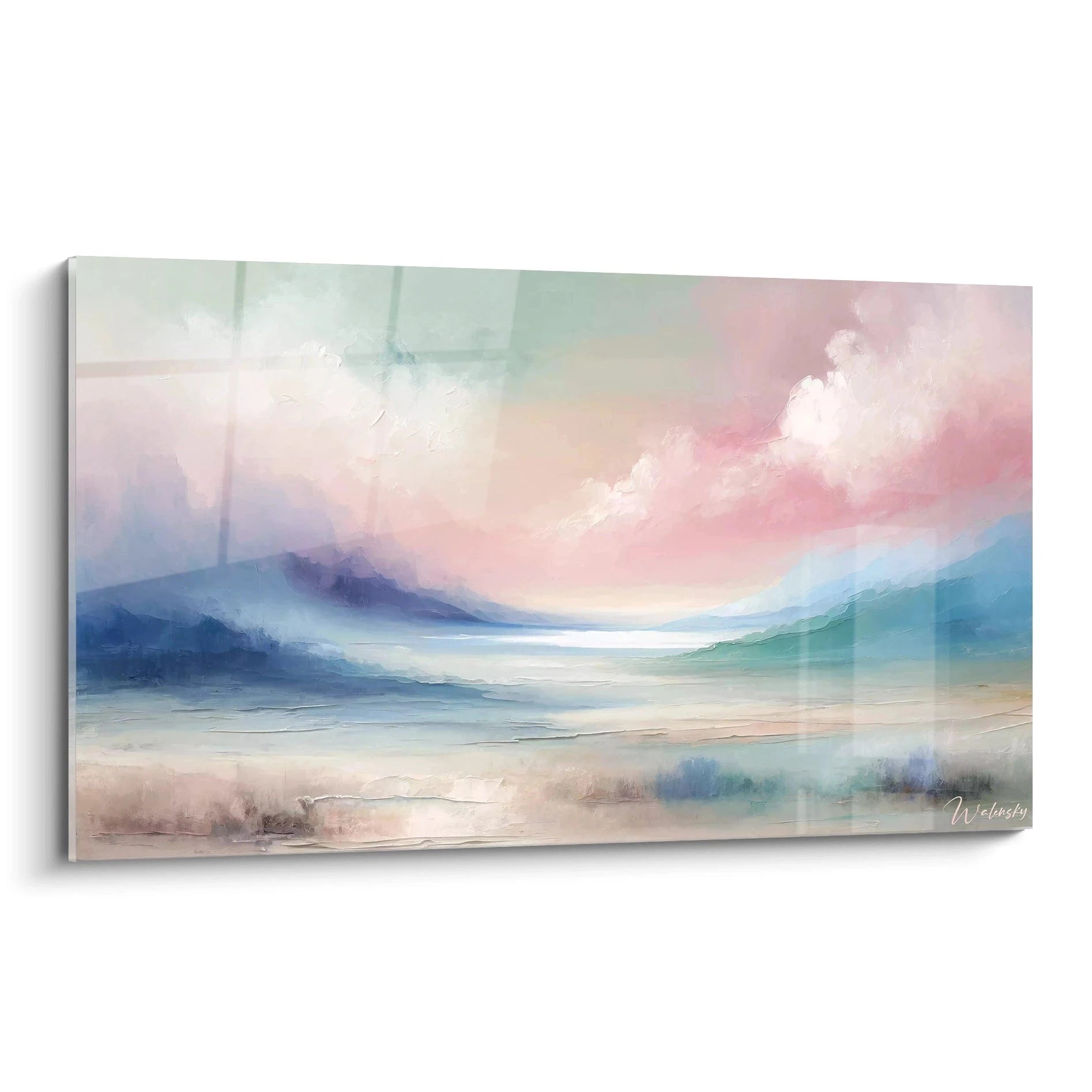

Choosing your frame to match the ambiance of the room
11 October 2025 · 17 min read · by Walensky
You've just acquired this magnificent modern artwork that moves you, but here's the thing: facing your wall, you hesitate for hours. Classic visible frame or modern invisible framing ? This question obsesses you and prevents you from fully enjoying your purchase.
You already imagine your guests' glances scrutinizing your choice. Will that gilded frame look too busy? Does that invisible frame risk looking cheap? Will the artwork be sufficiently protected? Each option seems to contain a trap.
You've probably already consulted dozens of decor sites, asked for advice from those around you, and compared prices. But opinions diverge, styles clash, and you're more lost than ever. It's impossible to make a serene decision.
Rest assured: this hesitation isn't a lack of taste on your part. It simply reveals that no one has yet explained to you the real criteria for choosing between a visible frame and an invisible frame depending on the desired effect.
By the end of this article, you will know exactly what type of frame will enhance your modern artwork, based on your interior, your personality, and the desired ambiance. Never again paralyzing hesitation!
Why this choice determines the entire ambiance of your room?
The framing of a modern artwork is like the framing of a photo: it completely orients the gaze and emotion. Choosing now avoids regretting it in 6 months when you realize that your living room lacks character or, conversely, that it is "too busy". Imagine the disappointment of having to change everything!
🎨 Collector's testimony: "I bought a magnificent abstract triptych. With classic gold frames, it looked like a hotel decoration. The day I opted for an invisible frame, the artwork literally came to life. It seemed to float on my white wall, creating that refined modernity I had been searching for for years."
Conversation with a decor expert
The frame doesn't decorate the artwork, it reveals its potential: Like lighting that transforms a rough diamond into a sparkling jewel, the right frame choice takes your interior from "pretty" to "extraordinary" in less than a week.

Our selection
Tableau Coups de Pinceau Noirs Tourbillonnants et Éclats Dorés sur Fond Blanc - Éclipse Dorée - Edition abstract
213,90€
Discover this paintingFinally understand why you hesitate so much
You surely recognize yourself in these situations: you change your mind every week between two options, you fear the judgment of others on your choice, or you keep postponing the hanging for fear of making a mistake.
This paralysis doesn't come from a lack of taste, but from a confusion between personal style and imposed trends. You have been conditioned to believe that there were absolute rules, when everything depends on the emotional effect sought.
It's like trying to choose between a sports car and an SUV without knowing if you're going to the city or the mountains. It's impossible to choose well without knowing the context!
First hidden cause: the confusion between "modern" and "minimalist"
Contrary to popular belief, modern art doesn't necessarily mean invisible framing. This confusion comes from decor magazines that always show the same aseptic interiors.
Imagine a chef who only serves white dishes on white plates: technically perfect, but where's the personality? Your interior deserves more character.
This belief deprives you of creative solutions and locks you into choices that don't reflect you. As a result: you end up with a "Instagram-friendly" but cold living room, where you don't feel at home.
🧪 2-minute express test: Look at your artwork while alternately hiding its edges with your hands, then framing them with your fingers. Observe how your perception changes instantly. This is proof that framing influences your emotion more than the artwork itself!
Second hidden cause: the fear of a "decorating blunder"
Many think that an exposed frame is "traditional" and that an invisible frame automatically makes it "trendy". In reality, it's the harmony with your space and your personality that creates elegance.
It's like wearing a bespoke suit versus a branded suit: it's not the price or the trend that matters, but the perfect fit to your morphology and your style.
This fear prevents you from combining bold but successful combinations, such as a clean modern frame that can enhance a contemporary artwork better than a standard invisible frame.
Third hidden cause: forgetting the emotional impact
No one has ever told you that the frame should first make you feel something. We focus on aesthetics, forgetting emotion, when it is what transforms a decoration into a personal universe.
You can easily check this: observe your reaction to the same artwork in different types of framing. Does your pulse quicken? Do you feel pride? Serenity? These signals never lie.
Ignoring this emotional dimension explains why some interiors, although technically successful, lack soul and tell no personal story.
🎪 3 signals that don't lie:
- You avoid looking at the artwork when passing by: The frame creates a visual dissonance that disrupts your subconscious well-being
- Your guests never positively comment: The whole lacks emotional impact, a sign of a bad frame choice
- You regularly consider moving the artwork: The problem is not the location but the mismatch between the frame and the desired atmosphere
The trigger element: the desired presence effect
The real criterion for choice is the intensity of presence you want to give to the artwork. Like a spotlight that can illuminate gently or create a dramatic focus, the frame modulates the impact force of your art. An invisible frame integrates the artwork into the space, while an exposed frame detaches it to highlight it.
The golden rule of modern framing : Choose based on the desired emotion, not on trends. Test your visceral feeling by visualizing each option in your space. Your first intuition is often the right one.
| ❌ Persistent misconception | ✅ Reality of professionals | 💡 Why this difference | 🎯 Benefit for you |
|---|---|---|---|
| Modern = necessarily frameless | Modern = harmony with the space and the artwork | Magazines show a single standardized aesthetic | Creative freedom and real personalization |
| Frames inevitably cost a lot | The impact depends on the choice, not the price | Confusion between luxury brand and visual effect | Controlled budget and professional result |
| A commitment for years to come | The framing can be easily changed | Lack of knowledge of modern modular solutions | Freedom to experiment without risk |
| Everything must match in the room | Controlled contrasts create character | Fear of risk and lack of confidence | Unique interior and affirmed personality |
— Also to discover


The foolproof method for choosing your frame
Finished with endless hesitations! This 3-step approach guides you to the perfect choice by analyzing your space, your artwork, and your personality. It's like following a recipe: each ingredient has its place, and the final result will look just like you. You'll feel a new clarity about your preferences from the first step.
🗺️ Your personalized roadmap: Space analysis (understanding your context), artwork evaluation (determining its needs), then emotional testing (validating your choice). Each step reveals a key aspect, and in the end you will have absolute certainty.
Step 1: Decipher your space (the foundation)
Analyzing your environment first avoids choosing a frame that is not suitable for your reality. It's like building a house: you first study the ground. This step will immediately give you a feeling of control and understanding of your actual constraints.
What you need for this analysis
- A tape measure: To measure distances between furniture and ceiling height. Opt for a metal model of at least 5m. Avoid fabric tapes that deform and distort proportions important for visual balance.
- Your phone's camera app: It allows you to objectively frame your space without deformation related to your usual perception. Use the "grid" mode to analyze guidelines. It's more reliable than your eye, accustomed to your interior.
- A notebook and a pencil: To note your observations so you don't forget them. Digital formats lose important nuances. Choose a notebook with blank pages so you can draw a schematic. The impact on memorizing your criteria is decisive.
Now, let's move to concrete action
How to proceed step by step
Photograph your wall from 3 different angles: Front, slightly to the right, slightly to the left. This technique reveals the shadows and light games that your eye no longer notices. Also vary the shooting heights because that's how your guests will discover the space.
⏱️ Time: 5 minutes | ✅ Success when: You see your space "with new eyes" on the photos | ⚠️ Attention: Don't take the photos at your usual height, it reproduces your biased vision
Measure the "breathing" around the location: Distance to the nearest furniture, available height, free width. An invisible frame requires more empty space to create its "floating" effect, while an exposed frame can structure a more loaded space.
⏱️ Time: 3 minutes | ✅ Success when: You have noted 3 precise measurements to the centimeter | ⚠️ Attention: Think about seasonal variations (Christmas decorations, plants that grow)
Identify light sources and their impact: Note the times when natural light hits the wall, the location of artificial lighting. The frame interacts with light: a shiny frame can create annoying reflections, an invisible frame can lack definition in low light.
⏱️ Time: 10 minutes (observation over a half-day) | ✅ Success when: You know when your wall is best lit | ⚠️ Attention: Cool white LED lighting can tarnish certain types of frames
✅ Validation of this first step: You must be able to describe your space in 3 words (e.g., "bright, clean, spacious" or "cozy, loaded, subdued”). If it's blurry, repeat the observation. If in doubt, ask someone else to describe your room, it reveals objective perception.
Step 2: Analyze your artwork's needs (the adapter)
Now that you know your environment, you need to understand what your artwork needs to fully express itself. Some creations need to be "contained" by a frame, while others "escape" with an invisible frame. This step creates the trigger: you will intuitively feel what suits your room.
Artwork Analysis Tools
- Mobile lighting (flashlight or spotlight): To test different light intensities on the artwork. Reveals the details that require a frame to be highlighted, or conversely the overall strength that is suitable for an invisible frame. Avoid fixed lighting that does not allow you to experiment.
- White sheets of A4 format: To temporarily create different types of framing and visualize the effect. More accessible and flexible than rigid frames. The neutral white does not bias your perception of the artwork's colors.
- Physical distance: Allow yourself to move at least 3 meters away from the artwork. This distance reveals the overall impact that the framing will have on the balance of your room, beyond the close aesthetic detail.
Reveal Your Artwork's Personality
"Framing paper" test: Position 4 white sheets around your artwork to simulate a wide frame, then bring them closer for a thin frame. Observe how the emotional impact changes. A strong artwork can support a marked frame, a subtle artwork risks being stifled.
⏱️ Time: 8 minutes | ✅ Successful when: You feel a clear preference for a width | ⚠️ Attention: Don't judge only from close up, step back to see the overall effect
Analysis of "critical edges": Examine whether the artwork has important elements that reach the edges (text, face, crucial detail). These elements often require the visual protection of an apparent frame. An invisible frame can "psychologically cut" these details.
⏱️ Time: 5 minutes | ✅ Successful when: You have identified the edges sensitive areas | ⚠️ Attention: Eyes on a portrait are particularly sensitive to "framing"
"Autonomous presence" test: Temporarily place the artwork against the wall without any framing. If it "holds" the space visually and naturally attracts the eye, it can accept an invisible frame. If it seems to get lost or lacks definition, it needs a structuring frame.
⏱️ Time: 3 minutes of observation | ✅ Successful when: Your first impression is clear and instinctive | ⚠️ Attention: Don't rationalize this step, trust your immediate feeling
🎯 Step 2 Checkpoint: You must be able to qualify your artwork as "autonomous" (capable of imposing itself = invisible frame possible) or "accompanied" (requiring visual support = frame recommended). If you are unsure, it means that the artwork is on the limit: choose the solution that reassures you the most.
Step 3: Emotional Validation (the personal signature)
This final step transforms your technical analysis into personal certainty. This is where you go from "correct" to "perfect for me". You will test your emotional reaction to the two options and discover the one that gives you that little spark of pride and pleasure. The final result will give you lasting satisfaction each time you look at your artwork.
The "confirmed crush" method
Real-world simulation: Test each option for a minimum of 24 hours using simulation material (paper, repositionable adhesive). Live with each choice: eat in front of it, watch TV, receive friends. The perfect frame becomes invisible in use but continues to please you.
⏱️ Time: 2 days of observation | ✅ Successful when: One of the two tests fails when you remove it | ⚠️ Warning: Resist the temptation to judge too quickly, let the habit form
The "other people's gaze" test: Discreetly show each option to 2-3 trusted people, without influencing their opinion. Note their spontaneous reactions. If they match your feelings, that's a good sign. If they completely disagree, delve deeper to understand why.
⏱️ Time: 15 minutes per person | ✅ Success when: You get consistent feedback | ⚠️ Warning: Avoid people who tend to impose their tastes rather than analyze objectively
The rule of progression of informed choice: Move to the next step only when you have a clear preference at the previous step. If you are still hesitating after step 3, it means that the two options are equal for you: choose the one that costs you the least or the one that offers the most future flexibility.
Congratulations! You now master the subtleties that only professional decorators know. Here are some expert secrets that will make the difference between a "pretty" result and a "wow" result that impresses your guests.
🏆 Pro tip at expert level: The "psychological invisible frame" effect: even with an invisible frame, create a subtle boundary by playing with lighting. A slightly offset spotlight creates a shadow that "draws" a natural frame. It's spectacular on textured or relief works!
"What if I'm wrong and regret it later?"
"I really like this artwork, but I'm afraid of making a framing choice that I'll regret in a few months..."
This concern is perfectly understandable and even reveals a developed aesthetic sensitivity! The good news is that modern framing solutions allow for easy evolution. An invisible frame can later receive an apparent frame, and vice versa. Start with the solution that inspires you the most confidence today. Your taste will refine over time, and this first experience will give you the keys for future choices. The important thing is to start enjoying your artwork now rather than leaving it in a closet for fear of doing it wrong.
💡 Securing tip: Choose a modular framing solution for your first acquisitions. You can experiment with different effects without regret or extra cost, and gradually develop your personal decorative signature.
— In the same spirit


Our eye-catcher
Painting golden light rays - Stellar explosion - modern abstract edition
233,90€
Discover this artwork →The 5 mistakes that sabotage your project (avoid them!
Even with the best method, some classic traps can ruin months of reflection. I will reveal the most frequent mistakes so that you can easily avoid them. They are tempting but avoidable when you know them.
- 🚨 Choose the frame first and force the artwork to adapt: It's tempting to start with a beautiful frame seen in a store, but it's the opposite that works. The artwork dictates its needs, the frame adapts. Like dressing a person: you start with their morphology, not the garment. This mistake creates disharmonious ensembles that will never fully satisfy you.
- Neglecting the evolution of light according to the seasons: Your space changes ambiance between winter and summer! A framing invisible beautiful in summer may lack presence in winter when the light decreases. Test at different seasons or provide supplemental lighting. It's a mistake even experienced professionals make in a hurry.
- Copying exactly what is seen on social networks: These photos are stylized for a "postcard" effect! Your daily reality is different. A perfect Instagram living room can be unlivable on a daily basis. Get inspired but adapt to your real lifestyle. Your guests come to your home, not a showroom.
- Sacrificing quality to save €30 on the frame: A modern framed artwork of poor quality devalues a work that cost you ten times more! It's like wearing cheap shoes with a bespoke suit. The penny-pinching pays for long-term dissatisfaction.
- Wanting to absolutely decide in one store visit: Commercial pressure pushes to decide quickly, but your interior deserves better. Always ask for a reflection period or samples to take away. A good professional understands and encourages this caution which avoids returns and disappointments.
🛡️Your anti-regret verification system: Before finalizing, check these 4 points: the artwork still has the same effect after 48 hours of "cohabitation", the chosen frame respects the balance of your room as seen from the entrance, you can explain your choice in 2 simple sentences, and you can easily imagine yourself showing this room to visitors in 2 years. If a point feels wrong, go back to the corresponding analysis step.
Your most frequent questions about modern framing
For a framing invisible professional, allow €80-150 depending on the size, 1-2 week lead time. A visible modern frame of quality varies from €120-300, 2-3 week lead time for custom-made. Optimize by grouping several artworks with the same framer. Concrete example: a triptych of 3 40x60cm canvases costs less when treated together than individually.
Absolutely! Modern invisible frame systems use stainless steel fixings and rigid supports that exceed museum standards. The artwork is often better protected than with a traditional frame because the glass or plexiglass is integrated with the support. Tested resistance up to 50kg for large formats.
It is even recommended to create visual rhythm! The rule: a maximum of 2 different types of framing per room, and keep consistency in the materials (e.g. matte metal for all visible frames). Pro technique: use framing invisible for the main artworks and thin frames for the secondary pieces.
Ultra-simple maintenance: monthly dusting with a dry microfiber cloth, cleaning the glass with standard ammonia-free product. No disassembly required unlike traditional frames. Lifespan: minimum 15-20 years with normal maintenance. The fixing system remains accessible for possible adjustments.
An invisible frame appeals more to potential buyers because it feels "new" and "trendy" without imposing a particular style. Framed pieces can look dated if poorly chosen. Real estate agent's advice: prioritize elegant neutrality that allows for projection. Investing in a good frame can add €500-€1000 to the perceived value of a living space.
Your new expertise will transform your relationship with art
In a few weeks, when you look at your perfectly framed artwork, you will feel the deep satisfaction of someone who made the right choice. Your guests will immediately notice the harmony of your interior without necessarily understanding why. They will ask you for advice for their own artistic acquisitions, instinctively recognizing your developed eye.
But beyond aesthetics, you have acquired a decision-making method that applies to all your future decorative choices. This ability to analyze space-artwork-emotion gives you new confidence in your personal taste. You are no longer dependent on trends or external opinions: you know what suits you.
The most difficult thing was to understand the real criteria for choosing. Now that you have mastered this, your first concrete step is to observe your artwork with this new reading grid. You will probably have an immediate revelation about the frame that suits it. Trust this enlightened intuition: it is your expertise expressing itself!
🚀 Your new decorative signature begins now: You now have the keys to an informed and personal choice. Each artwork you frame will be an authentic expression of your personality, creating that unique interior you dreamed of!
Also read: 🔍 Read the complete technical guide to materials
— Other selected pieces


Explore our collections


