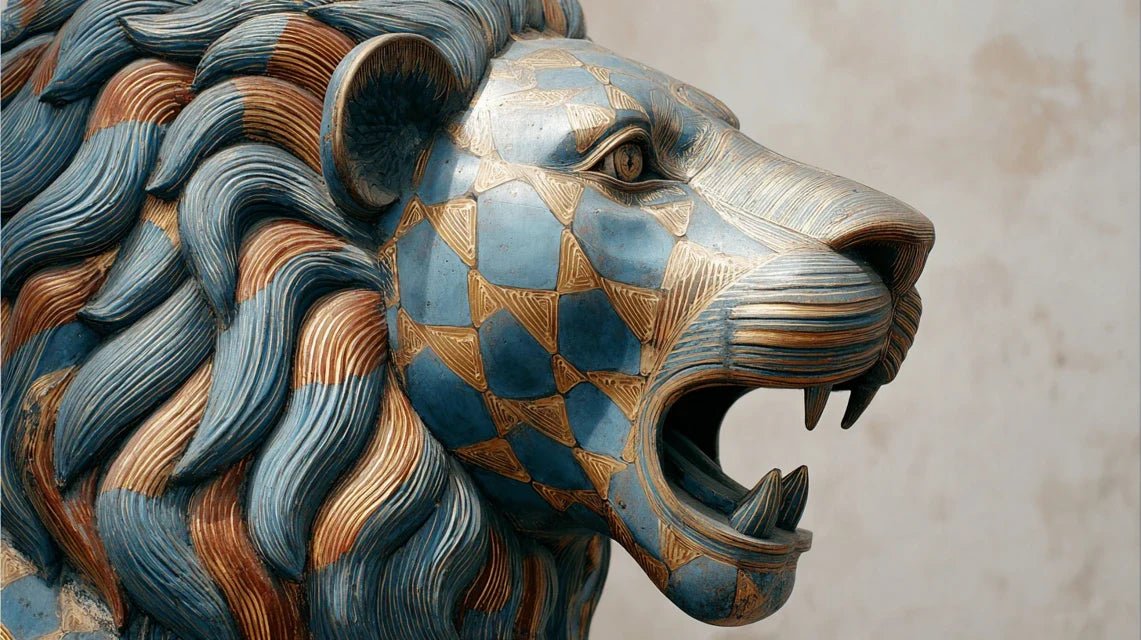
The first time I laid eyes on an Ethiopian manuscript from the 14th century, at an auction in Addis Ababa, I was struck by the majesty of the lion that adorned the margin. Its golden foil mane, its piercing cinnabar-tinted eyes, its proud bearing... This feline was not merely a decorative motif. It embodied millennial power, divine legitimacy, a national pride inscribed in the Ethiopian cultural DNA. The lion symbolizes power in Ethiopian art because it simultaneously represents the Solomonic dynasty, historical resistance to invaders, and the spiritual connection between the earthly and celestial realms. Here's what this symbolism brings: a deep understanding of Ethiopian identity, a source of decorative inspiration steeped in history, and a key to deciphering one of Africa’s richest artistic heritages.
Many admire Ethiopian art for its vibrant colors and geometric shapes, but few grasp the scope of the lion within this tradition. You see it everywhere - on the rock-hewn churches of Lalibela, in parchment paintings, on ceremonial fabrics - without understanding that it tells a story of royal lineage, biblical prophecy, and cultural resistance. This lack of awareness transforms profound works into mere exotic objects. Yet, once you understand why the lion symbolizes power in Ethiopian art, each representation becomes a window onto three thousand years of history, faith, and national pride.
The Solomonic dynasty: when the lion becomes a royal birth certificate
The story begins with the Queen of Sheba and King Solomon. According to the Kebra Nagast (Glory of Kings), an Ethiopian foundational text from the 14th century, their union gave birth to Menelik I, the first emperor of Ethiopia. This lineage, called the Solomonic dynasty, would reign until 1974 with Haile Selassie I. Their emblem? The Lion of Judah, directly taken from the biblical prophecy designating the tribe of Judah as that of kings.
In medieval Ethiopian art, every representation of the lion is not arbitrary. It affirms the divine legitimacy of the rulers. Illuminated manuscripts systematically show the lion alongside emperors, sometimes holding a cross between its paws - a perfect fusion of temporal and spiritual authority. I have studied these codices for years, preserved at Debre Libanos monastery: the lion symbolizes power in Ethiopian art by literally being the mythical ancestor of kings, their genealogical tree embodied in a golden feline.
The crowned lion: a millennial visual vocabulary
Carefully observe the frescoes of Ethiopian churches: the lion appears almost always crowned, sometimes with a scepter. This specific iconography differentiates Ethiopian art from other African traditions where the lion symbolizes brute force or hunting. Here, it bears the insignia of human power while retaining its divine nature. It is this duality that fascinates: the lion in Ethiopian art is simultaneously wild beast and civilized monarch, creature of God and terrestrial representative of celestial authority.
Red, gold, and black: the chromatic palette of leonine power
During my last mission to Gondar, 17th-century imperial capital, I spent weeks analyzing the pigments used in leonine representations. Ethiopian artists did not choose their colors at random. Vermilion red (imported at a high price) for the eyes and tongue evokes royal blood and dynastic vitality. Gold for the mane is never simple ochre yellow: it's real gold leaf, applied with a technique passed down from Axum. The deep black of the outline defines power, contains it, concentrates it.
This tricolor palette creates a visually recognizable code. When you see these colors associated with a feline in Ethiopian art, you instantly know that it is not just an animal. The lion symbolizes power through this sacred chromie which distinguishes it from any other animal representation. Hyenas, leopards or other felines are painted in natural tones. Only the royal lion receives this exceptional aesthetic treatment, this visual staging of the divine.

Discover this inspiring artwork
Resistance and pride: the lion facing invasions
Ethiopia holds a unique African record: it has never been colonized (except for a brief Italian occupation from 1936 to 1941). This historical resistance is embodied in the lion. During the Battle of Adoua in 1896, where Ethiopia crushed the Italian army, all imperial banners bore the Lion of Judah. Soldiers went into battle singing leonine hymns. The lion in Ethiopian art then becomes a symbol of defense of the territory, refusal of submission, Pan-African pride.
This resilient dimension explains why the Ethiopian lion far exceeds the borders of the country. Bob Marley and the Rastafarian movement adopted it as an emblem of African dignity. In the 1960s-70s, many newly independent African states looked to Ethiopia and its lion as a model of preserved sovereignty. Even today, contemporary Ethiopian artists reinterpret this motif to speak of postcolonial identity. The lion is no longer just royal: it is Pan-African, universally recognized as a symbol of power African, unalienated.
From manuscript to textile: migrations of a symbol
What I love about Ethiopian art is the circulation of the leonine motif through all mediums. Monks copyists from the 15th century insert it into the margins of the Gospels. Weavers embroider it on the netela (cotton shawls) worn during ceremonies. Silversmiths sculpt it on processional crosses in silver. Icon painters place it at the feet of holy emperors. This omnipresence is never repetitive: each artisan adapts the lion to his medium while preserving the codes - abundant mane, upright posture, frontal gaze.
The theology of the lion: when the beast becomes christlike
Here's a fascinating aspect that few know: in Ethiopian Orthodox theology, the lion has a Christological dimension. The Book of Revelation (5:5) designates Jesus as the Lion of the tribe of Judah. Ethiopian theologians have developed this metaphor for centuries. In the manuscripts I have translated, Christ and the lion sometimes exchange visual attributes: Jesus receives a stylized golden mane, the lion bears a cruciform halo.
This fusion explains why the lion symbolizes power in Ethiopian art with a spiritual depth absent from other heraldic traditions. It is not just a political emblem: it is a soteriological figure, a promise of redemption, an incarnation of the victory of good over evil. The frescoes of the Debre Berhan Selassie church in Gondar show lions guarding the gates of paradise - a role traditionally reserved for angels in Western Christian iconography. This theological boldness makes the Ethiopian lion a unique case in world Christian art.

Discover this inspiring work
Integrating the Ethiopian lion into your world: beyond folklore
When you choose a work representing the lion in Ethiopian art, you are not buying an exotic decorative motif. You are inviting three thousand years of condensed history into your home, a philosophy of legitimate power, an aesthetic that dialogues with the sacred. I have advised collectors who place these pieces in offices - there the lion becomes a daily reminder that true authority is earned through lineage (in the broad sense: transmission, heritage, continuity) and resilience in the face of adversity.
Contemporary Ethiopian art offers fascinating interpretations. Painters like Elias Sime or Aïda Muluneh revisit the lion with mixed techniques, blending traditional pigments and recycled materials. These works converse with medieval manuscripts while speaking of ecology, globalization, memory. They prove that the lion symbolizes power in a living, evolving way, capable of carrying current discourses without losing its historical significance.
Recognizing authenticity: the details that matter
Faced with the growing popularity of this motif, the market is flooded with superficial reproductions. How to distinguish a piece authentically rooted in Ethiopian tradition? Check the posture: the lion should be in profile but with its head facing forward (a typical twisted perspective of Ethiopian art). Examine the paws: they are often disproportionate, almost human, recalling that this lion transcends animality. Observe the treatment of the mane: it must form geometric volutes, never naturalistic. These aesthetic conventions, established since the Kingdom of Axum, guarantee that you are facing a true symbol of Ethiopian power, not a generic reinterpretation.
Let the Lion of Judah roar on your walls
Discover our exclusive collection of African paintings that celebrate Ethiopian majesty and transform your interior into a gallery of art steeped in millennia of history.
Your space, guardian of a millennial lineage
Imagine your gaze meeting the Lion of Judah every morning - gilded, crowned, bearer of three thousand years of resistance and faith. This is not just a decoration on the wall. It's a connection established with the only African nation never colonized, with emperors who claimed descent from Solomon, with artists who for fifteen centuries have painted power not as brutal domination but as sacred responsibility. The lion symbolizes power in Ethiopian art because it embodies this rare vision: authority as service, strength as protection, majesty as preserved dignity.
Start modestly if you are discovering this universe. A quality reproduction of a medieval manuscript, a contemporary engraving inspired by the frescoes of Gondar, an embroidered textile with a léonin motif. Let this symbol dialogue with your other pieces. You will see: it does not seek to dominate the space. It structures it, gives it a historical backbone, anchors your decoration in something larger than ephemeral trends. That is exactly what a true symbol of power does: it organizes chaos, creates coherence, tells a story that surpasses you while including you.
FAQ : The Lion of Judah Revealed
Why specifically the lion and not another powerful animal?
Excellent question that I often receive during my lectures. The choice of the lion comes directly from the Hebrew Bible, where the tribe of Judah (from which King David, then Solomon descended) is compared to a young lion in Jacob's blessing (Genesis 49:9). When the Queen of Sheba and Solomon had a son according to Ethiopian tradition, this leonine heritage naturally passed on. But there is also an ecological reason: lions actually lived in the Ethiopian highlands until the 20th century. The lion symbolizes power in Ethiopian art because it was both local reality and biblical metaphor - a perfect fusion of territory and theology. The elephant or leopard did not have this double scriptural and environmental legitimacy.
How to distinguish an Ethiopian lion from a lion in Egyptian or West African art?
The differences are striking once you're shown them. The Ethiopian lion is almost always crowned and often bears a cross - elements absent from animistic traditions or ancient Egypt. Its stylization is unique: body in profile but head frontal, geometric mane in concentric volutes, front legs raised in a heraldic posture (like on a European coat of arms, influence of contacts with Byzantium and Portugal in the 16th century). The Egyptian lion is generally lying down, sphinx-like, guardian of thresholds. The West African lion (in Bambara or Dogon art for example) is more naturalistic, represented hunting or in motion. The lion in Ethiopian art is static, frontal, majestic - it's a royal portrait, not a scene of animal life. Its eyes always meet yours, creating this characteristic direct connection of Ethiopian Orthodox iconography.
Can we integrate this symbol without knowing all of Ethiopian history?
Absolutely, and I encourage you to do so. No one masters the entirety of three thousand years of Ethiopian history (and I am still discovering aspects after twenty years of study). What matters is intention and respect. Understanding that the lion symbolizes legitimate power, resistance, and dignity is enough to welcome it into your home with authenticity. You will gradually learn - each time your gaze crosses the artwork, you will ask yourself new questions, do research, deepen your connection. This is exactly how true art works: it initiates a dialogue that lasts for years. Start with the basics (Solomonic dynasty, Ethiopian Orthodox faith, colonial resistance) and let the lion teach you the rest. Powerful symbols do not require complete scholarship before being welcomed - they require openness and curiosity. Your interior will become a classroom, and each curious guest facing your artwork will trigger a conversation that enriches your own understanding.
Frequently Asked Questions
Why specifically the lion and not another powerful animal?
The choice of the lion comes directly from the Hebrew Bible, where the tribe of Judah is compared to a young lion in Jacob's blessing. When the Queen of Sheba and Solomon had a son according to Ethiopian tradition, this leonine heritage was passed down. Lions also lived on the Ethiopian highlands until the 20th century. The lion symbolizes power in Ethiopian art because it was both local reality and biblical metaphor - a perfect fusion of territory and theology that the elephant or leopard did not have.
How can one distinguish an Ethiopian lion from a lion in Egyptian or West African art?
The Ethiopian lion is almost always crowned and often bears a cross. Its stylization is unique: body in profile but head frontal, geometric mane in concentric volutes, front legs raised in a heraldic posture. The Egyptian lion is generally lying down, sphinx-like, guardian of thresholds. The West African lion is more naturalistic, depicted hunting or in motion. The Ethiopian lion is static, frontal, majestic - a royal portrait whose eyes always meet yours, creating that direct connection characteristic of Orthodox iconography.
Can one integrate this symbol without knowing all of Ethiopian history?
Absolutely. What matters is intention and respect. Understanding that the lion symbolizes legitimate power, resilience, and dignity is enough to welcome it into your home with authenticity. You will gradually learn - each time your gaze crosses the artwork, you will deepen your connection. Start with the basics (Solomonic dynasty, Ethiopian orthodoxy, colonial resistance) and let the lion teach you the rest. Powerful symbols require openness and curiosity, not immediate complete scholarship.