The first time I held a fragment of terracotta in my hands, during an archaeological mission in the Kaduna Valley, I felt something inexplicable. This millennial piece, with its piercing eyes and enigmatic expression, seemed to stare across the centuries. Nok sculptures are not mere vestiges: they embody the birth of figurative artistic expression in sub-Saharan Africa, a visual language that has shaped African aesthetics for over 2500 years.
Here's what the legacy of Nok sculptures brings: a deep understanding of the roots of African art, an inexhaustible source of inspiration for contemporary creators, and a tangible connection with an advanced civilization that mastered metallurgy and symbolic expression long before the Christian era.
You admire African art but feel you lack the keys to truly understand where these forms, these particular proportions that characterize the continent's creations come from? This frustration is legitimate: the history of African art often remains fragmentary, confined to masks and statues without a deep historical context.
Rest assured: by delving into the universe of Nok sculptures from Nigeria, you will discover the very foundations of African aesthetics. This article reveals how this little-known civilization laid the visual foundations that still resonate in contemporary art, and why understanding their legacy radically transforms your view of decoration and African art.
The Nok: The civilization that reinvented human expression
Between 1500 BC and 500 AD, in the fertile plateaus of central Nigeria, an extraordinary civilization emerged without leaving written traces, but by sculpting its message into terracotta. Nok sculptures represent the oldest known tradition of figurative sculpture in sub-Saharan Africa, preceding the famous bronze castings of Ife and Benin by several centuries.
The fortuitous discovery in 1928 of a monkey head made of terracotta near the village of Nok opened a window onto a sophisticated society. These artisans mastered the terracotta technique at temperatures exceeding 800°C, creating works of astonishing technical complexity for the time. But what really strikes you are the faces.
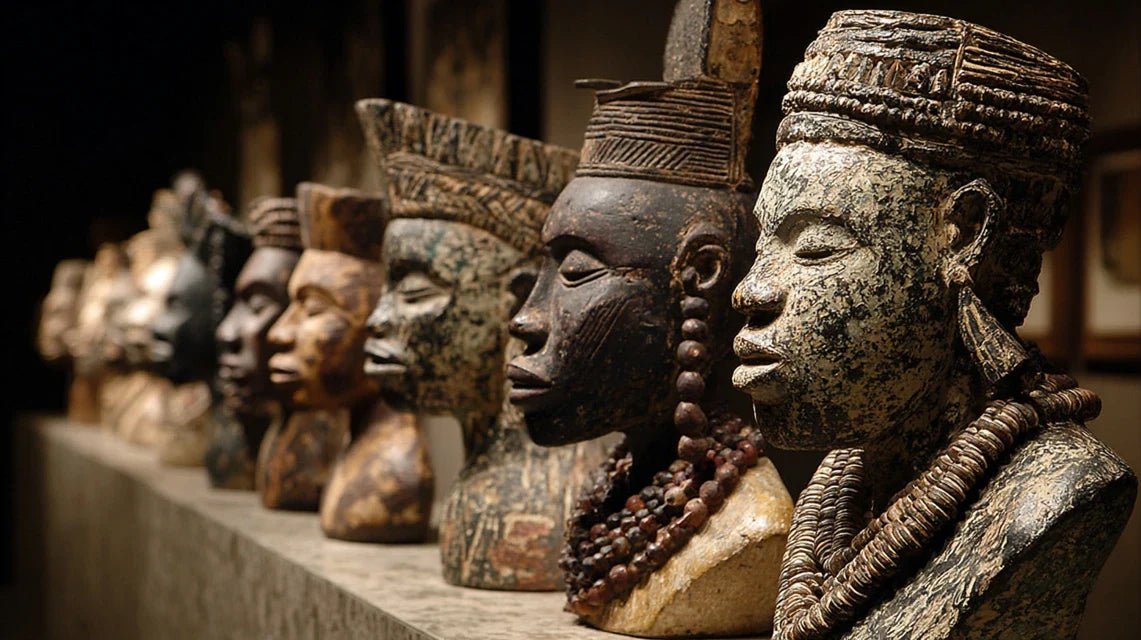
The Nok heads present immediately recognizable visual characteristics: triangular, circular or almond-shaped eyes pierced to let light pass through, elaborate hairstyles reflecting precise social statuses, and above all, this unique ability to capture the essence of humanity with a few essential sculpted gestures. This economy of means for maximum expressive power will become the signature of African art.
The visual DNA that crosses the millennia
The deepest legacy of Nok sculptures lies in their visual grammar: a way of representing the human body that has influenced generations of African artists. Look at the proportions: oversized heads compared to the body, sometimes representing one-third of the total height of the figure, establish a principle that will be found in almost all subsequent African sculptural traditions.
This emphasis on the head is not accidental. In the cosmogony of the people of the region, the head houses spiritual essence, the seat of personality and destiny. Nok sculptors visually codified this belief, creating a formal language that will be taken up by the Yoruba, Igbo and countless other cultures.
Founding stylistic codes
The characteristics of Nok sculptures established lasting aesthetic conventions: stylization rather than photographic realism, the importance of body ornaments (necklaces, bracelets, hairstyles) as markers of identity, and above all this magnetic presence that emanates from the figures despite their often modest size.
I spent hours at the National Museum in Lagos comparing Nok heads with Ife bronzes dating back to the 12th century. The lineage is evident: even when Ife seeks a more advanced naturalism, the proportions, attention to facial details, the quiet dignity of expressions, all recall the Nok heritage. This continuity over more than a thousand years testifies to the founding power of this aesthetic.

Discover this inspiring artwork
When archaeology meets contemporary design
The influence of Nok sculptures from Nigeria extends far beyond museum showcases. In the workshops of Lagos, Accra or Johannesburg, contemporary creators consciously draw on this millennial formal repertoire. Furniture designers incorporate the characteristic triangular and circular shapes, ceramists revisit Nok textures and proportions, architects are inspired by the balance between massiveness and elegance.
This resurgence is not nostalgic: it testifies to the current relevance of these aesthetic principles. Nok forms possess a timeless modernity, an ability to dialogue with Scandinavian design as well as with art brut. Their bold geometry, their worked surfaces, their sculptural presence perfectly match contemporary aspirations for authenticity and cultural connection.
Integrating into Modern Interiors
Integrating the spirit of Nok sculptures into an interior doesn't mean turning your living room into an ethnographic museum. It’s about understanding the principles: prioritizing sculptural quality, embracing controlled asymmetry, valuing natural raw materials like terracotta, creating powerful focal points rather than multiplying decorative elements.
A quality reproduction of a Nok head, placed on a minimalist pedestal in a clean space, creates a fascinating visual tension. The contrast between the antiquity of the motif and the modernity of the context generates exactly the temporal dialogue sought by avant-garde decorators. It is this ability to transcend eras that explains the growing appeal of these ancestral forms.
The Transmission of Technique: A Revolutionary Know-How
Beyond aesthetics, the legacy of Nok sculptures includes extraordinary technical mastery. How did artisans, 2500 years ago, manage to fire large hollow pieces without cracking them? This question has long intrigued archaeologists and modern ceramists.
Recent analyses reveal astonishing sophistication: Nok sculptors used the coiling technique, gradually building up their pieces by adding rolls of clay, then hollowing out the interior to reduce weight and facilitate even firing. They strategically drilled holes to allow air and moisture to escape during firing, preventing explosions.
This know-how has been transmitted, adapted, transformed over the centuries. Contemporary potters in Nigeria, even though they now use modern kilns, perpetuate gestures and shaping techniques that directly date back to the Nok era. This technical continuity constitutes an invaluable intangible heritage.

Discover this inspiring artwork
The Enigmas That Fuel Creative Imagination
One of the reasons why Nok sculptures fascinate so much is that they don't reveal everything. We do not know the names of their creators, nor the exact function of many pieces, nor the rituals in which they were inscribed. This part of mystery, far from being frustrating, stimulates creative imagination.
Some Nok figures clearly depict high-ranking individuals, adorned with intricate jewelry and elaborate hairstyles. Others seem to show the sick or people in particular positions. Do they represent venerated ancestors? Deities? Portraits of the living? Each hypothesis opens up interpretative avenues that nourish contemporary creation.
This semantic openness allows each era, each culture to project its own questions onto these millennial faces. It is precisely this ability to generate meaning without imposing it that makes Nok sculptures objects of eternal modernity.
Bring this millennial heritage to life in your interior
Discover our exclusive collection of African paintings that capture the essence of ancestral sculptural traditions and dialogue with your modern space.
The impact on the recognition of African art
The most political legacy of Nigerian Nok sculptures lies in their role as irrefutable proof: sub-Saharan Africa possessed sophisticated artistic traditions long before contact with Europe or the Arab world. This assertion, which should be obvious, has long been contested or minimized by a colonial historiography.
Scientific dating of Nok works by carbon 14 and thermoluminescence has definitively established their extraordinary antiquity. These sculptures require rewriting the history of world art, recognizing that while ancient Greece developed its statuary, an African civilization was simultaneously creating a language of sculpture just as powerful but radically different.
This recognition has concrete effects on the art market, on museum policies, and on the restitution of African works. Nok sculptures become arguments in contemporary debates about heritage, cultural identity, and decolonization of imaginations. Their legacy is therefore as political as it is aesthetic.
A universal source of inspiration
Paradoxically, by asserting their deep Africanity, Nok sculptures speak a universal language. Picasso, fascinated by African art, would have been overwhelmed by these triangular-eyed heads and bold proportions. German expressionists, Cubists, modernists of all trends sought in African art this formal synthesis that the Nok had already achieved two millennia earlier.
Today, creators around the world are inspired by the Nok aesthetic: Japanese designers, Scandinavian ceramists, Brazilian sculptors. This universality does not dilute the cultural identity of the works; on the contrary, it testifies to their ability to touch something fundamentally human across eras and geographies.
Imagine your living room transformed by the silent presence of a form inspired by Nok sculptures. Not as an exotic trophy, but as a temporal bridge, a mute conversation with artists who, 2500 years ago, asked themselves the same questions about expressing beauty, the essence of humanity, permanence in the face of impermanence. This is the living heritage of the Nok.
Start simply: observe the characteristic proportions, the geometry of the forms, the texture of the terracotta. Visit online collections, compare periods, let your eye be educated to this visual grammar. Then choose a piece, just one, that resonates with you. Integrate it into your space. You will see: these millennial forms possess a strange ability to make everything around them contemporary, as if they held a secret about the perfect balance between tradition and modernity.
Frequently Asked Questions
Why are Nok sculptures important for the history of African art?
Nok sculptures represent the oldest known tradition of figurative sculpture in sub-Saharan Africa, dating from 1500 BC to 500 AD. They established the fundamental aesthetic codes of African art: proportions with oversized heads, stylization rather than realism, importance of ornaments as social markers. These visual principles are found in all subsequent major artistic traditions, from Ife bronzes to contemporary masks. The Nok also prove that sub-Saharan Africa possessed sophisticated artistic traditions long before external contacts, which has radically transformed the international recognition of African art and its history.
How can the Nok aesthetic be integrated into a modern interior?
The spirit of Nok sculptures fits perfectly into contemporary interiors thanks to their timeless geometry and strong sculptural presence. The ideal approach is to choose a quality reproduction or a piece inspired by Nok forms, then showcase it on a minimalist pedestal in a clean space. The contrast between the antiquity of the motif and the modernity of the context creates a fascinating visual tension. Favor natural materials like terracotta, embrace the controlled asymmetry characteristic of these works, and create powerful focal points rather than multiplying elements. A single well-chosen piece transforms a space by creating that temporal dialogue so sought after today.
What is the significance of the visual characteristics of Nok heads?
The distinctive features of Nok heads are not arbitrary but laden with cultural meaning. Triangular, circular or almond-shaped eyes pierced probably served during rituals, allowing light or smoke to pass through. Oversized heads (sometimes one third of the total height) reflect the belief that the head houses spiritual essence and destiny. Elaborate hairstyles clearly indicate social status, with complex variations signaling rank, profession or affiliation. Sculpted ornaments (necklaces, bracelets) function as identity markers. This economy of means for maximum expressive power has become the signature of African art: communicating the essential with a few formal gestures perfectly mastered.