The first time I saw a giraffe painted on a wall made of raw earth in a village in Mali, I realized that I was contemplating much more than just a simple drawing. This large mammal with an endless neck, traced with an almost abstract elegance, told a story spanning millennia. Saharan mural art transforms the giraffe into a true guardian of traditions, a bridge between heaven and earth, a symbol of wisdom that transcends generations.
Here's what the giraffe in Saharan mural art brings: a deep spiritual connection with nature, an artistic expression that dialogues with the desert environment, and a visual language that perpetuates the collective memory of the Sahelian peoples.
Perhaps you have already felt this frustration: admiring an African motif without really understanding its depth, missing its cultural significance, seeing only a decorative element where a whole cosmogony is hidden. Saharan animal representations seem mysterious, inaccessible to those who do not know their codes.
Rest assured: understanding why the giraffe dominates the Saharan mural iconography does not require years of ethnographic studies. It suffices to listen to what these mural frescoes tell, to let the ochres and earths that compose these monumental works speak.
In this article, I invite you on a journey to discover this emblematic animal that adorns the facades of the Sahel, from its prehistoric roots to its contemporary reinterpretation, so that you can finally grasp all the richness of this ancestral mural art.
A millennial presence engraved in stone and earth
The history of the giraffe in Saharan art begins long before the mural paintings that we know today. On the rocky walls of the Bandiagara plateau in Mali, in the Aïr massifs in Niger, or even in the Tassili n'Ajjer in Algeria, rock engravings bear witness to a fascination dating back more than 8000 years.
At that time, the Sahara was still verdant. Giraffes actually roamed these lands which were to become desert. Neolithic populations lived alongside them, sometimes hunted them, but above all admired them. These prehistoric artists left hundreds of representations of giraffes of extraordinary finesse, capturing their majestic bearing with remarkable economy of lines.
When the climate dried up and the giraffes migrated south, their image remained. It was passed down from generation to generation, from stone to the clay walls of homes. Saharan mural art has preserved this animal memory as a treasure, transforming a disappeared zoological reality into a permanent cultural symbol.
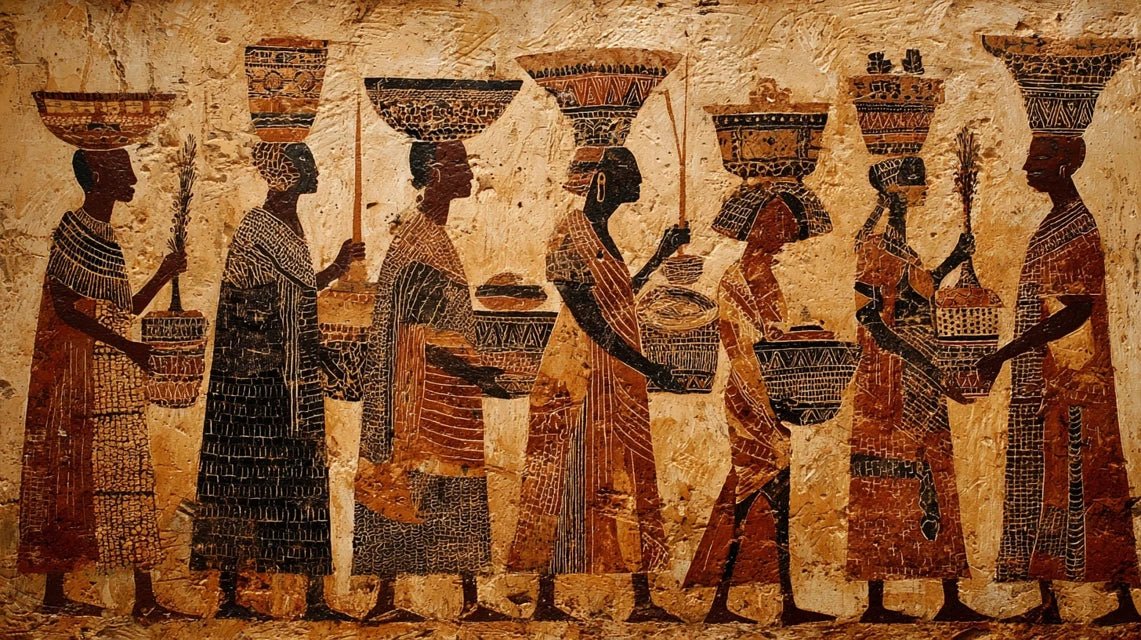
In Dogon, Bambara or Peul villages, women who traditionally decorate facades perpetuate these ancestral motifs. They mix clay, cow dung and natural pigments to draw stylized giraffes that seem to defy time.
The neck that connects the earth to the sky: spiritual symbolism
Why a giraffe rather than another animal? The answer lies in its unique morphology. This immense neck that allows the giraffe to reach the highest branches makes it, in Saharan cosmology, a messenger between worlds.
In the animistic traditions that still deeply permeate Saharan wall art, animals are never just creatures. Each carries a meaning, embodies a quality, transmits a teaching. The giraffe symbolizes the ability of spiritual elevation, the search for what goes beyond the ordinary, far-sightedness.
The ancients say that it can see dangers coming before all other animals, that it observes the horizon with an insight that humans must strive to imitate. Painting a giraffe on a wall is therefore invoking this clairvoyance, placing the home under the protection of a watchful gaze.
In some regions, particularly among the Dogon people, the giraffe is also associated with grace and elegance despite an appearance that might seem disproportionate. This philosophical lesson — finding harmony in what seems paradoxical — resonates deeply in societies where balance between humans and a hostile environment is essential.
The giraffe as guardian of the home
Women who paint family walls often choose giraffe motifs to delineate sacred spaces. The entrance to a house, the wall of the inner courtyard, the facade that welcomes visitors: these strategic areas receive the protective presence of the animal.
The color palette used reinforces this role: red ochres evoke the nourishing earth, whites obtained from kaolin represent spiritual purity, blacks derived from soot or charcoal anchor the drawing in material reality. Each color applied to the silhouette of the giraffe adds a layer of meaning.

Discover this inspiring artwork
A visual language adapted to Saharan architecture
The iconic nature of the giraffe in Saharan wall art is also explained by purely aesthetic and technical reasons. The vertical shape of the animal naturally complements the architecture of Saharan homes.
Traditional Sahelian homes are characterized by their smooth banco (raw earth mixed with straw) walls, vertical lines, and facades that are often tall and narrow. The slender silhouette of the giraffe blends perfectly with these proportions. It can stretch across the entire height of a wall without appearing compressed, creating a visual continuity between the floor and the thatched or terrace roof.
Unlike other animals that would require horizontal treatment (crocodiles, snakes) or circular (turtles, birds seen from above), the giraffe offers mural artists exceptional compositional freedom. Its neck can meander, create rhythm, guide the viewer's eye along the facade.
Moreover, the natural stylization of this animal lends itself wonderfully to the Sahelian graphic vocabulary, made up of clean lines, geometric shapes and repetitive patterns. The giraffe’s spots become lozenges, triangles, checkerboards that dialogue with other traditional decorative elements: zigzags symbolizing water, spirals representing wind, circles evoking the sun.
An ancestral technique still alive
I was fortunate to observe Malian women redecorating their walls after the rainy season. Their gesture is precise, quick, almost choreographed. With their fingers or a simple calabash piece, they trace the contours of giraffes that seem to spontaneously emerge from the earthy support.
This technique, passed down from mother to daughter, requires no preparatory sketch. The proportions, curves and overall balance are inscribed in the artists' bodily memory. Each giraffe is unique, slightly different, while belonging to a common repertoire immediately recognizable.
When Sahelian mural art meets contemporary decoration
Today, the giraffe of Sahelian mural art is experiencing a fascinating second life. Designers, decorators and contemporary artists draw on this visual heritage to create works that resonate with our time.
This respectful appropriation allows tradition and modernity to dialogue. Sahelian giraffe motifs now appear on printed textiles, in urban wall compositions, and on decorative objects that travel far beyond their land of origin.
What makes these creations so captivating is that they retain the soul of the original: this economy of means, this graphic elegance, this ability to evoke rather than faithfully represent. A stylized Sahelian giraffe is never photographic. It is suggestion, essence, pure idea of the animal.
In a contemporary interior, whether minimalist or more eclectic, these representations bring an organic and spiritual dimension. They tell a story, create a conversation, invite inner as well as geographical travel.
Bring the spirit of the Sahel into your home
You don't need to transform your living room into a replica of a Malian village to benefit from the evocative power of Sahelian wall art. A few principles are enough: prioritize earthy and natural tones, play on contrasts between smooth surfaces and organic textures, let compositions breathe without cluttering the space.
A table depicting a Sahelian giraffe on a light-colored wall instantly creates a soothing focal point. The eye naturally follows the animal's verticality, the space seems larger, and the room gains symbolic height. This is all the magic of these millennial representations: they transform the space they inhabit materially and emotionally.
Let the grace of the Sahel transform your interior
Discover our exclusive collection of African art that captures the timeless essence of Sahelian wall art and brings elegance and spirituality to your living spaces.

Discover this inspiring artwork
It must be said with lucidity: traditional Sahelian wall art is threatened. Rapid urbanization, the progressive abandonment of ancestral techniques in favor of modern materials, the disappearance of knowledge passed down orally: all these factors endanger an invaluable cultural heritage.
In some villages, younger generations prefer industrial paints to clay plasters. Traditional motifs, including the iconic giraffe, are giving way to standardized decorations with no connection to local history.
However, remarkable initiatives are emerging. Cultural associations document these practices, local artists reinvent traditional codes to make them attractive to new generations, and preservation programs support the last keepers of this ancestral knowledge.
As art and decoration enthusiasts, we have a role to play. Every time we choose a work inspired by Saharan wall art, every time we share the story behind these iconic giraffes, we participate in preserving this heritage. We affirm that these artistic expressions have their place in our contemporary world, that they deserve to be celebrated, understood, passed down.
The giraffe as an invitation to a still journey
Ultimately, if the giraffe remains so iconic in Saharan wall art, it may be because it perfectly embodies what we all seek: a connection with something greater than ourselves, an elevation that does not cut us off from our earthly roots, a presence both peaceful and vigilant.
Imagine your living space inhabited by this particular energy. Every morning, your gaze meets this elongated silhouette reminding you to look up, to seek perspective, to cultivate the distant vision symbolized by the animal. It's not just a decorative element: it's a daily companion that subtly influences your state of mind.
Art has this extraordinary power to condense centuries of wisdom into an image. The Saharan giraffe carries within it the memory of a verdant Sahara, the silent prayers of women painting family walls, the resilience of cultures that have learned to thrive in austerity.
Start simply: truly observe these representations, let yourself be touched by their minimalist grace, imagine the hands that traced these lines. Then, find the piece that will resonate with your own story, the one that will bring a touch of authenticity and depth to your interior. You won't just decorate a wall: you will welcome a fragment of millennial humanity.
Frequently Asked Questions about the Giraffe in Saharan Wall Art
Why is the giraffe so present in Saharan art when it no longer lives in these regions?
Excellent question that touches on the heart of cultural memory. The giraffe has indeed disappeared from the Sahel several millennia ago, when the climate dried up. But its image has remained because it has transformed into a spiritual symbol rather than a simple zoological representation. Saharan peoples have kept this motif as a link to their past, but also because the giraffe embodies values that are still relevant today: vigilance, spiritual elevation, grace in adversity. It is a fascinating example of how art preserves collective memory far beyond environmental reality. In Saharan wall art, the giraffe is not an animal documentary: it is a teaching passed down from generation to generation through a visually powerful and immediately recognizable form.
How to recognize a true traditional representation from a modern creation?
The distinction isn't always obvious, and that's precisely what makes successful contemporary reinterpretations so interesting! Traditional Saharan giraffes nevertheless have certain characteristics: extreme geometric stylization (the animal becomes almost abstract), the use of natural pigments in earthy tones (ochres, whites, blacks), integration into a set of symbolic motifs (zigzags, spirals, checkerboards), and above all, remarkable economy of lines. Modern creations draw inspiration from these codes but can add contemporary elements, use brighter colors, or isolate the giraffe from its traditional decorative context. Authenticity isn't necessarily the most important thing, but rather respecting the spirit of this art: its spiritual dimension, its graphic elegance, its ability to suggest rather than describe.
Can these motifs be integrated into a modern decor without cultural appropriation?
Your sensitivity to this question honors you, as it demonstrates a genuine respect for the cultures of origin. The key lies in intention and knowledge. Integrating Saharan wall art motifs becomes problematic when they are reduced to simple exotic ornaments without understanding or respecting their meaning. On the other hand, when you genuinely take an interest in the history, symbols, artists, and communities that perpetuate these traditions, your approach becomes a tribute and support. Prioritize works created by African artists or in respectful collaboration with them, share the story behind your decorative choices, consider these elements as cultural bridges rather than aesthetic trophies. Saharan art, with its iconic giraffe, just needs to be celebrated and understood: by welcoming it into your home with this awareness, you participate in its preservation and radiance.