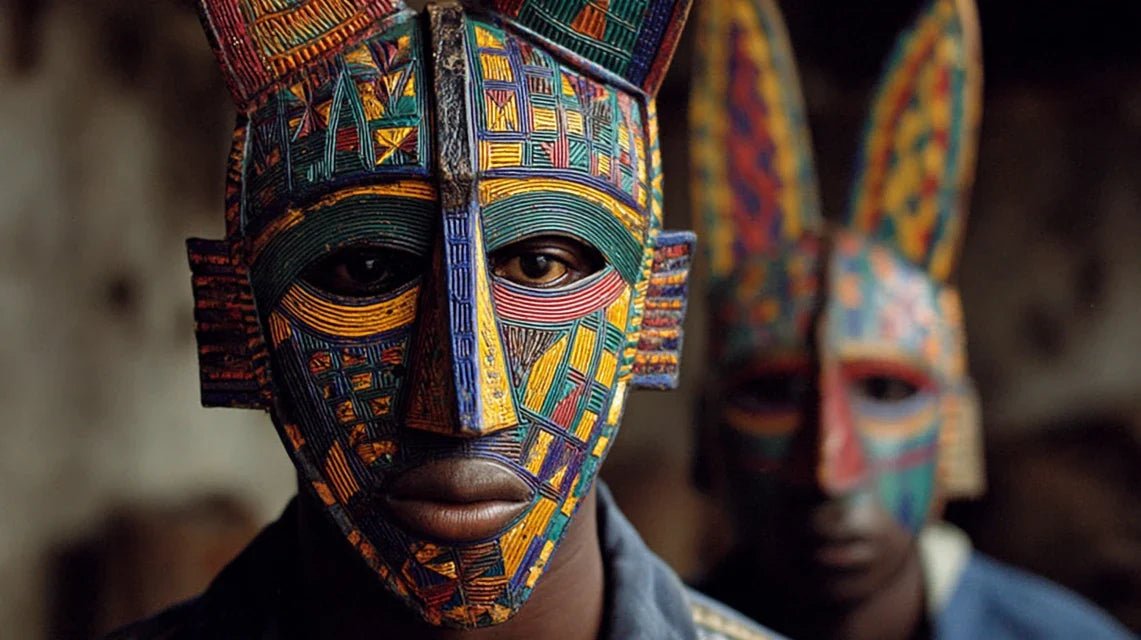
In the silence of a Parisian gallery, I first felt this unsettling presence. A white mask, with elongated features, its face covered in kaolin, stared at me with an intensity that transcended decades. It was not simply a decorative object: it was a gateway to the spiritual universe of the Fang people, a civilization that shaped one of the most powerful artistic legacies of Central Africa.
Here's what the legacy of Fang masks from Gabon brings us: an aesthetic revolution that inspired the greatest artists of the 20th century, a profound spiritual philosophy that connects the living to their ancestors, and a visual presence capable of radically transforming the atmosphere of a contemporary space.
You may have come across these masks in decorating magazines, admired their graphic elegance in design interiors, without really understanding their origin or meaning. Perhaps you hesitate to integrate these powerful forms into your home, for fear of cultural appropriation or simply due to a lack of knowledge of their history.
Rest assured: understanding the legacy of Fang masks is discovering how traditional Gabonese art continues to irrigate our modernity, how these centuries-old creations dialogue with our contemporary interiors, and why they remain an inexhaustible source of inspiration for today's creators.
I invite you to dive into the fascinating universe of these sculpted guardians, through their history, influence and current resonance.
Fang masks: guardians of the invisible world
In the heart of the equatorial forests of Gabon, Cameroon and Equatorial Guinea, the Fang people have developed for centuries a sculptural tradition of remarkable sophistication. Fang masks are not mere ornaments: they embody the sacred interface between the world of the living and that of the ancestors.
The white mask, or ngil, represented the instrument of justice of the male secret society. Covered in kaolin, this white pigment extracted from clay, it symbolized spiritual purity and the power to see beyond appearances. During nocturnal ceremonies, the one who wore the ngil mask became the vehicle of the ancestors, charged with exposing sorcerers and restoring social harmony.
These masks are distinguished by their unique aesthetic characteristics: an elongated heart-shaped face, half-closed eyes evoking meditation, a domed forehead symbolizing wisdom, and this spectral whiteness that contrasts with the shadows of the forest. Each sculptural element has a precise meaning in Fang cosmology.
A spiritual geometry
What fascinates about the legacy of Fang masks is this ability to synthesize the human face into essential geometric forms. The Fang sculptor does not seek realism: he extracts the spiritual essence, the vital force that the Fang call evu. This conceptual approach to representation revolutionized Western vision of art at the beginning of the 20th century.
When Paris Discovered Africa: An Aesthetic Shock
1906. In his Parisian studio, Pablo Picasso discovered African masks, particularly those from Gabon. This moment marked a radical turning point in the history of modern art. The following year, he painted Les Demoiselles d'Avignon, a foundational work of Cubism, directly inspired by the geometric aesthetics of Fang masks.
But Picasso was not alone. Matisse, Derain, Vlaminck, Modigliani: all these masters of modernism were profoundly marked by the legacy of Fang masks and African arts in general. What these artists understood was that Fang sculptors had long ago solved the problem of representation other than through imitation.
Simplified forms, pure volumes, expressiveness achieved through controlled distortion: all this plastic vocabulary that the European avant-garde desperately sought, Fang artists had mastered for generations. This revelation freed Western art from academicism and paved the way for all the experiments of the 20th century.
A Controversial Museum Legacy
Today, the most beautiful Fang masks are preserved in major Western museums: the Louvre, the British Museum, the Metropolitan Museum of Art. This presence raises legitimate questions about restitution and the circulation of works. Does the legacy of Fang masks belong to the institutions that preserve them or to the communities that created them? The debate remains open, but it testifies to the immeasurable value of these creations.

Discover this inspiring artwork
The Aesthetic DNA of a Forest Civilization
To truly understand the legacy of Fang masks, you must imagine their context of creation. In the darkness of the equatorial forest, illuminated by the flickering flames of torches, these white faces emerged like supernatural apparitions. Their power did not lie only in their form, but in the total experience they created.
The masks were accompanied by raffia costumes, hypnotic polyphonic chants, codified dances passed down from generation to generation. The Fang mask never existed in isolation: it was the center of a complete ritual device, where sculpture, music, dance, theater and spirituality mingled.
This performative dimension explains why Fang masks retain their magnetic presence today, even when displayed in silent galleries. They carry within them the memory of these ceremonies, the energy of those moments when the community gathered to reaffirm its values and ward off chaos.
From the equatorial forest to the New York loft
The contemporary influence of the Fang mask heritage extends far beyond the world of art. In interior design, these streamlined and expressive forms have found a second life. Interior designers around the world are incorporating authentic Fang masks or contemporary interpretations into resolutely modern spaces.
Why does this dialogue work so well? Because the Fang aesthetic shares with contemporary design this search for the essential. No superfluous details, no gratuitous ornamentation: every line, every curve has a function, whether spiritual or structural. This economy of means resonates with the principles of minimalism and Scandinavian design.
In a living room with white walls, a Fang mask becomes a living sculpture, a focal point that attracts the eye and questions. It brings this spiritual and cultural dimension that industrial objects cannot offer. It is an anchor, a story, a window onto another universe.
African art in conscious decoration
Integrating the heritage of Fang masks into your interior today is also making an ethical choice. It's about celebrating a civilization, recognizing its contribution to the universal history of art, while remaining aware of provenance and authenticity issues. Contemporary reproductions, created by current Gabonese artists, offer a respectful alternative for those who want to be inspired by this aesthetic without participating in the grey market of antiques.

Discover this inspiring work
Gabonese creators reinvent the heritage
In Gabon itself, a new generation of artists draws on the heritage of Fang masks to create resolutely contemporary works. They do not copy ancestral forms: they reinterpret them, question them, and make them dialogue with the challenges of the 21st century.
These creators explore new materials – recycled metal, recovered plastic, industrial textiles – while retaining the fundamental aesthetic principles: facial elongation, geometric stylization, symbolic power. Their work demonstrates that the legacy of Fang masks is not frozen in the past, but constitutes a living plastic language, capable of evolving and adapting.
This creative vitality testifies to the depth of this heritage. Fang forms are not mere motifs to be reproduced: they convey a worldview, a philosophy of balance between the individual and the cosmos, between the visible and the invisible.
Let the spirit of Gabon inhabit your interior
Discover our exclusive collection of African art that captures the aesthetic power of Fang masks and transforms your walls into living art galleries.
Why this legacy remains more relevant than ever
In our era dominated by digital imagery and ephemerality, the legacy of Fang masks reminds us of the power of physical objects charged with meaning. These masks teach us that art is not just decorative: it carries values, memory, spirituality.
They also invite us to recognize the sophistication of African civilizations, too long minimized by a Eurocentric view of art history. Fang sculptors were not naive or primitive artists: they were visual thinkers, philosophers of form, capable of condensing complex metaphysical concepts into wood.
Their influence on Western modern art is no accident: it is recognition of an artistic excellence that has solved fundamental aesthetic problems with an elegance that European academicism had lost.
The legacy of Fang masks also reminds us that true art transcends borders and eras. These faces sculpted a hundred years or more ago still speak to our contemporary sensibility, still provoke emotion and questioning. This is the very definition of a timeless work.
Integrate this wisdom into your daily life
Imagine yourself every morning, over your coffee, meeting the serene gaze of a Fang mask hanging in your living room. It's not just a decorative element: it’s a daily reminder of depth, of connection with something greater than everyday life. It is a window onto a universe where art, spirituality and community are one.
You don't need to be a collector or expert to appreciate the legacy of Fang masks. Start by educating yourself, visit exhibitions, discover contemporary works inspired by this tradition. Let these powerful forms nourish your aesthetic sensibility.
If you choose to incorporate a mask or work inspired by this tradition into your interior, do so with awareness and respect. Learn about its origins, prioritize contemporary artists, and above all, take the time to understand what you are welcoming into your home. The heritage of Fang masks deserves this attention.
FAQ : Understanding the Heritage of Fang Masks
Can you decorate your interior with a Fang mask without cultural appropriation?
Absolutely, provided you adopt a respectful and informed approach. Cultural appropriation becomes problematic when one appropriates sacred elements without understanding their meaning, or when one commercially exploits a culture without giving it credit. On the other hand, appreciating the heritage of Fang masks, understanding their history, and integrating an ethical reproduction or a contemporary work inspired by this tradition into your interior constitutes a form of cultural homage. Prioritize creations by current Gabonese artists, learn about the origins of antique objects, and above all, share the story of these works with your visitors. African art should not remain confined to museums: it can enrich our living spaces while being celebrated for its profound cultural value.
What is the difference between an authentic Fang mask and a reproduction?
Authentic Fang masks generally date from the 19th or early 20th century and were used in ritual ceremonies. They bear the marks of this use: natural wood patina, kaolin residue, sometimes slight deformations due to equatorial climatic conditions. Their museum value and price reflect this historical authenticity. Contemporary reproductions, on the other hand, reproduce the shapes and aesthetics of traditional masks without claiming antiquity. Created by contemporary artisans or artists, they allow you to appreciate the heritage of Fang masks without the ethical issues related to the trade of African antiquities. For an interior, a beautiful reproduction or a contemporary interpretation offers the same aesthetic presence as an original, while supporting today's African creators. The essential thing is transparency: acknowledge what you own and value living art rather than fantasizing only about the antique object.
How have Fang masks influenced contemporary design?
The influence of the Fang masks heritage on contemporary design is immense but often unknown. Their streamlined aesthetics, based on the geometrization of organic forms, directly inspired the modernist movement of the 20th century. The principles of formal simplification, the search for essentials and expressive power with a minimum of means – central concepts of contemporary design – find a perfect echo in Fang art. Many furniture, lighting or decorative object designers consciously or unconsciously draw on this formal repertoire. The elongated lines, stylized volumes and marked contrasts found in Nordic or Japanese minimalist design share an aesthetic kinship with Fang masks. This influence is a testament to a universal truth: formal excellence transcends cultures and eras. Recognizing the heritage of Fang masks in our contemporary interiors is also recognizing the African contribution to what we consider as aesthetic modernity.