In Mandingue villages, when the blacksmith strikes the anvil at dawn, it's not just metal that resonates. It’s an entire cosmogony that awakens. Each spark torn from the incandescent iron carries within it centuries of mythology, spiritual power and sacred symbolism. The blacksmith is not a simple artisan: he is the guardian of the secrets of transformation, one who dialogues with invisible forces, the mediator between the world of men and the world of spirits.
Here's what the veneration of the blacksmith in Mandingue iconography reveals: a deep connection with the primordial forces of creation, a power of transformation that transcends matter, and an ancestral wisdom transmitted through powerful visual symbols. These artistic representations - masks, sculptures, ritual jewelry - are not mere decorative ornaments. They constitute a codified visual language, a system of beliefs materialized in bronze, iron and wood.
Today, facing cultural uniformity and the loss of traditional knowledge, many admire African art without understanding its profound depths. Masks are collected like knick-knacks, ignoring the extraordinary stories they tell. The Mandingue blacksmith, omnipresent in this iconography, remains an enigma for most art lovers.
Yet, understanding his central place is to access an entire dimension of African aesthetics. It's discovering why some objects radiate a particular presence, why certain forms repeat constantly, why metalwork occupies such a unique place in the Mandingue visual imagination.
In this article, I invite you to the heart of this fascinating symbolism. We will explore together the mythological roots of the blacksmith, his role in Mandingue society, and how his prestige is translated into an iconography of extraordinary richness - a richness that continues to inspire creators and collectors around the world.
The primordial blacksmith: at the origins of the Mandingue world
In the Mandingue cosmogony, the first blacksmith was not born from the earth. He descended from heaven, sent by the Creator himself to bring men the tools of civilization. This celestial origin explains why iconography often represents him with divine attributes: halos of flames, hieratic postures, association with the stars.
The myth tells that this primordial blacksmith, Ndomadyiri in some traditions, brought not only mastery of fire and metal, but also seeds, musical instruments and sacred words. This multiplicity of gifts is reflected in artistic representations where the blacksmith appears surrounded by multiple symbols: anvil of course, but also musical instruments such as the balafon, seeds, snakes (symbols of transformation), and birds (messengers between earth and sky).
The Mandingue iconography constantly recalls this demiurgic function. On the carved doors of sacred houses, on ceremonial masks, on the bronze jewelry of griots, the blacksmith appears as an obligatory intermediary between initial chaos and social order. He is not simply one who makes tools: he is one who transforms the formless into shape, potential into reality.
This cosmogonic dimension is visually translated by a aesthetics of mastered power. Representations of the Mandingue blacksmith privilege massive, balanced forms, anchored in the ground but reaching upwards. Muscles are stylized to evoke strength, but never with brute force. The iconographic blacksmith is powerful yet serene, focused, inhabited by knowledge that transcends technical gesture.
The master of fire and transformation
What fascinates in the iconography of the Mandingue blacksmith is this omnipresence of fire as a purifying and revealing element. Fire is not destructive in this visual tradition: it is the agent of all positive metamorphosis. Mandingue artists often represent the blacksmith surrounded by stylized flames, spiral motifs evoking smoke, warm colors - ochres, reds, golds - that recall the incandescent forge.
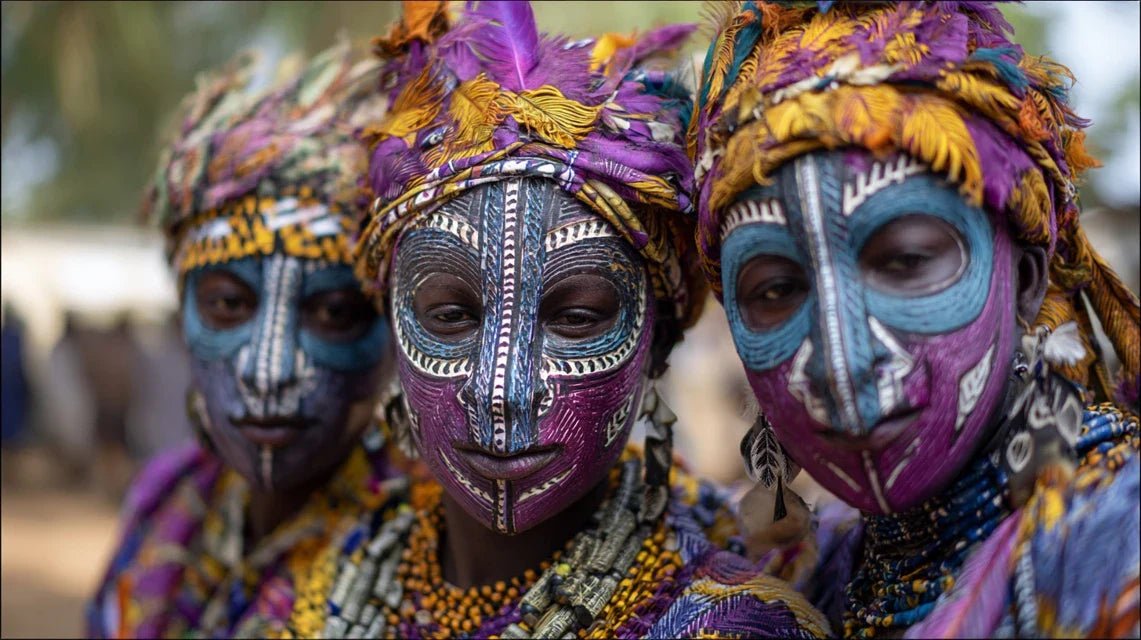
In ritual masks associated with blacksmith confreries, we systematically find geometric patterns evoking heat and movement. These zigzags, these interlocking triangles, these concentric curves are not mere decorations: they constitute a visual vocabulary signifying transformation, the passage from one state to another, the transmutation of raw ore into a shaped tool.
The Mandingue blacksmith is venerated precisely because he masters this mysterious process where matter changes nature under the combined effect of fire, water and human gesture. The iconography emphasizes this trilogy: we see the blacksmith holding the hammer (human action), near an anvil still red (fire), often with a jar of water nearby (the cooling and fixing element).
This ability to transform goes far beyond the metallurgical domain in the Mandingue imagination. The blacksmith is also one who forges destinies, who transforms individuals during rites of passage, who shapes society. Ceremonial sculptures sometimes show him holding not tools but miniature human figures, symbolizing his power over the social and spiritual identity of people.

Discover this inspiring artwork
Guardian of secrets: the blacksmith in initiationThe Mandingue iconography reveals another fascinating dimension of the blacksmith: his role as a keeper and transmitter of secret knowledge. Initiation masks, particularly those of the Komo society, are traditionally made and manipulated by blacksmiths. These sacred objects, charged with ritual substances, visually embody mystery and spiritual power.
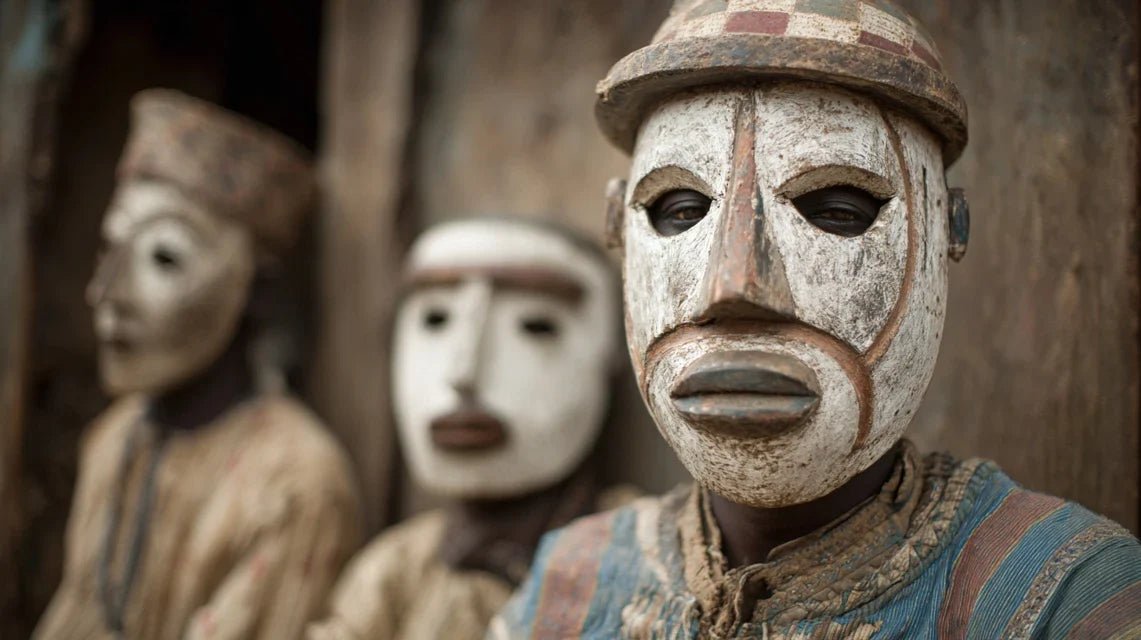
On these masks, the blacksmith is represented in a codified manner: closed or stylized mouth into a simple slit (the secret that must not be divulged), half-closed or blind eyes (inner vision counts more than physical sight), prominent forehead (seat of knowledge). These aesthetic conventions are found throughout the Mandingue cultural area, creating an immediately recognizable visual language.
The ritual jewelry worn during initiation ceremonies tells the same story. Bronze rings, massive bracelets, anthropomorphic pendants made by blacksmiths function as markers of belonging and condensations of knowledge. Their motifs - spirals (the initiatory path), ladders (spiritual ascent), crosses (crossroads of destiny) - constitute a veritable visual encyclopedia of esoteric knowledge.
In Mandingue iconography, the blacksmith often appears surrounded by young initiates, thus reproducing in the image the very structure of transmission. This visual recurrence underscores how Mandingue society values the continuity of knowledge, the unbroken chain that connects generations. The blacksmith is not revered for his technical skills alone, but for his ability to perpetuate a millennial wisdom through teaching and ritual.
Between sacred and profane: the double status of the blacksmith
One of the most intriguing aspects of Mandingue iconography of the blacksmith is this fundamental ambivalence that it visually expresses. The blacksmith is both venerated and feared, respected and kept at a distance. This tension is translated in artistic representations by fascinating aesthetic choices.
On one hand, sculptures show the blacksmith in a majestic, central, dominant posture. He often occupies the middle of the composition, larger than other figures, richly adorned. The materials used to represent him are noble: bronze, brass, precious wood. Everything indicates his high status, his eminent position in the spiritual and social hierarchy.
But at the same time, these same works integrate elements of separation, marginality. The blacksmith may be represented apart from the group, surrounded by an empty space, marked by attributes that radically distinguish him: tools incomprehensible to non-initiates, particular clothing, specific hairstyles. The iconography thus visually manifests the endogamy of blacksmiths, their status as a caste apart.
This duality is beautifully expressed in the sculpted doors of barns and homes. The blacksmith appears as a protector of the threshold, guardian of passages, but also as a liminal figure, neither entirely inside nor entirely outside. Mandingue artists use relief techniques, superposition of planes, and play of light and shadow to materialize this intermediate position, this in-between that defines the blacksmith.

Discover this inspiring artwork
The visual heritage: when iconography inspires contemporary creation
The veneration of the blacksmith in Mandingue iconography is not just a thing of the past. It nourishes today's living artistic creation, a permanent dialogue between tradition and modernity. Contemporary artists from West Africa constantly revisit these ancestral motifs, creating works that speak to both initiates and art lovers around the world.
The contemporary paintings inspired by this tradition take up the visual codes of the Mandingue blacksmith: the chromatic palette of molten metals (coppers, burnt golds, incandescent reds), compositions centered on the figure of the creator, symbols of transformation. But they reinterpret them with modern techniques: vibrant acrylics, collages of recycled metals, reworked photographs.
This aesthetic continuity allows contemporary interiors to welcome a fragment of this millennial wisdom. A painting depicting the mythical blacksmith instantly creates an atmosphere of depth, mastered mystery, and channeled creative energy. It recalls that true creation is not superficial but transformative, requiring mastery of inner fire as much as external technique.
Designers and decorators draw abundantly on this iconographic repertoire of the blacksmith to create spaces that tell a story. Geometric patterns from initiation masks are found on wall textiles, the shapes of ritual tools inspire luminaires, the colors of the forge guide entire color palettes. The aesthetics of the Mandingue blacksmith offers a powerful alternative to minimalist blandness: it brings symbolism, narrative depth, and connection with archetypal forces.
Transform your interior into a space of creative power
Discover our exclusive collection of African paintings that capture the mystical energy of the Mandinka blacksmith and bring symbolic depth to your decor.
Living with the spirit of the blacksmith: a philosophy of transformation
Beyond pure aesthetics, integrating the iconography of the Mandinka blacksmith into one's daily world is adopting a philosophy of life. The blacksmith teaches us that nothing is fixed, that everything can be transformed by the judicious combination of energy (fire), matter (metal), intention (the gesture) and time (cooling).
This lesson resonates particularly in our age of immediacy and superficiality. The iconography of the blacksmith reminds us that true creation requires patience, mastery, and respect for deep processes. It values long time over instantaneity, authentic transformation over cosmetic change, substance over appearance.
Objects inspired by this tradition - whether faithful reproductions or contemporary creations - act as daily reminders of these values. They invite us to consider our own lives as malleable material, our will as the hammer, our trials as the fire necessary for any true tempering.
This is why so many people seeking meaning turn to this particular aesthetic. It offers much more than decoration: it proposes a symbolic anchor, a connection with archetypal forces of creation and transformation. In a living room, an office, a meditation space, the iconographic presence of the blacksmith creates an atmosphere conducive to deep reflection, authentic creativity, personal transformation.
The veneration of the blacksmith in Mandinka iconography speaks ultimately of our own creative potential. It affirms that we are all, within our means, blacksmiths of our destiny - capable of transforming the raw into the refined, the formless into beauty, chaos into order. And that this transformation, far from being solitary, is part of a chain of transmission spanning millennia that connects us to ancestors and future generations.
As you may have understood: the Mandinka blacksmith is not venerated by chance in this rich iconography. He embodies universal values - creation, transformation, transmission, mastery - while remaining deeply rooted in a specific culture. This double dimension, local and universal, explains why his image continues to fascinate, inspire and nourish contemporary artistic creation. Integrating this iconography into your space is more than an aesthetic choice: it's asserting your connection with these primordial forces of transformation that cross all cultures and eras. It’s recognizing that true beauty always arises from the fire of mastered creation, the patience of repeated gesture, the respect for ancestral knowledge. Ultimately, it's honoring the blacksmith who slumbers within each of us.