The first time I held a Lega mask in my hands, in a museum reserve in Brussels, I was struck by its apparent simplicity. This white surface, almost lunar, these features refined to abstraction... How could these enigmatic objects contain so much ancestral wisdom? Lega white masks are not mere ornaments, but open books on one of Central Africa's most refined philosophies.
Here’s what Lega white masks reveal: an initiatory path to moral wisdom, a sophisticated educational system passed down for centuries, and a minimalist aesthetic carrying profound meanings. Each mask tells a story, teaches a virtue, marks a step in the construction of a fulfilled being.
Many admire these masks in galleries without understanding their true essence. They are collected for their graphic beauty, their unsettling modernity that evokes Brancusi or Modigliani. But reducing a Lega mask to a decorative object is missing its soul. It's like admiring the cover of a book without ever opening it.
Rest assured: understanding the meaning of white masks from the Lega culture does not require years of anthropological studies. You just need to accept that an object can be simultaneously a work of art, an educational tool and a spiritual symbol. Let me guide you into the fascinating universe of these guardians of Congolese wisdom.
In this article, I reveal the secrets of Lega masks: their role in Bwami society, their chromatic symbolism, the rituals that animate them, and how their timeless aesthetic inspires today's contemporary interiors seeking authenticity.
The Bwami: The Secret University of the Lega People
To understand Lega white masks, you must first grasp the extraordinary institution of the Bwami. Imagine a society where social advancement depends not on wealth or birth, but solely on your moral and intellectual development. This is exactly what the Bwami represents for the Lega, established in the east of the Democratic Republic of Congo.
The Bwami structures all of Lega society through several initiatory grades. Men and women progress separately, climbing rungs that extend throughout a lifetime. Each level reached testifies to an increased mastery of fundamental moral values: generosity, wisdom, courage, integrity, respect for elders.
The white masks intervene as visual supports in this sophisticated educational system. During initiation ceremonies, they are unveiled accompanied by proverbs, songs and dances. Each mask illustrates a specific lesson, an ethical principle to be integrated. It is pedagogy through image, where sculpture becomes the vehicle for transmitting ancestral knowledge.
A Hierarchy of Knowledge
The Bwami system comprises several major levels, the highest of which will only be reached by a few elders at the end of an exemplary life. Lega masks are not accessible to everyone: some types are reserved for higher grades. Possessing or simply contemplating certain masks is a privilege earned through decades of impeccable conduct.
This exclusive dimension makes the white masks much more than ritual objects: they are sculpted diplomas, medals of moral merit. Their brilliant whiteness symbolizes the purity achieved by the initiate, their inner transformation, their spiritual elevation.
Why white? Deciphering a sacred color
The white of the Lega masks is never accidental. In the cosmology of the Lega people, as in many cultures of Central Africa, white has considerable symbolic significance, quite different from Western associations.
White first evokes light and clarity. An initiate who progresses in the Bwami gradually emerges from the darkness of ignorance to access the light of knowledge. White masks materialize this inner illumination, this mental clarity acquired through learning.
White also represents purity and transformation. Like the white kaolin used in many African rituals to mark important transitions, the whiteness of the mask signals a metamorphosis. The initiate leaves behind immature behaviors, selfish attachments. He is reborn purified, aligned with collective values.
The connection to ancestors
In Lega thought, white also connects to the world of ancestors. These tutelary figures, guardians of tradition and morality, are often associated with spectral whiteness, with the luminous beyond. Wearing or presenting a white mask during a ceremony is invoking the presence of elders, seeking their approval, enrolling in a lineage of wisdom.
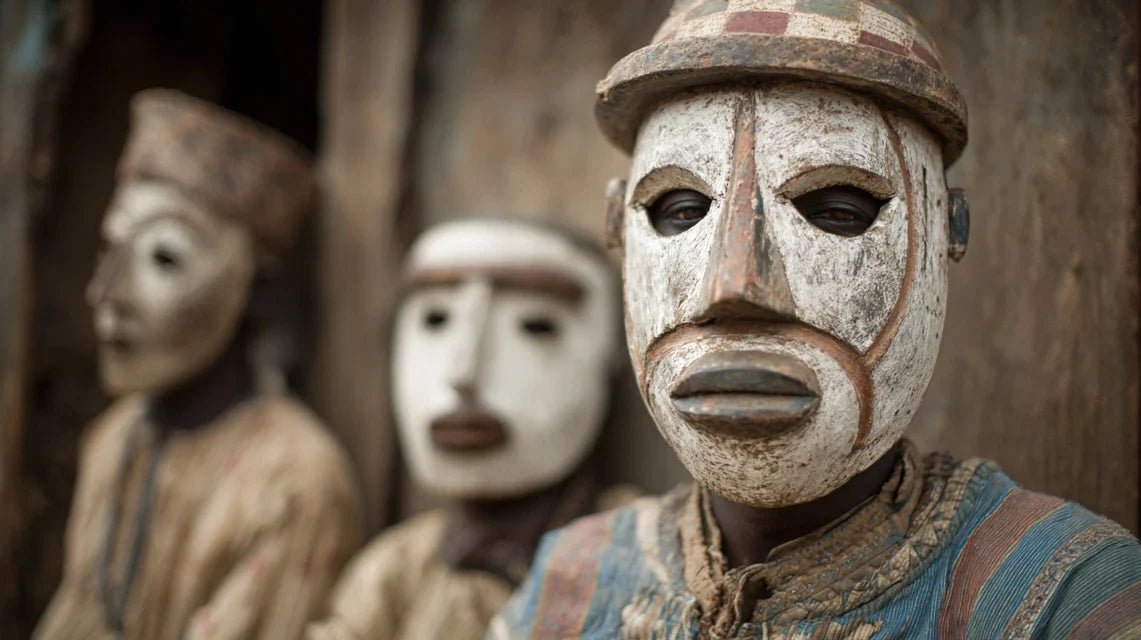
This white patina on carved wood creates a striking effect: the mask seems to emanate from within, as if inhabited by an invisible presence. This almost ghostly quality fascinates contemporary collectors, who perceive in it a disturbing modernity while it expresses a millennial spirituality.

Discover this inspiring artwork
The clean aesthetic: when minimalism conveys the message
Lega white masks are distinguished by a radical formal purification that evokes 20th-century modern art. Oval faces with simplified features, almond-shaped eyes, a mouth suggested by a simple incision... This economy of means is not the result of rudimentary technique, but of a deliberate aesthetic choice.
Lega sculptors perfectly master the art of realistic portraiture, as evidenced by other productions. But for Bwami masks, they opt for abstraction. Why? Because these masks do not represent specific individuals, but universal concepts. The purification of features allows everyone to project themselves, to see in the mask not a foreign face, but a mirror of their own conscience.
This minimalist aesthetic also facilitates memorization of teachings. Faced with a mask with simple yet expressive features, accompanied by a striking proverb, the initiate permanently engraves the lesson into his memory. The mask becomes a sculpted mnemonic, a moral aide-mémoire.
Subtle variations carrying meaning
Despite their apparent similarity, each Lega mask differs by significant details. The position of the eyes, the tilt of the head, the presence of a stylized beard, the shape of the forehead... These variations correspond to specific messages, to particular proverbs.
Some masks have half-closed eyes: they evoke contemplative wisdom, the ability to see beyond appearances. Others display a domed forehead, symbolizing intelligence and reflection. Initiates learn to decipher these visual codes, developing a true literacy of forms.
The rituals of masks: dancing wisdom
Lega white masks do not remain static on altars. They come to life during initiation ceremonies, manipulated in various ways according to the teachings to be transmitted. This performative dimension is essential to grasp their complete meaning.
Unlike many African masked traditions, Lega masks are not systematically worn on the face. They can be held out at arm's length, attached to the temple, fixed to the forehead with a headband, or even simply placed on the floor. Each mode of presentation corresponds to a specific ritual context, a particular lesson.
During a ceremony, several masks are presented successively or simultaneously, creating a choreography of knowledge. Senior initiates manipulate these sacred objects with a codified gesture, while chants and proverbs resonate. The message thus penetrates through all the senses: sight, hearing, movement.
Proverbs engraved in memory
Each white mask is associated with one or more traditional proverbs. These formulas condense Lega wisdom into memorable phrases: 'The elephant does not die from a single arrow' (perseverance), 'The path through the forest never ends' (continuous learning), 'The canoe that goes too fast capsizes' (moderation).
The mask thus becomes a three-dimensional illustration of the proverb. Seeing the mask instantly recalls the moral lesson it embodies. This association creates a mental library where each sculptural form activates an ethical knowledge.

Discover this inspiring artwork
Lega masks in the contemporary world: more than just a decor trend
Since the 1920s, white Lega masks have fascinated Western art lovers. Their formal modernity has seduced prestigious collectors and inspired major artists. But this admiration raises complex ethical questions.
Many authentic Lega masks left Congo under questionable circumstances, during the colonial period or post-independence turmoil. Today, they adorn museums and private collections, disconnected from their ritual context. This migration raises legitimate debates about the restitution of African heritage.
For a contemporary decor enthusiast, integrating a Lega mask (or a respectful reproduction) into one's interior should never be a superficial gesture. It is welcoming an object charged with history, carrying a profound philosophy. This implies a responsibility: that of understanding and transmitting the original meaning, even modestly.
How to honor their heritage in your space
If you wish to integrate the aesthetics of Lega masks into your decor, prioritize ethical reproductions or contemporary works inspired by their formal language. Place them in a space that invites contemplation: a clean wall, an alcove subtly lit.
Combine them with natural materials (raw wood, linen, terracotta) which respect their organic essence. Avoid decorative clutter: these masks, designed to focus attention, deserve space and visual silence around them. Their whiteness dialogues beautifully with neutral palettes, creating soothing interiors where pure form becomes meditation.
Let the soul of Africa transform your interior
Discover our exclusive collection of African paintings that capture the spiritual essence and timeless aesthetic of the traditional arts of Congo. Each work tells a story, each composition honors a millennial heritage.
When wisdom becomes timeless
The white masks of the Lega culture remind us of an essential truth: the deepest societies are not those that accumulate, but those that transmit. While the West developed its formal education systems, the Lega perfected a holistic learning where art, morality and spirituality were one.
These white faces with clean features continue to question us. In our era saturated with images and noise, they offer an alternative: meaningful simplicity, inhabited minimalism, form that elevates rather than distracts. Perhaps this is their most current message.
The next time you come across a Lega mask in a museum or gallery, give it more than a distracted look. Observe the wisdom emanating from its simplified features, the light playing on its white surface. Imagine the generations of initiates who learned, before similar masks, to become better beings. And ask yourself: what lesson does this mask want to convey to you today?
Frequently asked questions about Lega white masks
How to recognize an authentic Lega mask?
Recognizing an authentic Lega mask requires a trained eye, but some clues are not misleading. Genuine masks have a characteristic white patina, traditionally obtained with kaolin or light clay mixed with natural resins. This surface is never uniformly white: it shows variations, areas of wear revealing the wood underneath, witnesses to repeated ritual manipulations.
The features are always clean but never crude. The Lega sculptor perfectly masters symmetry and proportions, even in simplification. Look for a quality of sculpture that reveals a clear artistic intention: flowing curves, carefully polished surfaces, visual balance. Fakes, often produced in series, display a mechanical regularity that betrays their industrial origin.
Documented provenance remains the most reliable criterion. A mask accompanied by certificates of authenticity, old photographs or legal acquisition documents offers more guarantees. Be wary of prices that are too attractive: ancient Lega masks reach significant values on the African art market. If you wish to acquire an authentic piece, consult specialized experts or reputable auction houses.
Are Lega masks still used today in rituals?
Yes, the tradition of the Bwami and the use of Lega masks continues in some communities in eastern Congo, despite historical upheavals. Colonization, Christianization, wars and exoduses have weakened these practices, but not extinguished them. Initiations continue to be organized, perpetuating a millennial knowledge.
However, practice has evolved. Ancient masks, now rare and valuable, are sometimes kept as community treasures rather than used regularly. New masks are carved for ceremonies, keeping the artistic tradition alive. Some Lega diaspora communities are also trying to preserve these practices in urban contexts, adapting rituals to contemporary realities.
Anthropologists note a renewed interest among young Lega generations for their cultural heritage. After decades where these traditions were stigmatized as 'primitive', they are now recognized as treasures of wisdom and identity. Documentation and transmission initiatives are emerging, often with the support of cultural NGOs and Congolese museums. White Lega masks continue their journey through time, carrying a philosophy that resists oblivion.
Can a Lega mask be integrated into modern decor without cultural appropriation?
This delicate question deserves a nuanced answer. Integrating a Lega mask (or its representation) into your decoration is not inherently problematic, provided you adopt a respectful and informed approach. Cultural appropriation begins where the object is stripped of its meaning, treated as a simple exotic ornament, or acquired by unethical means.
Several attitudes demonstrate respect: first, inform yourself about the cultural significance of the object, as you are doing by reading this article. Then, prioritize legal reproductions rather than authentic pieces potentially illegally exported from Congo. Many contemporary artists, African and others, create works inspired by Lega aesthetics without claiming to produce authentic ritual objects.
If you own an authentic mask, take responsibility for presenting it with dignity and sharing its story when the opportunity arises. Avoid heterogeneous collections of 'ethnic souvenirs' that reduce complex cultures to decorative clichés. A Lega mask deserves a presentation that honors its depth: dedicated space, careful lighting, uncluttered environment. Treat it as the philosophical work of art that it is, not as a colonial trophy. This conscious approach transforms decoration into an enriching cultural dialogue, far from any superficial appropriation.