I unpacked my bags in Timbuktu for the first time in 2008, sketchbook under my arm and camera around my neck. What I discovered that day changed my perception of sacred architecture forever. These earth structures, sculpted like giant sandcastles, tell a millennial story that few monuments in the world can match.
Here's what the history and heritage of Timbuktu’s mosques offer: a lesson in sustainable architecture ahead of its time, a living testimony to trans-Saharan trade routes, and an inexhaustible source of inspiration for rethinking our relationship with natural materials in contemporary interiors.
You may admire Gothic cathedrals or Asian temples without knowing that architectural gems just as remarkable stand in the Malian desert. Many are unaware that these Timbuktu mosques, inscribed on the UNESCO World Heritage List, embody an architectural know-how passed down since the 13th century.
Rest assured: you don't need to be an art historian to understand the beauty and ingenuity of these buildings. I take you on a journey to the heart of these monuments that continue to influence designers and architects around the world, and which can transform your vision of space and materials.
Djingareyber: the mosque that defied the centuries
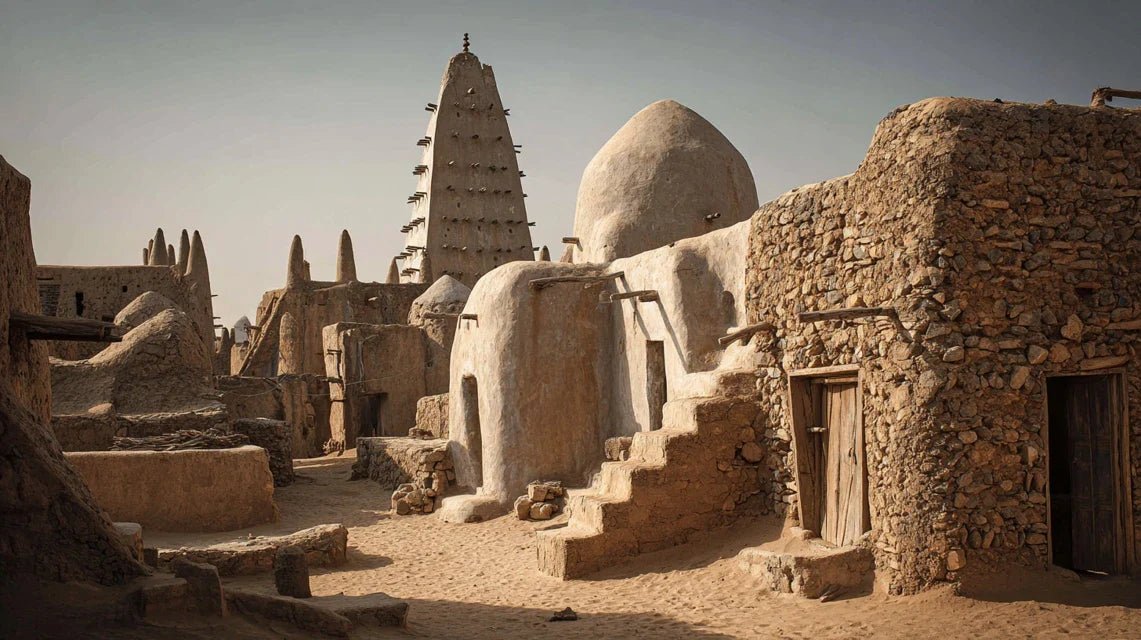
The Djingareyber Mosque is the oldest of Timbuktu’s mosques. Built in 1327 during the reign of Mansa Moussa, this legendary emperor who rained gold on Mecca, it represents the pinnacle of Sudanese-Saharan architecture. Its massive banco walls – a mixture of earth, straw and shea butter – are almost a meter thick.
What fascinated me on my first visit were these palm wood beams that protrude from the walls like spines on a cactus. Far from being decorative, they constitute a permanent scaffolding for annual repairs. Every year, the entire community mobilizes to re-plaster the facades, perpetuating an ancestral ritual of collective preservation.
The interior, sober and fresh despite the scorching heat of the Sahara, offers remarkable acoustics. The massive columns create a forest of earth where light filters gently, generating plays of shadows that evolve throughout the day. This bioclimatic approach inspires many architects today seeking to design ecological buildings.
The ancestral techniques that fascinate modern architects
The heritage of Timbuktu’s mosques rests on an exceptional mastery of banco. This locally available material offers remarkable natural thermal insulation. Thick walls maintain a stable interior temperature, creating comfort without air conditioning or heating.
I was fortunate enough to attend a restoration session with the Barey masons, these hereditary artisans who hold the secrets of banco making. They mix clayey earth with chopped straw, rice husk and sometimes shea butter which naturally waterproofs the material. This recipe, passed down orally for generations, varies slightly from family to family.
The characteristic pyramidal shape of the minarets of the mosques of Timbuktu is not just aesthetic. It responds to a structural logic: the wide base ensures stability while the tapered top limits wind resistance. These construction principles are now inspiring eco-construction projects in Europe and North America.
Community maintenance: a preservation model
Unlike Western monuments restored by specialized companies, the mosques of Timbuktu are maintained by the community itself. This system of collective preservation guarantees the transmission of know-how and strengthens social ties. A lesson in participatory urban planning that our modern cities could draw inspiration from.

Discover this inspiring artwork
Sankoré: the university that radiated across Africa
The Sankoré mosque, built in the 14th century, was much more than a place of prayer. It constituted the heart of a prestigious university that attracted students from all over the Muslim world. At its peak, Timbuktu had more than 25,000 students and its library housed hundreds of thousands of manuscripts.
The architecture of Sankoré reflects this dual function. The square plan, unusually regular for the time, is inspired by the Kaaba in Mecca. Its dimensions would have been calculated to exactly reproduce those of the Meccan sanctuary, testifying to the spiritual link between Timbuktu and the center of Islam.
The study rooms surrounding the central courtyard feature acoustics designed for oral teaching. The niches in the walls were used to store precious manuscripts. This spatial organization, both functional and symbolic, offers avenues for reflection on how to design contemporary learning spaces that combine tradition and modernity.
Sidi Yahia: legend and architectural reality
According to legend, the Sidi Yahia mosque was built in 1400 in anticipation of the arrival of a saint who would not arrive for another 40 years. This story, as poetic as it may be, masks an equally fascinating architectural reality. Sidi Yahia represents an important stylistic evolution in the history of mosques in Timbuktu.
Its minaret, more slender than that of Djingareyber, announces a new aesthetic search. The geometric decorations in relief on the facades bear witness to influences from the Maghreb and Egypt, proof of the dynamism of cultural exchanges along the trans-Saharan routes. These motifs, surprisingly modern, inspire textile and wallpaper designers today.
The interior space, more intimate than in the other two great mosques, creates a unique atmosphere of contemplation. The light, filtered through small openings strategically placed, draws changing patterns on the beaten earth floor. This mastery of natural light could inspire our interior layouts, which are too often dependent on artificial lighting.
Contemporary threats and heritage resilience
The heritage of the mosques of Timbuktu has weathered centuries of climate change, conquests, and political upheavals. Recently, these monuments suffered attacks during the 2012-2013 crisis. The international community mobilized for their restoration, proof of their universal value.
What deeply moved me was the determination of the people of Timbuktu to rebuild their mosques exactly as they were, using the same ancestral techniques. This fidelity to traditional methods, in a world obsessed with technological innovation, raises essential questions about our relationship to heritage and authenticity.

Discover this inspiring artwork
How the aesthetics of Timbuktu inspires contemporary design
The influence of the mosques of Timbuktu extends far beyond the realm of religious architecture. Their organic forms, wall textures, and color palettes inspire interior designers and decorators around the world. This banco aesthetic, with its ochre tones and irregular surfaces, brings an incomparable warmth to contemporary spaces.
I recently collaborated with a Parisian interior architect who incorporated rammed earth walls into a Haussmann loft. The result? A warm and soothing atmosphere that contrasts beautifully with the concrete and steel. The natural textures of the mosques of Timbuktu recall that luxury is not always synonymous with expensive materials, but with authentic craftsmanship.
The geometric patterns adorning some facades of the mosques echo in modern graphic design. These patterns, both simple and sophisticated, lend themselves wonderfully to textiles, cement tiles or wallpapers. They bring a touch of exoticism without falling into folklore, a delicate balance sought by many decorators.
The color palette of the Sahel in your interior
The colors of the mosques of Timbuktu – these shades of ochre, terracotta, golden beige – create a natural harmony that instantly soothes. Combined with touches of indigo blue (the iconic color of the Tuaregs) or deep green, they compose atmospheres that are both warm and sophisticated. This palette, tested by centuries of exposure to the Saharan sun, guarantees remarkable chromatic durability.
Be inspired by the richness of African heritage
Discover our exclusive collection of African paintings that capture the essence of these legendary architectures and will transform your space into a place rich in history and authenticity.
Preserving and transmitting: lessons from Timbuktu for our time
The history of the mosques of Timbuktu teaches us that true sustainability is not technological but communal. These buildings have survived for seven centuries not thanks to high-tech materials, but because a community commits to maintaining them year after year. This collective approach to heritage preservation challenges our individualistic societies.
In a context of environmental crisis, the construction techniques of the mosques of Timbuktu offer concrete alternatives. Banco, a material with virtually zero carbon footprint, locally available and fully recyclable, meets the requirements of sustainable building. Many architects are rediscovering these ancestral methods and adapting them to contemporary standards.
The heritage of Timbuktu also reminds us that Africa, far from being a continent without architectural history, has developed sophisticated construction traditions perfectly adapted to their environment. Recognizing this richness allows us to deconstruct prejudices and enrich our aesthetic references.
Imagine yourself in your living room, surrounded by elements inspired by this millennial architecture: a textured wall with warm banco tones, subtle geometric patterns, natural materials that breathe. You are not simply decorating a space; you are creating a bridge between civilizations, honoring an ancestral know-how. The mosques of Timbuktu are not just distant monuments; they are a living source of inspiration to rethink our interiors with authenticity and awareness.
Start small: integrate a Sahel palette of colors into a room, choose textiles with geometric patterns inspired by the Soudano-Sahelian architecture, or opt for natural and textured materials. Each choice becomes a discreet tribute to this exceptional heritage and a way to travel without leaving your home.